 * Image is for illustrative purposes only.
Tanagura Castle (Kamegashiro)
棚倉城(亀ヶ城)
Tanagura Castle (Kamegashiro) is a historic castle in the Tōhoku region (Built 1625 (Kan'ei 2); fell during the 1868 Boshin War). Its lord was Niwa Nagashige / Naitō family / Abe family.
Overview
Tanagura Castle is a flatland castle located in Tanagura Town, Higashishirakawa District, Fukushima Prefecture. Known by the alternate name Kamegajō, it is an early modern castle from the Edo period. In Kan'ei 2 (1625), Niwa Nagashige, lord of the Tanagura domain, relocated Tsutsukowake Shrine and built a new castle on the former site (Naitō Nobuteru entered the castle as a later lord). Thereafter, through repeated transfers of various daimyo, it functioned as the main castle of the Tanagura domain until the Abe family at the end of the Edo period.
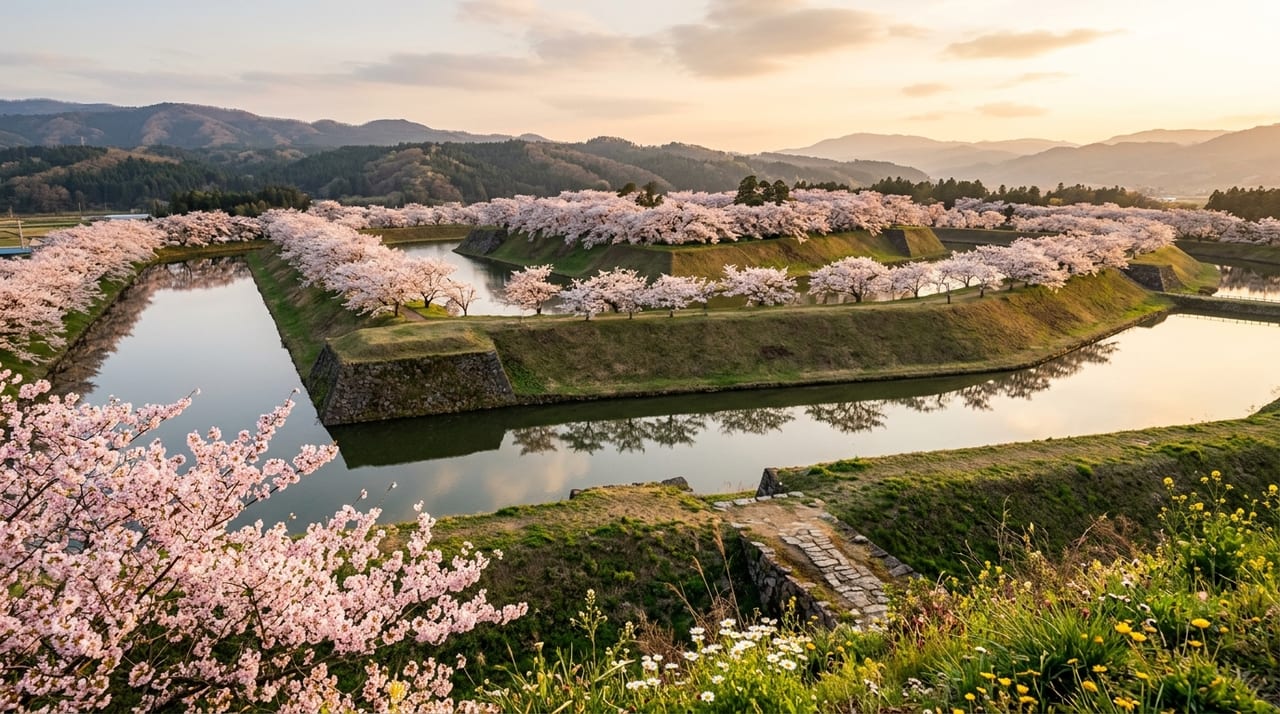
The castle's layout is that of a flatland castle of the rinkaku–teikaku style, composed of earthen ramparts and a double moat. The honmaru is a long rectangle running north to south, with four double-storied corner turrets linked by tamon-yagura (connecting turrets). Enclosing the honmaru with tamon-yagura was a rare layout in the Tōhoku region. The buildings were destroyed by fire in the Boshin War, but the honmaru's moat and earthen ramparts remain in good condition and are designated as a national historic site.
Particularly noteworthy in the history of Tanagura Castle is the fighting during the Boshin War in Keiō 4 (1868). The Tanagura domain, which had joined the Northern Alliance (Ōuetsu Reppan Dōmei), came under attack from the new government forces. Because the domain lord, Abe Masakiyo, had dispatched troops to Shirakawa, the castle's defenses were thin, and the castle burned itself down and fell within just one day. The fall of Tanagura Castle became one of the important turning points in the course of the Boshin War in the Tōhoku region.
Today the site has been developed as Kamegajō Park, and the surrounding moats and earthen ramparts convey the form of the castle of the past to the present. It is also known as a cherry-blossom spot, and in spring it is a tourist attraction in Higashishirakawa District that draws many hanami visitors.
Connection to Swords
The relationship between Tanagura Castle and swords is condensed into the intersection of swords and modern weapons in the Boshin War, the civil war at the end of the Edo period. In the battle for Tanagura Castle in Keiō 4 (1868), the new government forces were equipped with modern firearms (Snider rifles, Minié rifles, etc.), whereas many samurai remained among the former domain's Tanagura forces who fought with swords and spears.
It is thought that many of the Japanese swords worn by Tanagura domain retainers were family-heirloom blades handed down through the Edo period. Ōshū was a production center for swords known as Ōshū-mono, and smiths in Aizu (western Fukushima Prefecture) and Sendai (Miyagi Prefecture) in particular produced high-quality blades.
After the defeat in the Boshin War, many samurai lost the right to wear swords under the Haitōrei (Sword Edict, 1876), and not a few gave up their family-heirloom swords.
The fall of Tanagura Castle in the Boshin War also holds significance in the context of sword history, as an event from the era when the Japanese sword was coming to the end of its role as a practical weapon. The Tanagura area, where modernity and tradition collided, is a historic place that quietly marks the end of the samurai sword culture.
Highlights
- Remains of the honmaru moat and earthen ramparts — A national historic site where the honmaru's water moat and earthen ramparts survive in good condition
- Cherry blossoms of Kamegajō Park — Bustling in spring as a famous cherry-blossom spot
- Historic sites associated with the Boshin War — A group of remains associated with the Tanagura Castle battle
- Layout of an early modern flatland castle — A layout unusual in the Tōhoku region, with the honmaru enclosed by tamon-yagura
- Former site of Tsutsukowake Shrine — The site where Niwa Nagashige relocated the shrine and built the castle
* Opening hours and admission fees are subject to change. Please check the official website before visiting.