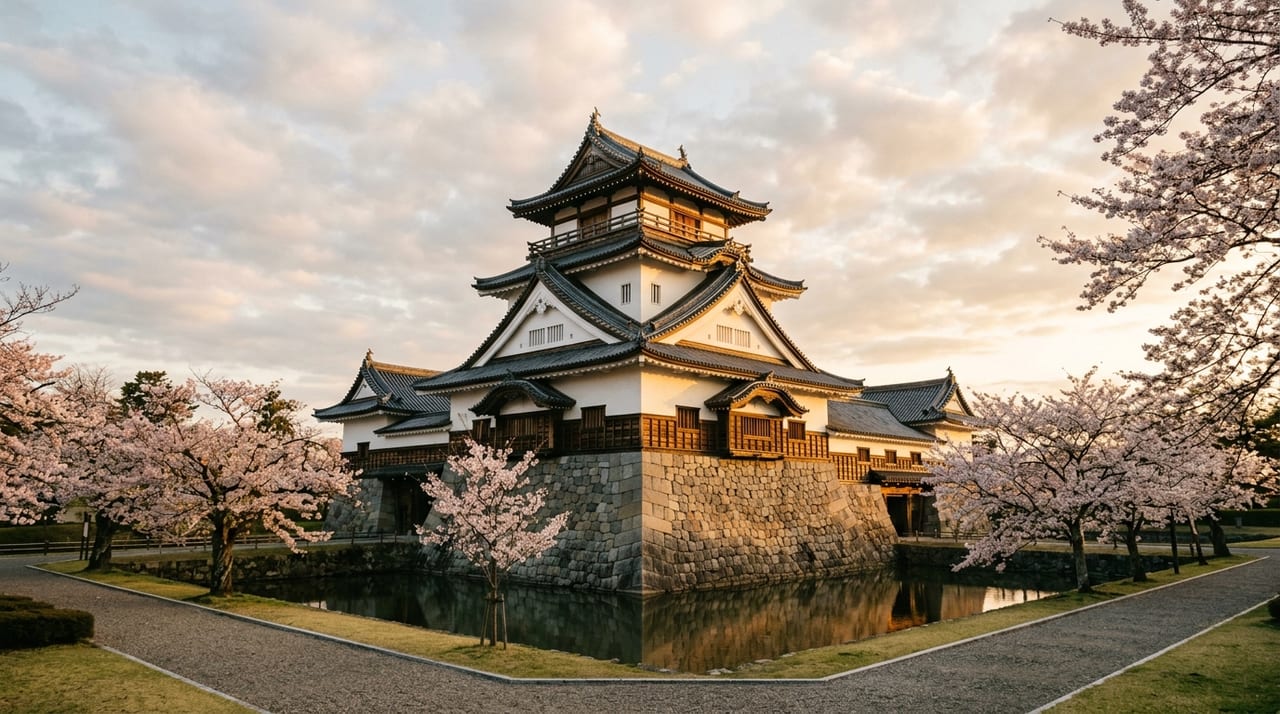
 * Image is for illustrative purposes only.
Shirakawa Komine Castle
白河小峰城
Shirakawa Komine Castle is a historic castle in the Tōhoku region (Founded c. 1340–1369 (Kōkoku–Shōhei eras) / Major renovation by Niwa Nagashige in 1627 (Kan'ei 4)). Its lord was Yūki Chikatomo / Niwa Nagashige / Abe clan.
Overview
The Gateway to Ōshū
Shirakawa Komine Castle was built in Shirakawa, the gateway to Ōshū, where the Ōshū Kaidō (one of the Five Great Roads, alongside the Tōkaidō and Nikkō Kaidō) passes. Since ancient times, Shirakawa has held major military and political significance as the boundary between Tōhoku and Kantō. It is also a utamakura (poetic place-name) celebrated in waka since the Heian period as "Shirakawa no Seki." The history of a castle on this site goes back to the Nanboku-chō period. After the Yūki family lost its domain, the site was ruled as a branch castle of Aizu territory by the Gamō and Uesugi clans, among others. In the early Edo period, Niwa Nagashige carried out a major renovation, creating an early-modern castle with a three-tiered yagura (equivalent to a tenshu).
Niwa Nagashige's Construction
In 1627 (Kan'ei 4), Niwa Nagashige, who was transferred from Tanagura in Mutsu to Shirakawa, began large-scale castle renovation work. Nagashige was born the son of Oda Nobunaga's senior retainer Niwa Nagahide, and he continued to maintain the pride of a warrior even after Nobunaga's death. The Shirakawa Komine Castle that Nagashige developed was completed as an early-modern castle. It had a three-tiered, three-story yagura (sankai-yagura, in effect the tenshu) at its center, with the honmaru, ninomaru, and sannomaru arranged in a teikaku-style layout. It became a sturdy stronghold worthy of the gateway to Ōshū. The castle, with its honmaru and ninomaru fortified by full stone walls, was rare in the Tōhoku region. Together with Morioka Castle and Wakamatsu Castle, it is counted among the Three Famous Castles of Tōhoku.
Connection to Sword Culture
Matsudaira Sadanobu, who became lord of Shirakawa domain in the Edo period (renowned as senior councilor and for the Kansei Reforms), is also known for compiling Shūko Jisshu, an illustrated catalog of ancient treasures. Sadanobu was also a literary statesman who left essays including Kagetsu Sōshi.
The Boshin War and the Battle of Shirakawa-guchi
Shirakawa Komine Castle appears in late-Tokugawa history during the Boshin War of 1868 (Meiji 1). The Battle of Shirakawa-guchi was a major clash between the Ōu-Etsu Reppan Dōmei and the new government forces. The fighting over Shirakawa Castle became a fierce battle that decided the course of the Tōhoku Boshin War. Soldiers of the Aizu and Sendai domains joined in defending the castle and fought fiercely against the elite troops of the new government forces from Tosa, Chōshū, and Satsuma. In the end, Shirakawa Castle was occupied by the new government forces and became the base for the subsequent subjugation of Tōhoku.
The Restored Tenshu
The three-tiered yagura, which was destroyed by fire during the Boshin War, was faithfully restored in wood in 1991 (Heisei 3). This restoration is highly regarded as meticulous work, based on Edo-period old drawings, foundation stone surveys, and archaeological excavations, and it is recorded as an important project in the history of castle research. The three-tiered yagura at Shirakawa Komine Castle became a pioneer of wooden castle reconstruction and a model for subsequent castle restoration projects. The Great East Japan Earthquake of 2011 (Heisei 23) caused extensive collapse of the stone walls. Restoration work that rebuilt the fallen stones in their original positions was carried out and was completed in 2019 (Reiwa 1). Recovery from the disaster and the revival of the castle have attracted much attention as a symbol of the unbroken spirit of the people of Tōhoku.
Connection to Swords
Niwa Nagashige, the first lord of Shirakawa domain, was the son of Niwa Nagahide, a senior retainer of Nobunaga. Matsudaira Sadanobu, lord of Shirakawa domain in the mid-Edo period, was a senior councilor known for the Kansei Reforms, as well as a literatus and collector. He is known for compiling the illustrated catalog of ancient treasures called Shūko Jisshu. Shirakawa was also a fierce battleground of the Boshin War. In the Battle of Shirakawa-guchi, samurai of the Aizu, Sendai, and other domains fought fiercely against the new government forces. At the castle site, the Shirakawa Shūkoen exhibits materials associated with the Yūki and Abe clans.
Highlights
- Sankai-yagura (three-tiered yagura; equivalent to a tenshu, wooden reconstruction) — a meticulous wooden reconstruction based on Edo-period old drawings. A representative of Tōhoku's castle beauty
- Stone walls (ishigaki) — full stone walls fortifying the honmaru and ninomaru, rare in Tōhoku. Rebuilt after the earthquake to their form before the collapse
- Shirakawa Shūkoen — exhibits historical materials associated with the Yūki and Abe clans
- Nanko Park — Japan's oldest public park, built by Matsudaira Sadanobu. Enjoy seasonal flowers and the natural scenery of Shirakawa
- Shirakawa no Seki Site — a utamakura (poetic place-name) celebrated in waka since the Heian period. The ruins of an ancient barrier that guarded the entrance to Ōu
* Opening hours and admission fees are subject to change. Please check the official website before visiting.