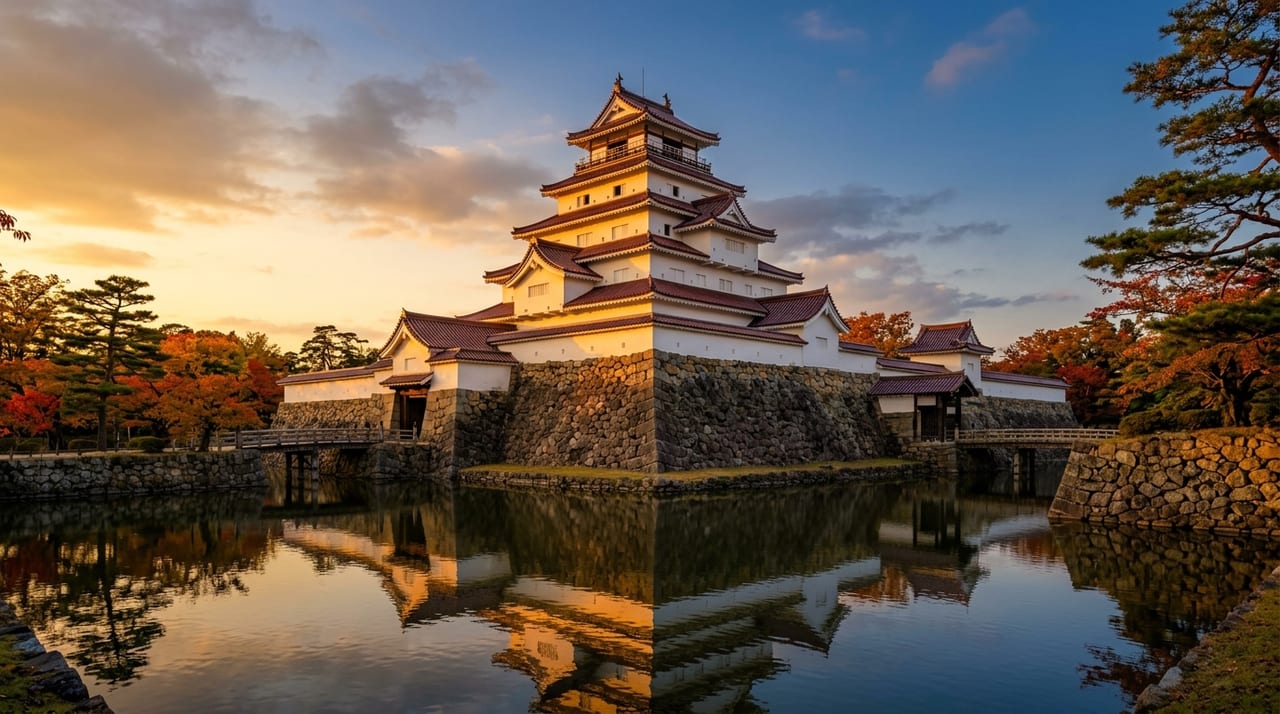
 * Image is for illustrative purposes only.
Aizu Wakamatsu Castle (Tsuru-ga-jo)
会津若松城(鶴ヶ城)
Aizu Wakamatsu Castle (Tsuru-ga-jo) is a historic castle in the Tōhoku region (Built in 1384 (Shitoku 1)). Its lord was Gamō Ujisato / Matsudaira Katamori.
Overview
About the Castle
Aizu-Wakamatsu Castle is a famous castle built at a military and political stronghold of the Tōhoku region, and it will be remembered forever as the stage of the Boshin War, one of the most tragic battles in Japanese history.
Its history began when Ashina Naomori built it as Kurokawa Castle in Shitoku 1 (1384). In the Sengoku period the Ashina clan ruled Aizu, but in Tenshō 17 (1589) Date Masamune destroyed the Ashina clan at the Battle of Suriagehara and held Aizu for a time. Afterward, through Toyotomi Hideyoshi's Ōshū settlement, Gamō Ujisato was enfeoffed here. He extensively renovated the castle and built a magnificent seven-story keep.
Culture and Crafts
Ujisato was a cultured warlord who served Nobunaga and Hideyoshi. He also worked hard on developing the castle town and laid the foundation for craft culture such as Aizu lacquerware and Aizu-nuri. After Uesugi Kagekatsu and Katō Yoshiaki, Hoshina Masayuki was enfeoffed in Kan'ei 20 (1643), and from then on the Matsudaira (Hoshina) family governed the Aizu domain. Hoshina Masayuki was a half-brother of the third shogun, Iemitsu, and was renowned as an enlightened lord. He established the Aizu House Code of Fifteen Articles and taught the retainers the spirit of loyalty and martial valor. The teaching in the first article of this house code, to the effect that "the Aizu domain exists to protect the shogunal house, and if the domain lord ever betrays it, the retainers must not follow him," became the foundation of Matsudaira Katamori's decision to accept the post of Kyoto Shugoshoku in the late Edo period.
Battles and Warfare
In the Boshin War of Keiō 4 (1868), the Aizu domain fought a fierce siege lasting one month against the all-out attack by the new government forces. The Byakkotai, made up of boys aged sixteen to seventeen, mistakenly believed the castle was burning at Mt. Iimori and carried out a group ritual suicide. This tragedy still moves people's hearts today as the ultimate expression of the Japanese samurai spirit. The keep, rebuilt in Shōwa 40 (1965), had its roof tiles replaced with the red tiles of the late Edo period in Heisei 23 (2011), vividly reviving its former majestic appearance. As a "land of martial arts," Aizu has long valued the martial arts, and it provided education in both learning and martial skills at a domain school called Nisshinkan.
The Spirit of Bushidō
This spirit is also deeply rooted in sword culture, and Aizu swords are known for their honest and steady style. Aizu's bushidō has continued to be passed down after the Meiji period as the spirit of the "Jū no Okite" and "Naranu koto wa naranu mono desu" ("Some things must not be done"), and it continues to have a major influence on the moral views of the Japanese people. Tsuruga Castle is a castle of tragedy and at the same time a castle of unbending pride. Aizu is also blessed with famous hot springs such as Higashiyama Onsen and Ashinomaki Onsen, and it is a treasure trove of traditional crafts such as Aizu lacquerware, Aizu cotton, and picture candles. Castle, history, hot springs, and crafts — Aizu-Wakamatsu is a city where the culture of martial arts and the skill of artisans are concentrated, and it is an ideal destination for travelers who want to deeply savor Japan's traditional culture.
Connection to Swords
The Aizu domain was a rare domain that made the martial arts the foundation of its governance, and its sword culture has a distinctive depth. The most famous swordsmith of the domain is Miyoshi Nagamichi. Nagamichi was a master craftsman also called "Aizu Kotetsu," and his cutting ability was ranked among the saijō ō-wazamono in the Kaihō Kenjaku. Nagamichi's swords were a symbol of pride for Aizu retainers, embodying the martial prestige of the domain. In the Aizu domain, under a strict educational system represented by the "Jū no Okite," retainers were drilled in swordsmanship from early childhood. At Nisshinkan, swordsmanship including Mizoguchi-ha Ittō-ryū was taught, and the wearing of swords by retainers was the very soul of the warrior, going beyond a mere status symbol. In the late Edo period, the Aizu domain, as Kyoto Shugoshoku, placed the Shinsengumi under its command and worked to maintain order for the shogunate. Shinsengumi commander Kondō Isami is known for using a Nagasone Kotetsu as his favorite sword, and vice-commander Hijikata Toshizō for wearing an Izumi-no-kami Kanesada. The Izumi-no-kami Kanesada that survives as Hijikata's belongings is a work of the 11th-generation Aizu Kanesada, and it conveys that Aizu swords came through the turmoil of the late Edo period. In the Boshin War, many retainers, including the Byakkotai, fought fiercely with swords in hand and upheld the samurai's pride until the day of surrender. The swords they gripped are witnesses that eternally inscribe the spirit of Aizu bushidō. At the Wakamatsu Castle Keep Local History Museum inside the Tsuruga Castle keep, collection items related to swords connected to Aizu and to the Byakkotai are displayed in collection exhibitions and the like. Aizu's sword culture is inseparable from the domain's character, which placed loyalty and martial valor above all, and its spirit shines with a unique light in the world of Japanese swords. After the Boshin War, many Aizu retainers were moved to Tonami Domain (Aomori Prefecture) and endured hardship in a bitterly cold land; it is said that not a few of them, even among that, did not let go of their swords. Aizu swords were not mere weapons but crystallizations of the samurai's soul and pride.
Highlights
- Red-tiled Keep — five-story keep restored to its late-Edo-period appearance; interior is a museum on Aizu history
- Mt. Iimori, associated with the Byakkotai — graves of the Nineteen Warriors and site of their ritual suicide, a sacred site of Aizu bushidō
- Rinkaku tea house — a historic tea house built by Gamō Ujisato, who sheltered Shōan, son of Sen no Rikyū
- Local history museum inside the keep — swords and Byakkotai materials connected to Aizu are displayed in collection exhibitions and the like
- Oyakuen Garden — daimyō garden of the Aizu Matsudaira family; the beauty of seasonal medicinal herbs and a pond-stroll garden
- Nisshinkan (reconstruction) — Aizu domain school, carrying on education in both learning and martial arts and the Jū no Okite into the present
* Opening hours and admission fees are subject to change. Please check the official website before visiting.