New Arrivals — Browse our catalog for the latest authentic Japanese sword arrivals. Browse →
July 17, 1589 (Tenshō 17, 6th month, 5th day)
Suriagehara, Yama District, Mutsu Province (present-day Inawashiro Town, Fukushima Prefecture)
Forces
Date Forces
Ashina Forces
About 9 min read
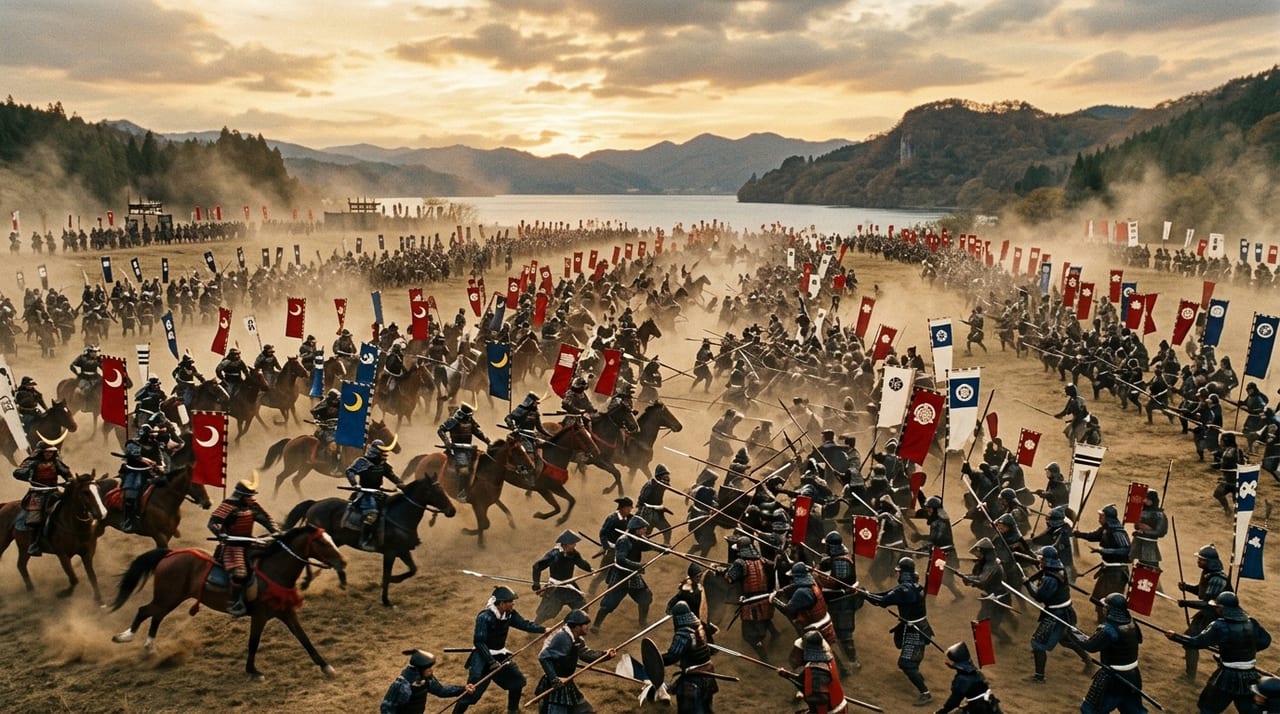
On the 5th day of the 6th month of Tenshō 17 (1589), at Suriagehara in Yama District, Mutsu Province, Date Masamune utterly crushed the forces of Ashina Yoshihiro. This 'Battle of Suriagehara' marked the practical end of the Sengoku period in the Tōhoku region and was the greatest turning point leading to Date Masamune's rise as the hegemon of Ōshū.
Date Masamune was born in Eiroku 10 (1567) and was 23 years old by traditional reckoning at the time of the Battle of Suriagehara in Tenshō 17. After succeeding to the family headship in Tenshō 12 (1584), Masamune aimed at the 'unification of Ōshū.' He fought one neighboring daimyo after another and achieved rapid growth, extending his influence across southern Ōshū within just a few years.
Meanwhile, the Ashina clan of Aizu had long held sway as a powerful house of southern Ōu, but in the late Sengoku period, discipline within the clan had broken down over a succession problem. Yoshihiro, a son of Satake Yoshishige of Hitachi, was adopted to succeed to the Ashina house, and this in fact lowered the real strength of the Ashina as a regional daimyo. Masamune did not let this opportunity slip.
On the 1st day of the 6th month of Tenshō 17 (1589), Inawashiro Morikuni, an Ashina retainer who had not yet made his position clear, submitted to Masamune. Masamune entered Inawashiro on the 4th day, and on the following day, the 5th, fought the Ashina army at Suriagehara at the foot of Mount Bandai.
In the decisive battle at Suriagehara, the Date force numbered about 23,000 and the Ashina force about 16,000, so the Date had the numerical advantage. However, the outcome of the battle cannot be explained by numbers alone.
The Date army took the field with Inawashiro Morikuni in the vanguard, Katakura Kagetsuna in the second division, and Date Shigezane, a cousin of Masamune and a renowned warrior, in the third division. When the vanguard and second division were broken by the Ashina forces, the third and fourth divisions charged forward but were driven back by Ashina Yoshihiro's hatamoto (bannermen). However, around the time the fighting became a clash between bannermen, the wind shifted from west to east and the tide of battle turned.
The Ashina army lost its discipline and retreated, and many drowned in the Nippashi River, whose bridge had been destroyed by Inawashiro Morikuni. Yoshihiro returned to Kurokawa Castle (later Aizu-Wakamatsu Castle) but could not defend it. On the night of the 10th day of the 6th month of Tenshō 17 (1589), he abandoned the castle and fled to Shirakawa, and later returned to his birth family, the Satake family. The Ashina house effectively perished at this point.
Date Masamune is also known as a man of deep appreciation for swords. As both a warrior and a man of culture, Masamune collected and appreciated famous swords and laid the foundation for the sword culture of the Sendai domain.
Clear historical sources are scarce regarding the swords Masamune wore at the Battle of Suriagehara, but there is an interesting fact from the perspective of Ōshū's sword culture. Mutsu Province (present-day Aomori, Iwate, Miyagi, Fukushima prefectures, etc.) had long been a region where sword smiths flourished. Incidentally, the 'Mutsu no kami' in the name 'Mutsu no kami Yoshiyuki,' the sword favored by Sakamoto Ryōma in the late Edo period, is a zuryōmei (an honorary title conferred by the court). Yoshiyuki himself was a sword smith who was active in the Tosa domain.
Also, in the Aizu region there was a sword smith known as 'Aizu Kanesada,' and from that lineage came the 'Izumi no kami Kanesada' favored by Hijikata Toshizō of the Shinsengumi. Aizu, the stage of the Battle of Suriagehara, was also a holy ground of such sword smiths.
The victory at Suriagehara brought Masamune an unprecedented domain. However, this great victory was at the same time the beginning of Masamune's tragedy.
In Tenshō 18 (1590), the year after the victory, Toyotomi Hideyoshi ordered the daimyo of the Kantō and Ōu regions to join the Odawara campaign. Masamune arrived late, but he apologized to Hideyoshi and was forced to accept a major reduction of his territory (the Ōshū Punishment). The domains Masamune had gained through the Suriagehara victory, including the former Ashina territories, were confiscated, and he was reduced to approximately 720,000 koku.
But Masamune did not yield to this humiliation. In the early Edo period he laid the foundations of the Sendai domain and became a figure who led the culture and economy of Ōshū. Known by the epithet 'Dokuganryū' (One-Eyed Dragon), Masamune also protected and nurtured Ōshū's traditions in sword culture, and he came to be revered by later sword enthusiasts.
The Battle of Suriagehara is remembered as the moment when the outstanding hero Date Masamune took the first step toward becoming 'tenka-bito' (ruler of the realm). It is also remembered as the last glow of the Sengoku period in Tōhoku and as the battle that announced the end of the era in which Japanese swords were used most fiercely.
Date Masamune
Date supreme commander who defeated Ashina Yoshihiro and unified Ōshū
Date Shigezane
Date Shigenari — Masamune's cousin who led the vanguard assault
Katakura Kojūrō
Katakura Kojūrō — Date strategist who planned the battle's tactics
Ashina Moriuji
Ashina Moriuji — the greatest Ashina lord of the preceding generation whose legacy ended at Suriagehara
Satake Yoshishige
Yoshihiro's father and backer, daimyo of Hitachi who lost his influence over Aizu with the Ashina defeat