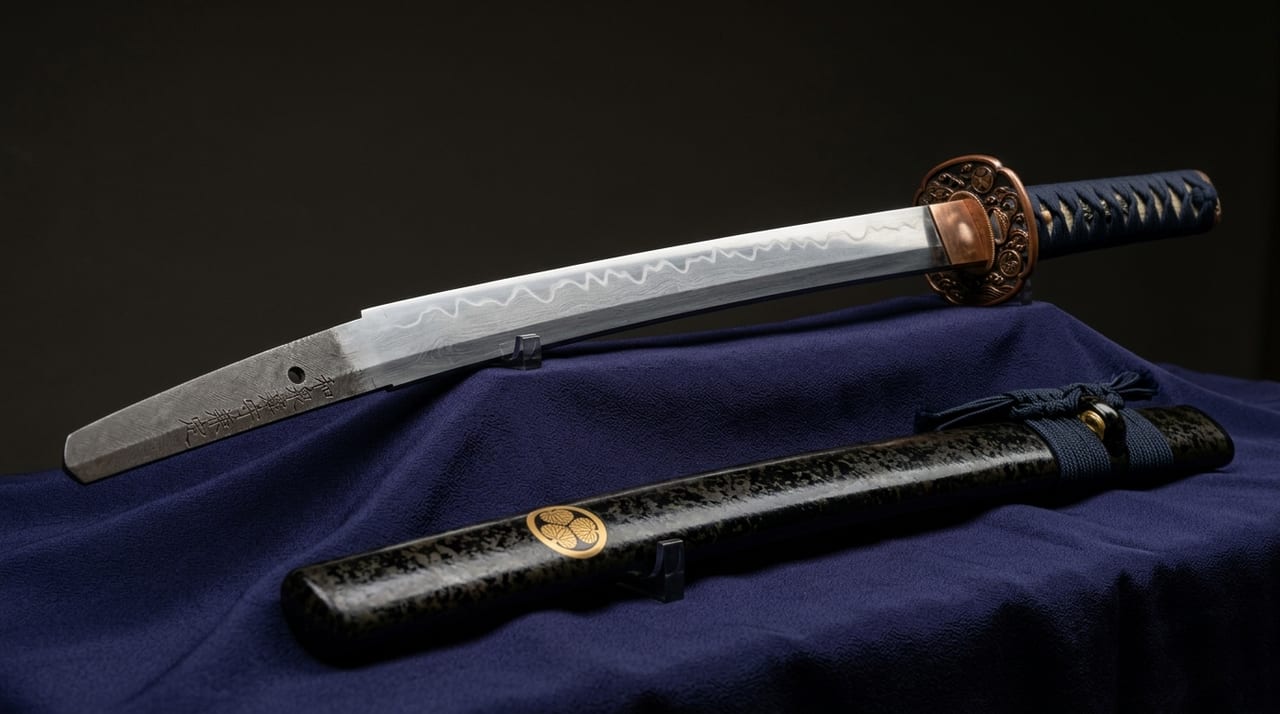
 * Image is for illustrative purposes only.
Izuminokami Kanesada
和泉守兼定
Also known as: Nosada (second-generation Kanesada) · 11th-generation Kanesada · Hijikata Toshizō's beloved sword · a sword that rode through the Boshin War alongside the Demon Vice-Commander
Description
Overview of the Sword
This is the signature of Kanesada, a renowned smith of Seki in Mino Province (present-day Seki, Gifu Prefecture). The same Kanesada signature was also carried on by a family of smiths of Aizu Domain (Aizu Kanesada) during the Edo period and continued until the late Shogunate era. The second-generation Kanesada in particular is known by the nickname "Nosada," because he cut the character for "sada" in a distinctive cursive form that looks like the "no" character. Nosada is celebrated as one of the two great Mino smiths alongside Seki no Magoroku Kanemoto, and is one of the master smiths representing the Mino tradition.
Forging Methods and Characteristics
Nosada's style features a jigane of itame-hada mixed with masame, and a hamon based on togari-gunome. It is a splendid finish characteristic of the Mino tradition, balancing cutting performance and beauty at a high level. In the late Edo period, a sword by the 11th-generation Izuminokami Kanesada (Aizu Kanesada) of Aizu Domain came to be known as the beloved sword of Shinsengumi vice-commander Hijikata Toshizō, and the name Kanesada resounded into the modern era. Hijikata Toshizō's Izuminokami Kanesada is said to be the work of the 11th-generation Kanesada, a smith in the employ of Aizu Domain in the late Edo period. It is an uchigatana with a blade length of 2 shaku 3 sun 1 bu (approx. 70.3 cm). The jigane is itame-hada mixed with ko-mokume, and the hamon shows a splendid style typical of the Mino tradition, with gunome-midare mixed with togari-ba. Hijikata Toshizō (1835–1869) was a swordsman of the late Edo period. Though born into a farming family in Tama in Musashi Province, he studied Tennen Rishin-ryū and served as vice-commander of the Shinsengumi, working hard to maintain public order in Kyoto. Feared as the "Demon Vice-Commander," Hijikata survived numerous battles, beginning with the Ikedaya Incident. During the Boshin War, though pursued by the imperial forces, he kept fighting his way northward, ever northward. He ultimately arrived at Goryōkaku in Hakodate in Ezo (Hokkaido), and on 20 June 1869 (Meiji 2/5/11), in the midst of the Hakodate War, he fell to a bullet. He was 35 years old. The Izuminokami Kanesada is said to have remained at Hijikata's side until his last moments. It is now held by the Hijikata Toshizō Museum in Hino City, Tokyo.
Legends & Stories
Legends and Anecdotes
The story of Izuminokami Kanesada and Hijikata Toshizō is the very life of one samurai who rode through the turbulent era from the late Edo period to the Meiji Restoration, alongside his sword. In Bunkyū 3 (1863), Hijikata, together with Kondō Isami and others, went up to Kyoto to guard the shogun's visit to the capital, and formed the Mibu Rōshigumi (later the Shinsengumi). As vice-commander, Hijikata imposed strict discipline and was called the "Demon Vice-Commander," bringing absolute control within the corps. The Ikedaya Incident of Genji 1 (1864) was the battle that made the name of the Shinsengumi resound throughout the land, and Hijikata also took part in it, crossing swords with sonnō jōi activists. In Keiō 4 (1868), when the former shogunate forces were defeated in the Battle of Toba-Fushimi, the Shinsengumi began its path to collapse. Kondō Isami surrendered to the new government forces at Nagareyama in Shimōsa and was beheaded at Itabashi. But Hijikata did not consider surrender acceptable, and headed north with the former shogunate forces. Through Utsunomiya, Aizu-Wakamatsu, Sendai, and then to Ezo, Hijikata repeatedly fought across the land, continuing to resist the new government forces. Throughout this long struggle, the Izuminokami Kanesada was always at Hijikata's side. After crossing to Ezo, Hijikata took the post of deputy army commissioner (rikugun bugyō-nami) of the Republic of Ezo, which was based at Goryōkaku in Hakodate. In the 5th month of Meiji 2 (1869), the new government forces launched their full-scale assault. On 20 June 1869 (Meiji 2/5/11), Hijikata was commanding from horseback when a single bullet pierced his abdomen, and his life ended at the age of 35. Hijikata Toshizō, often called "the last samurai," embodies the pride of a man who kept fighting with a sword at his side, even in an age when bushidō was reaching its end. According to tradition, after Hijikata's death the Izuminokami Kanesada was delivered as a keepsake to his hometown of Hino, where it was carefully preserved by the Hijikata family. It is now held by the Hijikata Toshizō Museum in Hino City, Tokyo. The blade is displayed for limited periods once or twice a year, timed to his death anniversary among other occasions. In the game Touken Ranbu, the Izuminokami Kanesada is enormously popular as a character who embodies strong loyalty to Hijikata Toshizō and the spirit of "fighting to the very end."