New Arrivals — Browse our catalog for the latest authentic Japanese sword arrivals. Browse →
March 24, 1860 (3rd day, 3rd month, Man'en 1)
Sakuradamon Gate, Edo, Musashi Province (present-day Chiyoda Ward, Tokyo)
Forces
Rōnin from Mito and Satsuma domains (assassins)
Hikone Domain (Ii Naosuke's escort)
About 11 min read
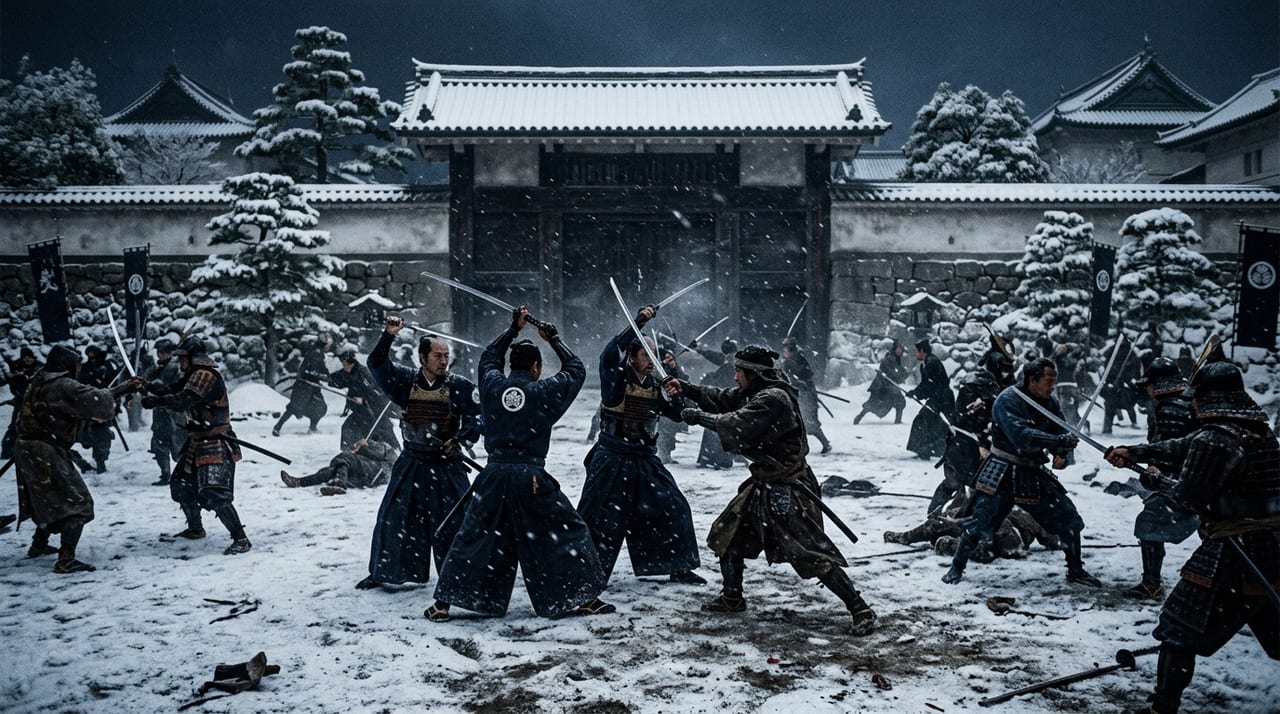
On the morning of the 3rd day of the 3rd month of Man'en 1 (1860), outside Sakuradamon Gate of Edo Castle (present-day Chiyoda Ward, Tokyo). On a quiet morning blanketed in fallen snow, one of the most famous political assassinations in Japanese history was carried out. The procession of Tairō (senior councilor) Ii Naosuke, the highest authority of the shogunate, was ambushed by 18 assassins, rōnin who had defected from Mito and Satsuma domains, and Naosuke was assassinated. This 'Sakuradamon Incident' was the moment the authority of the Edo bakufu was irreparably damaged, and a historic event that began the countdown to the Meiji Restoration.
In 1858 (Ansei 5), Ii Naosuke, as Tairō of the shogunate, signed the Treaty of Amity and Commerce between Japan and the United States. Because this treaty was concluded without the emperor's imperial sanction (permission), it was fiercely condemned by the imperial court and the Sonnō Jōi faction (the Revere the Emperor, Expel the Barbarians faction) as a 'signing of a treaty without imperial sanction.'
Naosuke sought to suppress this criticism by force and carried out the 'Ansei Purge (1858–1859).' More than 100 daimyō, court nobles, and activists of the Sonnō Jōi faction and those with anti-shogunate positions were punished, and prominent activists including Yoshida Shōin and Hashimoto Sanai were executed.
The backlash from Mito Domain (one of the Tokugawa gosanke) against this authoritarian rule was especially fierce. Mito Domain had a strong tradition of 'sonnō' (reverence for the emperor's authority), and viewed Naosuke's actions as those of a 'rebel who showed contempt for the imperial court.' Some Mito retainers defected from their domain and planned the assassination of Naosuke.
The plot was devised by a group of defected rōnin, centered on former retainers of Mito. The core of the plan was Mito's Kaneko Magojirō and Takahashi Taichirō. Seki Tetsunosuke led the attack on the scene, and Arimura Jizaemon, who had defected from Satsuma Domain, also took part. The plan was prepared over several months, and the 3rd day of the 3rd month (the Peach Festival, Girls' Day) was chosen as the day of execution. On this day, the daimyō residing in Edo were to gather at the castle for the festival celebrations, so the rōnin, holding bukan heraldic directories in hand, posed as spectators of the daimyō processions and waited for the Tairō's palanquin.
It was snowing in Edo that day. The approximately 60 Hikone Domain guards marched with bags placed over the hilts and scabbards of their swords so that the hilts would not get wet in the snow. This backfired: in an emergency, their swords could not be drawn quickly.
The rōnin ambushed the procession outside Sakuradamon. First, Mori Gorokurō, posing as someone making a petition at the palanquin, attacked the head of the retinue. Then Kurosawa Chūzaburō fired a pistol into Naosuke's palanquin as the signal. The Hikone guards fought back, struggling with their bagged swords, but the rōnin stabbed through the palanquin with their swords one after another, and Arimura Jizaemon dragged Naosuke out of the palanquin and took his head. While withdrawing with the head, Arimura was cut down and seriously wounded by pursuing Hikone retainers, and he committed suicide at the gate of the residence of wakadoshiyori (junior councilor) Endō Tanenori.
Among the perpetrators, in addition to those who died at the scene or committed suicide after being seriously wounded, many of those who surrendered were later executed. However, some survived into the Meiji period, such as Mashiko Kinpachi and Kaigo Sakinosuke.
The Sakuradamon Incident is also an interesting case from the perspective of the practical use of Japanese swords. Many of the swords actually used by the samurai activists of the late Tokugawa period reflected the sword culture of the time.
Major swordsmiths of the late Tokugawa period include Koyama Munetsugu and Kiyomaro, also known as Minamoto no Kiyomaro. Swords made by these smiths were prized by the activists as sturdy blades designed for real combat in the late Edo to late Tokugawa period.
Mito Domain also had its own sword culture, and famous swords have been handed down in the Mito Tokugawa family.
Swords by Koyama Munetsugu were especially highly regarded among the swordsmen and dōjō of the late Tokugawa period. Koyama Munetsugu was a representative swordsmith of the late Edo period, and his works combined practicality in combat with artistic quality.
Regarding the swords used in the Sakuradamon Incident, it is recorded that Kurosawa Chūzaburō's sword, wielded in a fierce fight, had its edge chipped like the teeth of a saw, which shows the intensity of the melee that day. The unusual situation of a bare-blade fight in the snow was also a scene where the performance of the swords directly determined life and death.
The significance of the Sakuradamon Incident beyond a mere assassination lies in its symbolism: the highest authority of the shogunate was killed on a public road.
Throughout the Edo period, the authority of the bakufu was supported by 'guaranteeing public order' and 'maintaining order over swords.' The fact that Tairō, the most powerful figure in the shogunate, was killed by 18 rōnin in the very heart of Edo, the seat of the shogun, showed the whole realm that the bakufu had 'lost its ability to maintain public order.'
After this incident, political assassinations and bloody incidents followed one after another in the late Tokugawa period: the Ikedaya Incident (1864), the assassination of Sakamoto Ryōma (1867), and then the Boshin War. The Sakuradamon Incident was the starting point of that chain.
The political conflicts of the late Tokugawa period, 'expel the foreigners or open the country?' and 'overthrow the shogunate or support it?', moved toward resolution through the actions of activists who took up swords. The snow that had piled up outside Sakuradamon may have been an omen of the Edo bakufu, which had boasted 260 years of peace, collapsing like melting snow.
Ii Naomasa
Founder of the Hikone domain; ancestor of Ii Naosuke, whose retainers served as escort
Saigō Takamori
Central figure of Satsuma's overthrow-the-shogunate movement, continuation of the Sakuradamon trajectory
Sakamoto Ryōma
Bakumatsu activist; successor to the movement the Sakuradamon Incident intensified
Hijikata Toshizō
Shinsengumi vice-commander who lived through the turbulent sonnō jōi era intensified by Sakuradamon