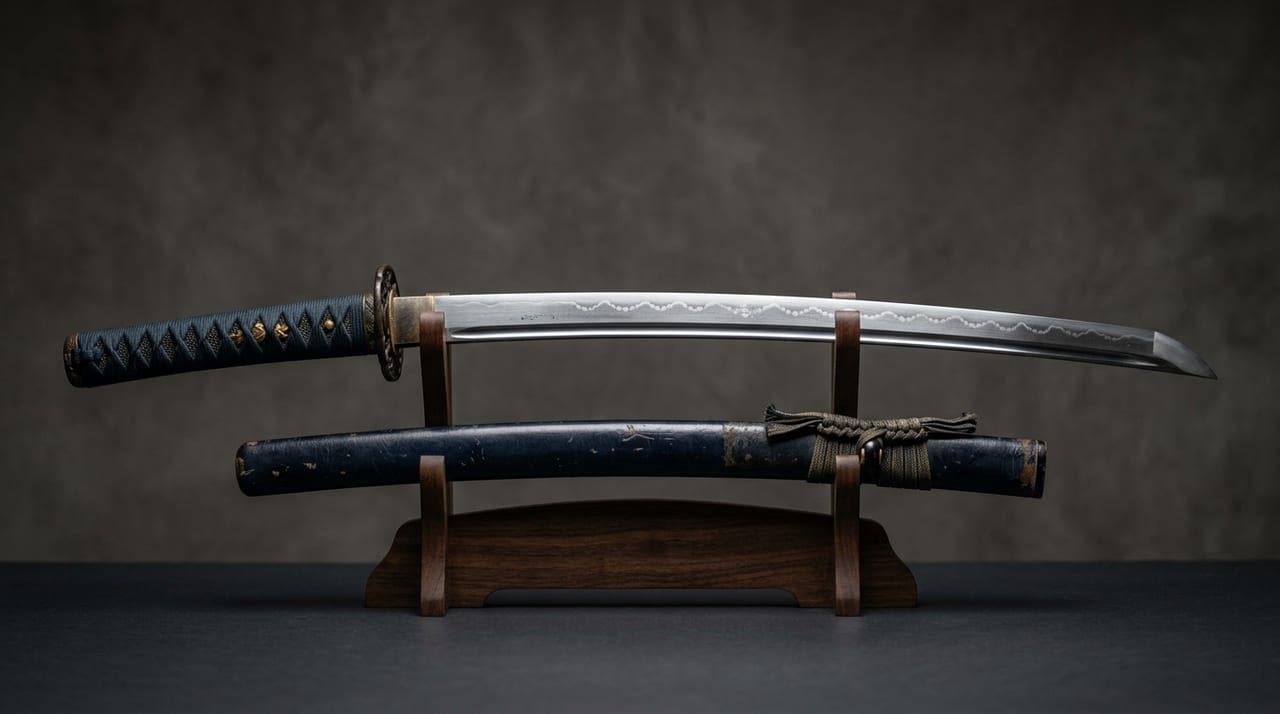
 * Image is for illustrative purposes only.
Nagasone Kotetsu
長曽祢虎徹
Also known as: Kotetsu
Description
Overview of the Sword
An early-Edo swordsmith and master who holds the highest place in the "Shintō saijō-saku" (supreme Shintō) rating.
The Smith
Nagasone Kotetsu, whose real name was Nagasone Okisato, is generally held to have come from Nagasone village in Ōmi Province (though some theories place him in Echizen). He was active as part of the Nagasone family, who made their living as armorers. Around the age of fifty, however, he moved to Edo and turned to swordsmithing, an unusual career path. His long experience as an armorer had a decisive influence on his swords. A smith who knew the structure and weaknesses of armor forged blades aimed at a practical cutting power capable of cutting through armor. His performance in cutting tests was considered the finest among shintō swords (those made from the Keichō era onward).
Methods and Characteristics
The most distinctive feature of his work is the unique gunome-midare hamon called juzuba (rosary-bead). Rounded gunome that link together like the beads of a rosary are unique to Kotetsu and produce an original scene found in no other smith's work. The jigane shows itame-hada mixed with mokume, with thick jinie, producing a forged surface that is finely detailed yet powerful. The bōshi is often midare-komi with a hakikake tip. The nakago finish is careful, and the signature is cut as 'Nagasone Okisato Nyūdō Kotetsu' or 'Kotetsu Nyūdō Okisato', among other forms. His style changed between the early and late periods. The early works are rugged and strongly shaped by his years as an armorer, while the later works matured into a refined and splendid style. This transformation is evidence of his unceasing study as a swordsmith. The fact that a late-career convert (tenshin-gumi) rose to the summit of the Shintō saijō-saku may be called a miracle in the history of Japanese swords. What raised Kotetsu's name even higher was his association with Shinsengumi commander Kondō Isami. The line 'Tonight, my Kotetsu thirsts for blood' is a later invention, but the fact that Kondō treasured a blade he called Kotetsu is also evident in Kondō's own letters. Kotetsu's popularity is shown by the number of forgeries, so much so that the saying 'If you see a Kotetsu, think it a fake' was born. Because Kotetsu was popular even in his lifetime and many fakes were made, it is also thought that he varied the way he wrote his signature by period. Authenticating his works is regarded as one of the most difficult subjects in sword appraisal.
Legends & Stories
Legend and Anecdotes
The legend of Nagasone Kotetsu cannot be told without its link to Kondō Isami, commander of the Shinsengumi. Kondō Isami (1834–1868) was born to a farming family in Kami-Ishihara village, Tama District, Musashi Province (present-day Chōfu, Tokyo). He entered the Tennen Rishin-ryū dōjō, Shieikan, and later succeeded as the fourth head of the school, a swordsman. In Bunkyū 3 (1863), he went up to Kyoto to guard the shogun's visit and became commander of the Mibu Rōshigumi (later the Shinsengumi). Kondō's favored blade is said to be Kotetsu. There are several accounts of how he acquired it, including 'bought in Edo' and 'received from Kōnoike Zen'emon'. On 8 July 1864 (Genji 1/6/5), the Ikedaya Incident, a landmark event in Shinsengumi history, took place. Having learned that patriots of the sonnō-jōi faction, centered on the Chōshū domain, had gathered at the Ikedaya inn on Sanjō in Kyoto to plot the burning of the Imperial Palace, Kondō, together with Okita Sōji, Nagakura Shinpachi and Tōdō Heisuke—only four men in all—charged into the inn. The blade Kondō wielded at that moment is said to have been Kotetsu. In the fierce close-quarters fighting within the narrow interior, Kondō's Kotetsu neither broke nor bent, and it is said he struck down the patriots one after another. Three days after the Ikedaya Incident, on 11 July 1864 (Genji 1/6/8), Kondō wrote in a letter to a patron in Musashi Province: 'My blade being Kotetsu, perhaps, I came through unscathed.' This passage is often cited by sword researchers as evidence of Kotetsu's remarkable durability. However, opinions differ on whether the Kotetsu Kondō owned was genuine, and today the view that it was a fake prevails. Togishi (polisher) Inuzuka Tokutarō holds that Kondō's Kotetsu was a work of the late-Edo master Minamoto Kiyomaro bearing a false Kotetsu signature, and that it was destroyed in the Great Kantō Earthquake. Minamoto Kiyomaro, also called 'Yotsuya Masamune', was one of the finest smiths of the late Edo period. Even if Kondō's blade were a Kiyomaro work, it would remain a fine sword. But the fact remains that Kondō himself fought believing it to be Kotetsu, and rode out the Bakumatsu turmoil under the Kotetsu name. Kotetsu's career as an armorer is deeply rooted in his sword-making philosophy. Kotetsu's blades are known for their cutting ability. In the late-Edo text Kaihō Kenshaku, they are ranked in the top grade, 'Saijō Ōwazamono' (supreme great blades). Kotetsu's pursuit of 'cutting ability' above beauty is held by modern sword enthusiasts in the highest esteem, as the purest embodiment of the essence of the Japanese sword.