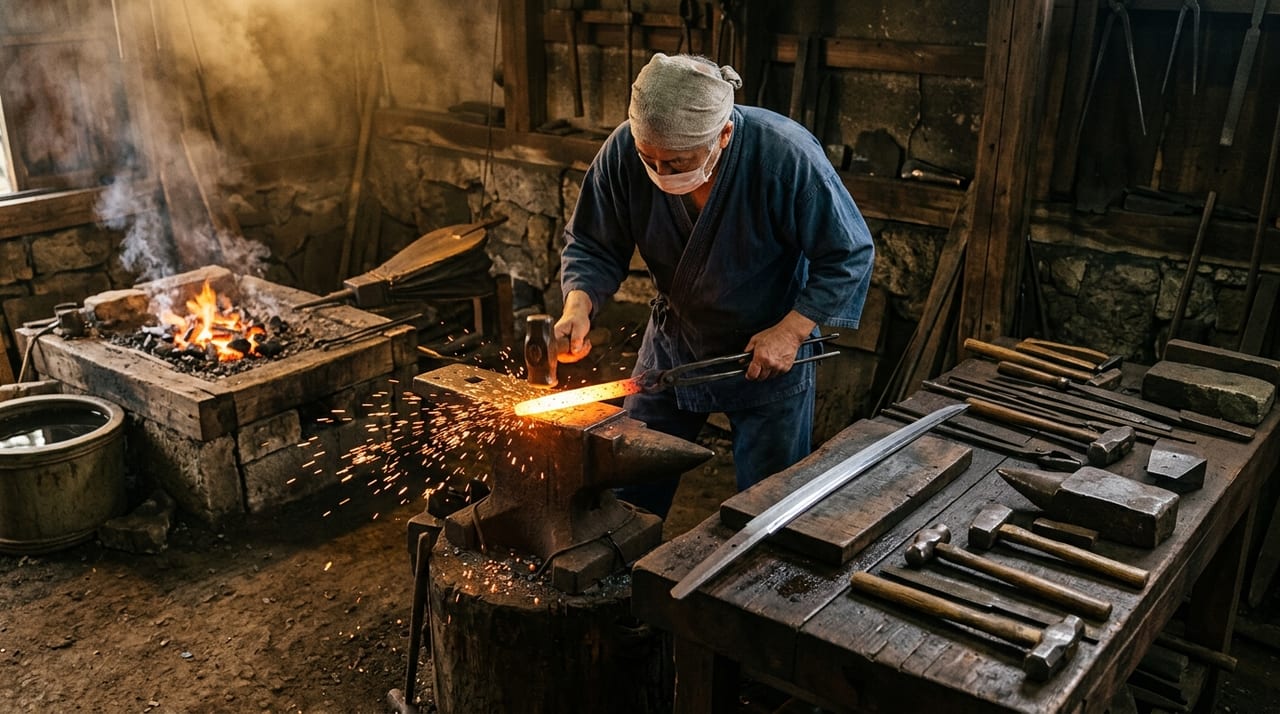
 * Image is for illustrative purposes only.
Nagasone Kotetsu
長曽祢虎徹
Description
Nagasone Kotetsu (birth year unknown–1678) was a master smith of the shintō period, representative of the early Edo period, and a master craftsman who left his name to posterity for his cutting ability and robust formal beauty, which earned him a place among the saijō ōwazamono. Born into the Nagasone family, which made its living as armorers (katchūshi), he is said to have moved to Edo around the age of 50 and turned to sword-making, an unusual career path. There are two theories about his place of origin, Ōmi and Echizen. He then continued to make swords vigorously for about 20 years.
The greatest feature of Kotetsu's sword-making lies in the bold jigane and hamon that embody the revival of the Sōshū-den in the shintō period. The jigane shows itame mixed with ō-hada, with chikei and ji-nie thickly present and nie-utsuri standing out, presenting the powerful forging texture unique to the Sōshū-den. The hamon has thick nie on gunome, ō-gunome, and notare. From the habuchi into the hanaka, a wealth of activity is seen, including kinsuji, sunagashi, and tobiyaki, creating a lively Sōshū ō-midare. In particular, a hamon in which gunome line up like a string of beads is called juzuba (rosary-bead hamon) and is considered representative of Kotetsu's style.
Shinsengumi commander Kondō Isami is widely known for favoring a sword inscribed "Nagasone Kotetsu." However, the accepted view is that the sword Kondō owned was a forgery rather than a genuine work. It is also well known that, during Kotetsu's lifetime, many forgeries of his signed works were made. Paradoxically, this shows how high Kotetsu's reputation was, and authentic Kotetsu works still receive extremely high regard today.
Kotetsu's signatures (mei) come in several forms, including "Nagasone Okisato," "Kotetsu," "Nagasone Kotetsu," "Nyūdō Okisato," and "Kotetsu Nyūdō Okisato," and many dated examples survive. Currently, five of Kotetsu's swords are designated Important Cultural Property, and others have been designated Jūyō Tōken. They are owned or stored at Kishū Tōshō-gū, the Kyoto National Museum, the Japanese Sword Museum, and other institutions.
Famous Works
- katana, signed Nagasone Okisato Nyūdō Kotetsu (Important Cultural Property, Kishū Tōshō-gū)
- katana, signed Nagasone Okisato Nyūdō Kotetsu (Important Cultural Property, held by the Japanese Sword Museum)
- katana, signed Nagasone Okisato Nyūdō Kotetsu (Important Cultural Property, Kyoto National Museum)