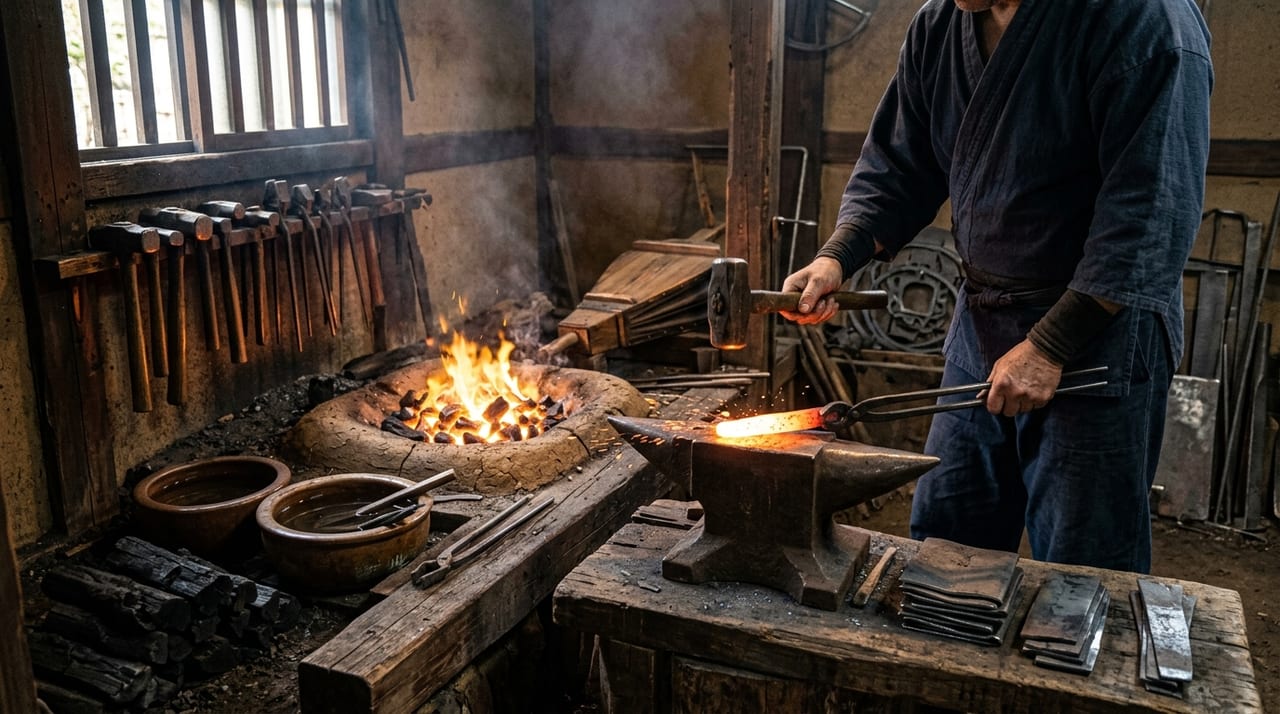
 * Image is for illustrative purposes only.
Horikawa Kunihiro
堀川国広
Description
Horikawa Kunihiro (1531–1614) was a swordsmith who was active from the Momoyama period into the early Edo period. As the founder of the Horikawa school, he is a master representing the early shintō era. Also called the 'founder of shintō,' Kunihiro studied the forging methods of the Sōshū tradition and the Mino tradition, which flourished from the Kamakura to Nanboku-chō periods. He completed a new style called Horikawa-mono and produced many master craftsmen among his disciples.
Kunihiro was a native of Hyūga Province (present-day Miyazaki Prefecture). At first he served the Itō clan, a sengoku daimyō of Hyūga, but after his lord's house fell in Tenshō 5 (1577), he became a yamabushi (mountain ascetic) and continued making swords while wandering through various provinces. In Tenshō 18 (1590), he forged swords for Nagao Akinaga, lord of the castle at Ashikaga in Shimotsuke Province. From around Keichō 4 (1599), he settled at Ichijō Horikawa in Kyoto, and from then on he was called 'Horikawa Kunihiro.' During the Keichō era (1596–1615), he opened a workshop in Kyoto, trained many excellent disciples, and formed the Horikawa school. From among his disciples came master craftsmen representative of the early Edo period, including Dewa Daijō Kunimichi, Echigo no Kami Kunitomo, Izumi no Kami Kunisada, and Kawachi no Kami Kunisuke.
The greatest feature of Kunihiro's work is the fusion of the bold, irregular hamon of the Sōshū tradition with refined jigane. The jigane is a rough forged surface, consisting mainly of itame with masame and ōhada mixed in. Chikei and jinie appear abundantly, clearly displaying the vigorous surface character of the Sōshū tradition. The hamon features large gunome, ō-gunome, and notare, and it abounds in activity within the blade characteristic of the Sōshū tradition, such as tobiyaki, nijūba, and uchinoke. As a whole, his work boasts a bold, grand style that embodies the force of the Sōshū tradition and the magnificence of Momoyama culture.
Among his works, the 'Yamanbagiri Kunihiro' is especially famous as a representative work of Kunihiro. It is known as a piece made in Tenshō 18 (1590) at the request of Nagao Akinaga, lord of Ashikaga Castle, as a copy of the sword by Osafune Chōgi (Honsaku Chōgi) that Akinaga owned. In recent years, it has achieved high recognition even among sword enthusiasts. This sword is an Important Cultural Property held by the Ashikaga Civic Culture Foundation, and it is still revered today as a masterpiece representative of the shintō period. Its signatures include 'Kunihiro,' 'Nisshū Furuya jū Kunihiro,' 'Kyūshū Hyūga jū Kunihiro,' and 'Shinano no Kami Kunihiro.' Many signed works bearing Tenshō and Keichō dates survive.
Famous Works
- katana, signed Kyūshū Hyūga-jū Kunihiro saku, dated Tenshō 18, kanoe-tora, 2nd month, auspicious day, Taira Akinaga (Yamanbagiri Kunihiro, Important Cultural Property, owned by Ashikaga Citizens' Cultural Foundation)
- tachi, signed Nisshū Furuya no jū Kunihiro, made during his yamabushi period, dated Tenshō 12, 2nd month, higan (Yamabushi Kunihiro, Important Cultural Property)
- katana, signed Kunihiro (Katō Kunihiro, Important Cultural Property, owned by Mitsui Memorial Museum)