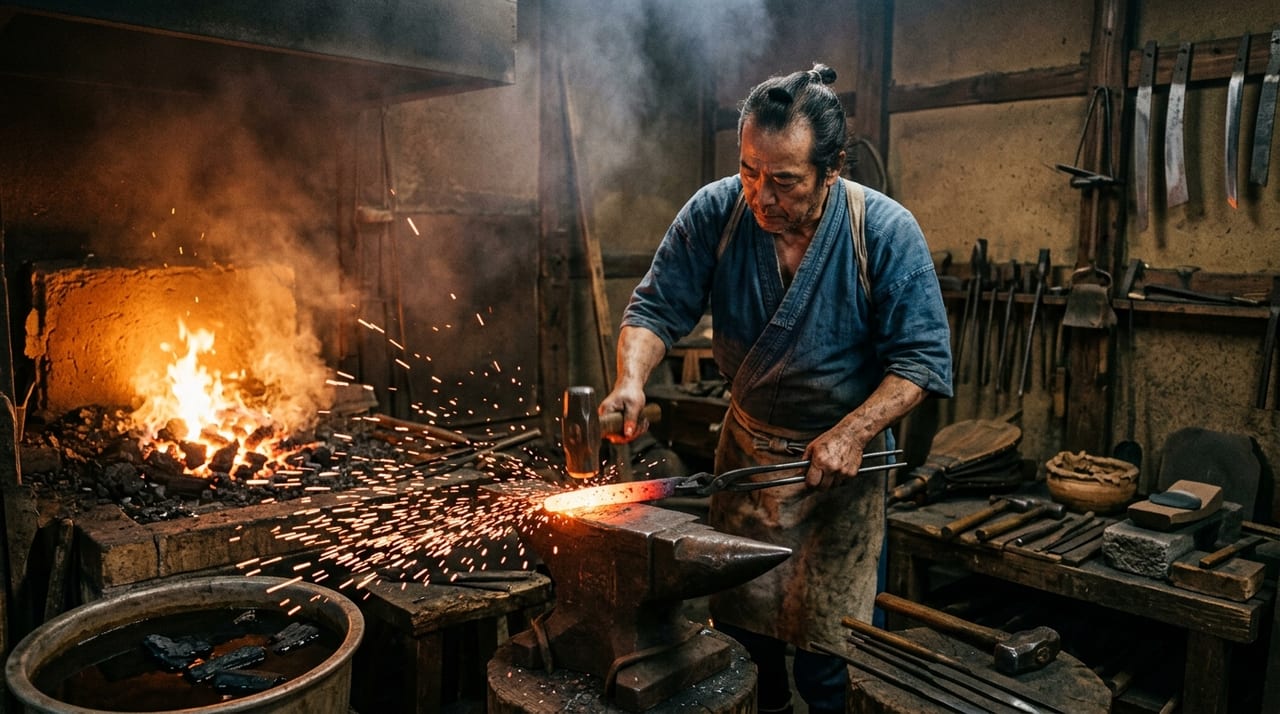
 * Image is for illustrative purposes only.
Yamaura Saneo
山浦真雄
Description
Yamaura Saneo (also read Masao; 1804–1874) was a master swordsmith of the shinshintō period, born in Chiisagata District, Shinano Province (present-day Tōmi City, Nagano Prefecture). He is known as the elder brother of Yamaura Tamaki (Minamoto Kiyomaro), who was nicknamed "Yotsuya Masamune." Saneo himself was also a renowned master, and during the late-Edo movement to revive the sword arts, he embodied the techniques of the Sōshū-den at a high level.
The greatest feature of Saneo's blades is the fusion of bold hamon based on the Sōshū-den with finely crafted jigane. The jigane is dense with ko-itame, with fine ji-nie scattered throughout, giving it a moist, lustrous surface. The hamon is mainly gunome, with large, wildly irregular ashi and yō appearing actively and abundant nie adhering to form a bright, crisp hamon-zakai. Within the hamon, suna-nagashi and kinsuji work vividly, and an air of refinement lingers amid the intensity of the Sōshū-den.
Saneo studied under Kawamura Toshitaka, a smith of the Ueda Domain, together with his younger brother Tamaki (later Kiyomaro), and later trained in Edo and Kyoto as well. Kiyomaro went up to Edo through the good offices of Sanada Yukitsura and matured as a swordsmith under the patronage of the hatamoto Kubota Sugane. Saneo forged blades on commission for the Komoro Domain and the Matsushiro Domain, and is best known for the anecdote in which the toughness of his blades was proven by an ara-tameshi (destructive endurance test) held by the Matsushiro Domain in Kaei 6 (1853).
His signatures included inscriptions such as (山浦昇源正雄), and he also used the names (完利, 寿昌, 正雄, 寿長). His art names (gō) included Tennenshi and Yūunsai. He died in Meiji 7 (1874).
Related Swordsmiths
堀川国広
Soshu tradition (New Sword)Horikawa Kunihiro
Momoyama to Early Edo period (New Sword genesis era)
肥後守輝広
ShintōHigo no Kami Teruhiro
Azuchi-Momoyama to early Edo period (around Keichō)
越前下坂
Sōshū tradition lineage (Shintō period)Echizen Shimosaka
Early Edo period (Shintō era)
信国吉貞
Yamashiro-den / Soshu-denNobukuni Yoshisada
Late Azuchi-Momoyama to early Edo period