New Arrivals — Browse our catalog for the latest authentic Japanese sword arrivals. Browse →
January 27–30, 1868 (3rd–6th day, 1st month, Keiō 4)
Toba and Fushimi, Yamashiro Province (present-day Fushimi Ward and Minami Ward, Kyoto City, Kyoto Prefecture)
Forces
Imperial Forces (Satsuma-Chōshū-Tosa)
Former Shogunate Forces
About 17 min read
The gunfire that rang out on the 3rd day of the 1st month of Keiō 4 (27 January 1868) along the Toba Road south of Kyoto and in the town of Fushimi split Japanese history in two. The clash between the new government forces, centered on Satsuma and Chōshū, and the former Bakufu forces led by Tokugawa Yoshinobu, the Battle of Toba-Fushimi, was the opening engagement of the Boshin War. It dealt a fatal blow to the Edo shogunate, which had lasted just over 260 years, and opened the door to a new era, the Meiji Restoration.
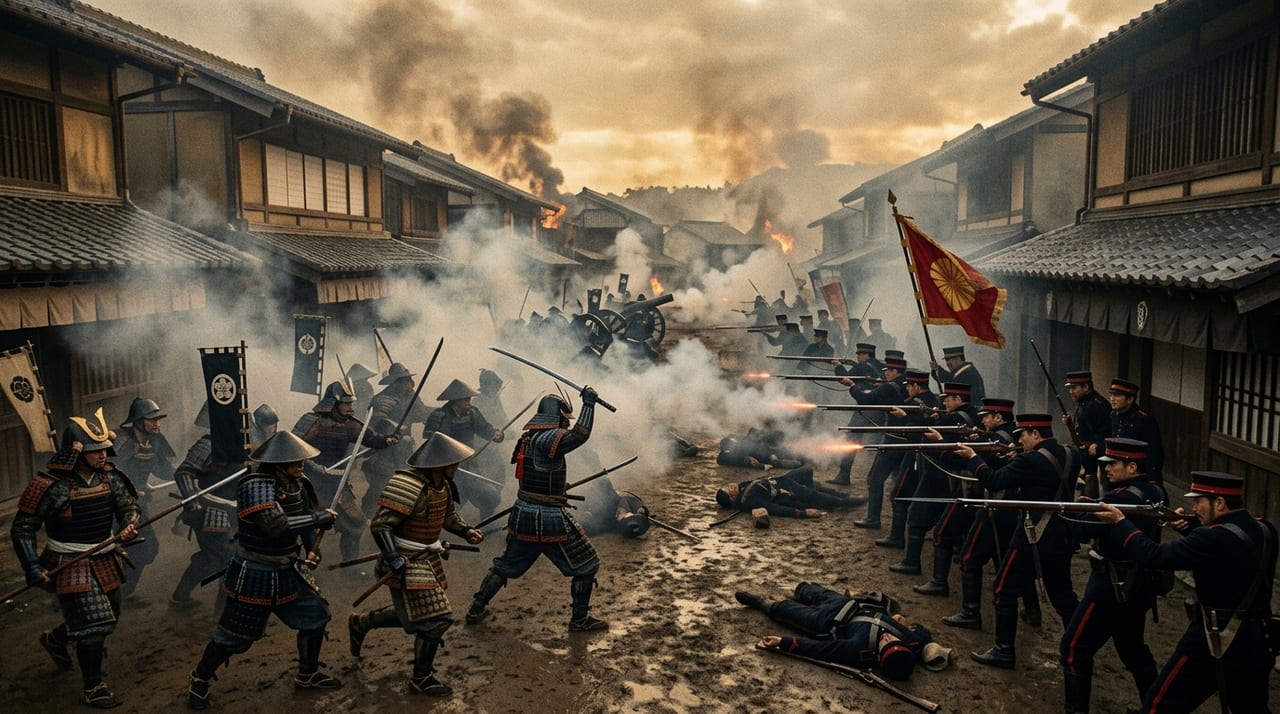
This battle holds a special meaning in the history of the Japanese sword as well, because it was here that the final settlement between “the age of the sword” and “the age of the gun” took place. The Bakufu forces outnumbered their opponents but were defeated by the latest rifles and cannons carried by the Satsuma and Chōshū forces. It was a battlefield that condensed the very contradiction of the Bakumatsu period: samurai wearing swords were defeated by modern firearms.
In the 10th month of Keiō 3 (1867), Tokugawa Yoshinobu submitted the return of governing power (taisei hōkan) to the throne. However, this was not the complete transfer of power intended by the anti-shogunate faction. The Tokugawa house calculated that it could continue to retain political influence. On the 9th day of the 12th month (3 January 1868), the Restoration Edict (Ōsei fukkō no daigōrei), issued under the leadership of Satsuma and Chōshū, was promulgated, and Yoshinobu was ordered to resign his office and surrender his lands (jikan nōchi), that is, to give up his post as Naidaijin (Minister of the Interior) and his domains. At the Kōgosho Conference held that same evening, Satsuma retainer Saigō Takamori is said to have remarked during a recess that “a single short sword would settle the matter,” and this is said to have bolstered the hardline stance of Iwakura Tomomi and others. This anecdote is one of the final scenes from an age in which swords functioned as symbols of political tension.
Yoshinobu moved from Nijō Castle to Ōsaka Castle, but negotiations with the anti-shogunate faction broke down. On the 2nd day of the 1st month of Keiō 4 (26 January 1868), the Bakufu forces set out toward Kyoto, bearing the Tōsatsu-hyō (Declaration against Satsuma). At Fushimi, Aizu domain troops, the Shinsengumi, and others were deployed around the Fushimi Magistrate's Office, while the Mimawarigumi and the Bakufu Infantry Corps advanced along the Toba Road.
At around 5 p.m. on the 3rd day of the 1st month of Keiō 4 (27 January 1868), near Koeda Bridge on the Toba Road, after a heated exchange over passage, the Satsuma forces opened a volley on the Bakufu troops who attempted to force their way through. The sound of the guns became the signal, and fighting also broke out at Fushimi.
Looking at troop strength alone, the Bakufu forces numbered about three times those of the Satsuma-Chōshū forces, and they also included units equipped with Western-style guns and artillery. However, they lacked unified command. While advancing in marching formation along the narrow road, they were struck first by Satsuma-Chōshū rifle units and artillery armed with Enfield rifles and other weapons. Although swordsmen on the Bakufu side, led by Shinsengumi deputy commander Hijikata Toshizō, fought valiantly, individual swordsmanship meant nothing in the face of bullets.
What decided the course of the battle was the appearance of the Nishiki no Mihata (Brocade Banner). The moment the Satsuma-Chōshū forces raised this banner, which signified the army of the emperor, the Bakufu forces became “enemies of the throne” (chōteki). Many domain troops on the Bakufu side were thrown into confusion and withdrew from the front, and the Bakufu forces collapsed rapidly. After four days of fighting, the Bakufu forces suffered a crushing defeat by the 6th day of the 1st month (30 January 1868), and Tokugawa Yoshinobu fled from Ōsaka Castle to Edo by warship.
On the Toba Road, from the night of the 3rd day of the 1st month (27 January 1868) into the 4th (28 January 1868), the Mimawarigumi and the Bakufu Infantry Corps faced off against the Satsuma forces. At first the Bakufu side had the numerical advantage, but under bombardment they were forced to fall back. At Fushimi, the Fushimi Magistrate's Office was set ablaze by Satsuma artillery, and the Bakufu garrison abandoned the office and retreated toward Ōsaka.
The Shinsengumi's fighting at the Battle of Toba-Fushimi deserves special mention as a tragic final chapter in the history of the Japanese sword.
Since the Ikedaya Incident (Genji 1, 1864), the Shinsengumi had been a band of swordsmen who devoted themselves to keeping public order in Bakumatsu Kyoto, and their fighting strength rested on high swordsmanship. Commander Kondō Isami, who had been shot and wounded in the 12th month of the previous year, was recuperating at Ōsaka Castle. Deputy Commander Hijikata Toshizō therefore led the unit, took up positions at the Fushimi Magistrate's Office, and threw himself into fierce street and gun battles. However, swords and rifles had limits against modern weapons, and the Shinsengumi also suffered heavy losses.
The “Izumi no kami Kanesada,” known as the favorite sword of Hijikata Toshizō, is a blade that symbolizes this era. Hijikata continued fighting for the Bakufu side to the very end, moving from the Aizu campaign to the Hakodate campaign. But on 20 June 1869 (Meiji 2/5/11) he was felled by a bullet in the battle at Hakodate. That Kanesada survives today and is held by the Hijikata Toshizō Museum in Hino City. This famous sword, which embodies the spirit of the last swordsman who staked his life on the age of the sword, has continued to be cherished by many people up to the present day as a symbol of Bakumatsu sword culture.
“Nagasone Kotetsu” is one of the swordsmiths prized by the Shinsengumi swordsmen, and there is a tradition that Kondō Isami owned a Kotetsu blade (there is also a theory that the signature is spurious). After the Battle of Toba-Fushimi, Kondō took command of the Bakufu side. But in the 4th month of Keiō 4 (1868) he was captured by the new government forces at Nagareyama in Shimōsa Province, and on the 25th of that month (17 May 1868) he was beheaded at Itabashi. The final chapter of the Shinsengumi, a “band of swords,” is among the most dramatic chapters in the history of Japanese sword culture.
The significance that the Battle of Toba-Fushimi left on the cultural history of the Japanese sword is multilayered.
First, this battle announced the effective military end of the samurai class. Here was the moment when the Japanese sword, which had held an absolute position as the “soul of the samurai,” completely lost its role as a principal weapon of modern warfare. This battle was the practical starting point of the chain of events leading to the 1873 Conscription Ordinance and the 1876 Sword Abolition Edict.
Second, the process by which Bakumatsu swordsmen, led by the Shinsengumi, were idealized and turned into legend as “the last samurai who fought through with swords” deepened the Japanese people's special emotional attachment to the sword. Behind the continued prizing of swords as “works of art” and “symbols of the spirit” even after the Sword Abolition Edict lay a yearning for these Bakumatsu swordsmen. From the Ikedaya Incident to Toba-Fushimi and then to Goryōkaku in Hakodate, the Shinsengumi's trajectory will be retold forever as the final brilliance of a band of swordsmen who carried the Japanese sword.
Third, it is also noteworthy that the swords used in the Battle of Toba-Fushimi were, after the Meiji period, preserved and collected as relics of the Bakufu side, leading to today's museum collections. Swords belonging to Shinsengumi members still survive in various places, welcoming visitors as living witnesses to the turbulent Bakumatsu era. In this way, the swords of the battlefield came to be passed on to later generations as cultural properties that transcend their era.
The Boshin War, which opened with Toba-Fushimi as its first engagement, was a civil war fought between the Bakufu forces and the new government forces from 1868 (Meiji 1) to 1869 (Meiji 2). As typified by Hijikata Toshizō, who campaigned through Tōhoku and Hakodate, many samurai on the Bakufu side never let go of their swords until the end.
In the 5th month of Meiji 2 (1869), the Boshin War ended with the conclusion of the Hakodate campaign. However, the treatment of Bakumatsu swordsmen and samurai continued afterward, and the new government faced the question of how to handle the swordsmanship dōjō and swordsmen of the former Bakufu and domains.
The 1873 Conscription Ordinance fundamentally overturned the practice that “only samurai bear arms.” And the 1876 Sword Abolition Edict, which prohibited the wearing of swords by samurai (shizoku, former samurai), became the decisive blow to the social meaning of the Japanese sword. Rebellions by shizoku who resisted the Sword Abolition Edict broke out one after another: the Kumamoto Shinpūren Rebellion (1876), the Akizuki Rebellion (1876), and the Seinan War (1877). All were suppressed.
Paradoxically, because the Sword Abolition Edict stripped the Japanese sword of its practical aspect as a “weapon,” its value as a “work of art,” a “cultural property,” and a “symbol of the spirit” became clearer. Sword research and preservation activities after the Meiji period would have been impossible without the change of era that began at Toba-Fushimi.
Hijikata Toshizō
Shinsengumi vice-commander, fought for the shogunate
Saigō Takamori
Imperial army strategist and key commander
Kondō Isami
Shinsengumi commander, fought for the shogunate
Okita Sōji
Shinsengumi 1st unit captain, swordsman for the shogunate
Saitō Hajime
Shinsengumi 3rd unit captain, swordsman for the shogunate
開港間もない神戸で起きた備前藩兵と外国人居留者の衝突。滝善三郎の切腹に至る経緯と、発足直後の明治新政府が迫られた外交試練を解説する。
2026-10-11
2026-10-11
2026-10-11
大政奉還後も続いた倒幕派の攪乱工作と、幕府方による三田薩摩藩邸焼き討ち。鳥羽・伏見の戦いへとつながる江戸最後の市街戦を振り返る。
2026-10-10