New Arrivals — Browse our catalog for the latest authentic Japanese sword arrivals. Browse →
5th–8th months of Keiō 4 (1868)
Nagaoka, Echigo Province (present-day Nagaoka City, Niigata Prefecture)
Forces
Imperial (New Government) Forces
Nagaoka Domain / Ōuetsu Reppan Dōmei
About 14 min read
In Keiō 4 (1868), the Nagaoka domain in Echigo Province (present-day Niigata Prefecture), as a member of the Ōuetsu Reppan Dōmei, faced off against the new government forces. The central figure in this struggle was Kawai Tsugunosuke, chief retainer of the Nagaoka domain. He is also called “the last samurai” because he fought a battle of the age of guns at the close of the age of the sword.
Kawai Tsugunosuke (1827–1868) was a chief retainer of the Nagaoka domain in Echigo. He promoted political reform in the domain and devoted himself to westernizing its military system. In Edo he studied under Sakuma Shōzan, and he apprenticed under Yamada Hōkoku of the Bitchū-Matsuyama domain and traveled as far as Nagasaki. He had an international outlook that was unusual even for a samurai of his time.
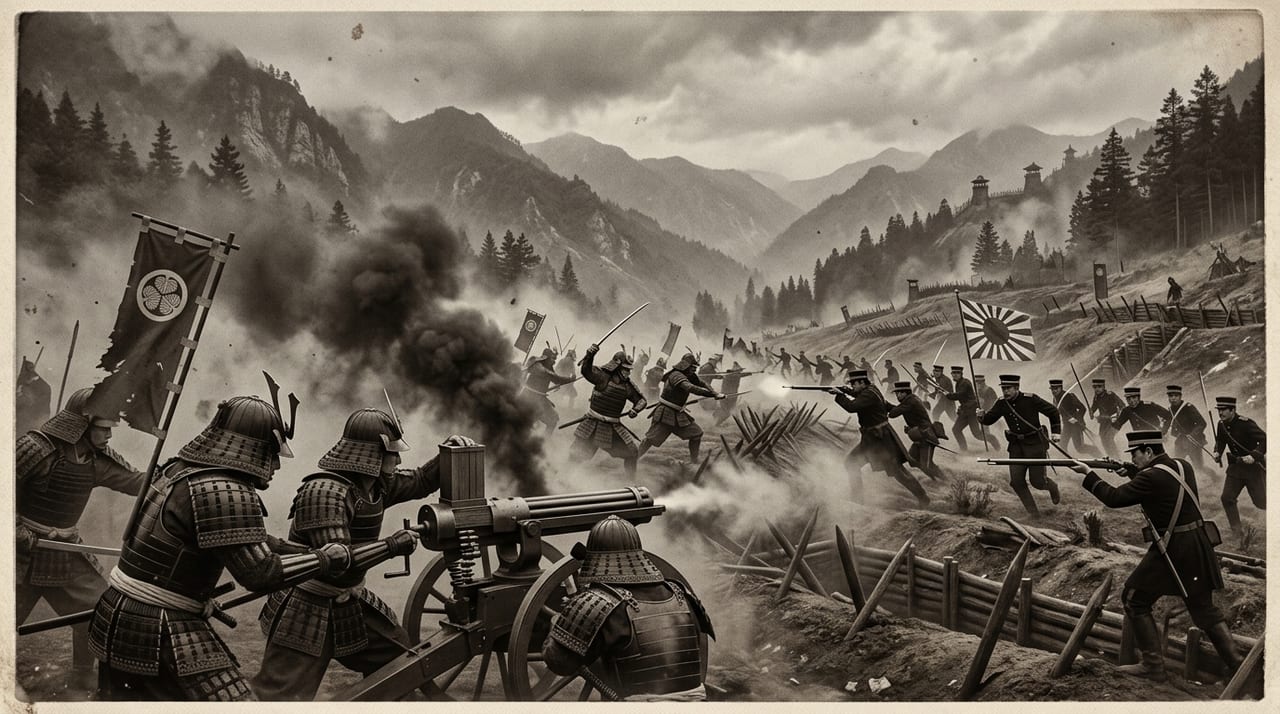
Tsugunosuke's deployment of Gatling guns in actual combat is recorded in history as one of the earliest such uses in Japan. The Gatling gun was a multi-barreled rotary machine gun developed in America in the 1860s, and Tsugunosuke purchased two of them through a foreign trading house in Yokohama. The introduction of this advanced weapon embodied a strange marriage of the samurai spirit and modern weaponry.
After Tsugunosuke took office as chief retainer, a large-scale reform of the domain government was carried out in Nagaoka. Tsugunosuke's energy in carrying out these measures in a short time, namely restoring the finances, recruiting capable people, and introducing Western weapons and military reform, made him outstanding among the samurai statesmen of the late Tokugawa period.
The two Gatling guns purchased by the Nagaoka domain were the most advanced weapons in Japan at the time. The purchase was a considerable financial burden on the domain, but Tsugunosuke carried it out, holding the conviction that “a domain cannot be defended without modern weapons.” As the man who bore the transition from an age of spirit, symbolized by the sword, to an age of power, dominated by the gun, at the front lines of the domain, Tsugunosuke left a distinctive mark on Japanese history.
In the early part of the 5th month of Keiō 4 (1868), peace negotiations were held at Jigen-ji in Ojiya between the new government forces, who had invaded Echigo, and the Nagaoka domain (the Ojiya negotiations). Kawai Tsugunosuke attended as the representative of the Nagaoka domain and argued for neutrality, meaning a position of not taking sides. However, Iwamura Seiichirō, the representative of the new government forces, rejected this.
Tsugunosuke's position was that the Nagaoka domain was on neither side and asked to be allowed to choose not to fight in order to protect the people of Echigo. However, for the new government forces, which upheld the cause of overthrowing the shogunate, the option of neutrality did not exist. The negotiations broke down, and the Nagaoka domain chose the path of fighting the new government forces.
The scene of the Ojiya negotiations is remembered as a particularly symbolic moment in late Tokugawa history. Tsugunosuke's choice to try to avoid war through negotiation, and the regret at its failure, are themes that many writers and historians have continued to portray.
After the talks broke down, the Nagaoka domain set up its headquarters at Kōfuku-ji in Settaya, attacked Enoki Pass, where the new government forces were stationed, and seized it. The Nagaoka troops had received modern training and were armed with the latest weapons, and at the start of the war they fought on even terms with the large forces of the new government.
However, on the 19th day of the 5th month of Keiō 4 (1868), the new government forces crossed the Shinano River and made a surprise attack on the thinly defended castle town of Nagaoka. Nagaoka Castle fell in only half a day. Tsugunosuke kept fighting while retreating. From the evening of the 24th day of the 7th month of Keiō 4 (1868), he carried out a surprise crossing of the swampy Hatchō-oki marsh, and on the following day, the 25th, he temporarily retook Nagaoka Castle. This “recapture of Nagaoka Castle” is told as one of the greatest miracles of the Boshin War.
However, the recapture did not last long. Four days later, on the 29th day of the 7th month of Keiō 4 (1868), Nagaoka Castle fell again. Tsugunosuke had been shot in the leg during the battle to retake the castle and was seriously wounded.
What Tsugunosuke embodied was the contradictory ideal of practicing the spirit of the age of the sword with the weapons of the age of the gun. While wielding modern firearms, he never bent a whit from his pride as a samurai or his loyalty to the domain. His attitude was one answer that the samurai of the late Tokugawa period gave to the question of how to live and how to die.
In the battles of the Nagaoka domain, there are only limited records of swords being used in actual combat, but the domain's retainers never let go of their swords. Although the sword gave up its role as a practical tool in battle to the rifle, it remained worn at the waist until the end as a symbol of the samurai and their pride.
That Tsugunosuke, raised as a samurai, took up firearms at the last and fell to a bullet is recorded as a symbolic event of the late Tokugawa period.
Badly wounded, Tsugunosuke attempted to head for Aizu by way of the Hachijūri-goe pass through the mountains of Echigo, but he died on the 16th day of the 8th month of Keiō 4 (1868) at Shiozawa in Tadami, Fukushima Prefecture, along the way. He was 42 years old. His final moments are told as legend, and he has become the pride of Nagaoka's citizens as “the samurai who kept fighting to the end.”
Tsugunosuke's grave at Shiozawa is still visited by many worshippers. Nagaoka City also has the Kawai Tsugunosuke Memorial Museum, which displays items and materials related to Tsugunosuke.
After Tsugunosuke's death, the Nagaoka domain surrendered shortly afterward. The Ōuetsu Reppan Dōmei also moved toward collapse, and the domains of the Tōhoku region surrendered to the new government one after another. The Nagaoka domain was ordered to accept a large reduction in its kokudaka (assessed rice yield). However, after the Meiji period, people from Nagaoka were active in business, politics, and the military, and the “Nagaoka spirit” has been passed down to the present day.
Viewed from the perspective of the history of swords in Japan, the Hokuetsu Boshin War is a symbolic battle of the transition “from sword to gun.” In this battle, the modern weapon of the Gatling gun was fully deployed on Japanese battlefields for the first time. It announced both the end of the age of the samurai and the dawn of modern warfare.
Even so, the retainers of the Nagaoka domain continued to wear their swords until the end. Although swords were losing their standing as practical weapons, they continued to function as the spiritual pillar of the samurai. Eight years later, the Haitōrei (Sword Abolishment Edict) of Meiji 9 (1876) prohibited samurai from openly wearing swords. The Hokuetsu Boshin War is a page not to be forgotten from the last era in which Japanese samurai fought with swords at their waists.
Kawai Tsugunosuke's way of life is still told to many people today as proof of a samurai who lived through both the spirit of the sword and the age of the gun at once. Tsugunosuke, who in an age of transition did not abandon the bushidō spirit symbolized by the sword, yet squarely faced the changes of the times, can be said to have helped shape one of the archetypes of the Japanese view of bushidō.