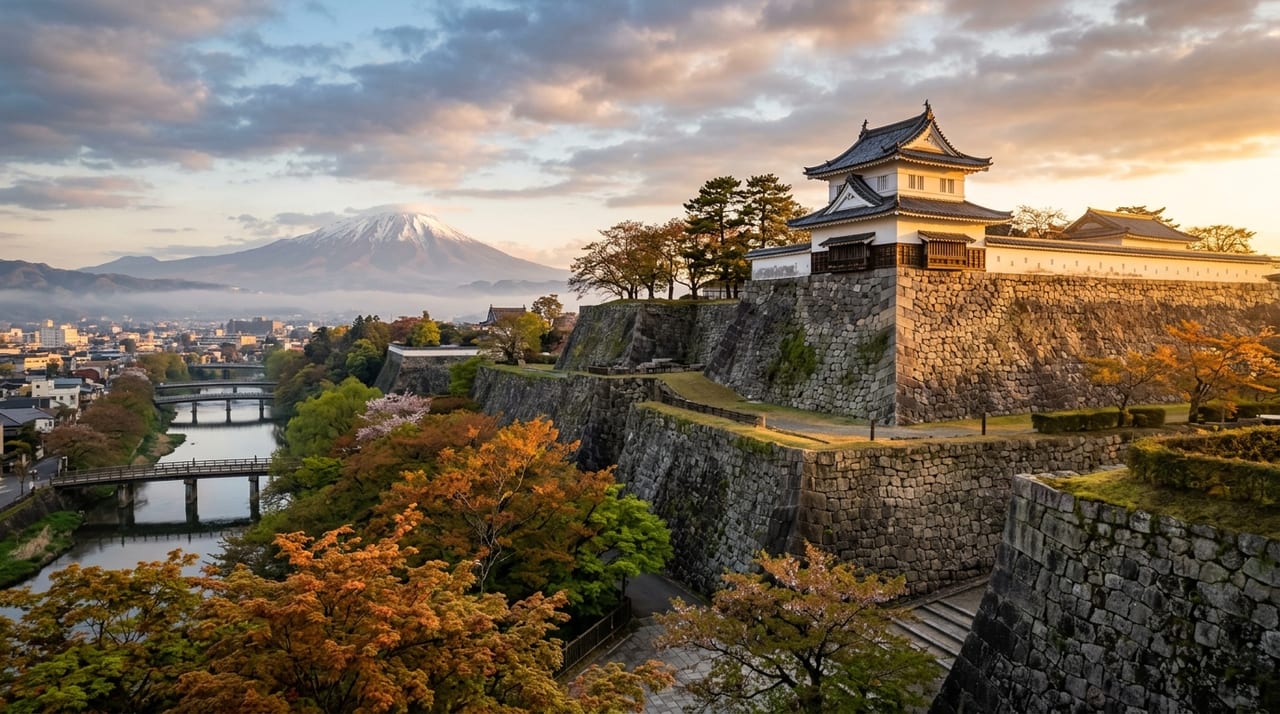
 * Image is for illustrative purposes only.
Morioka Castle (Kozukata Castle)
盛岡城(不来方城)
Morioka Castle (Kozukata Castle) is a historic castle in the Tōhoku region (Construction began 1598 (Keichō 3)). Its lord was Nanbu Nobunao / Nanbu clan.
Overview
About the Castle
Morioka Castle (Kozukata Castle) is a grand stone-walled castle whose construction Nanbu Nobunao began in Keichō 3 (1598) at Kozukata, near the confluence of the Kitakami and Nakatsu rivers. The entire castle was completed in Kan'ei 10 (1633). The Nanbu clan was one of Tōhoku's leading great domains, ruling vast territories spanning Iwate, Aomori, and Akita. Their history is colored by pride as a noble house descended from the Kai Genji and by tales of martial prowess. The castle name Kozukata is said to derive from 'kozukata' (the direction from which people do not come), or from the ancient fact that people did not settle in this place. It still conveys the mysterious resonance of a northern place name. Nanbu Nobunao had long envisioned a new main castle, and he judged that the site where the Kitakami and Nakatsu rivers meet was the finest location in three respects: transportation, defense, and the formation of a castle town. Even after Toyotomi Hideyoshi unified the realm, the Nanbu clan had its domain confirmed, and Nobunao poured his remaining resources into the castle-building project.
Architecture and the Beauty of Stone Walls
The greatest feature of Morioka Castle is the magnificent beauty of its stone walls. Built with abundant granite from the Kitakami highlands, the walls in the nozura-zumi, uchikomi-hagi, and kirikomi-hagi techniques are a precious architectural heritage in which the changes of period and technique can be seen within a single castle. The stone walls of the honmaru and ninomaru in particular reach more than ten meters in height, forming a spectacular stone-wall landscape that stands out among castles in Tōhoku. The castle's layout is a renkaku-shiki structure of honmaru, ninomaru, sannomaru, and koshi-kuruwa, and a robust design in which the Kitakami and Nakatsu rivers function as natural moats. Out of deference to the shogunate, a formal tenshu was not built. The Go-sankai yagura was used in its place and was later renamed tenshu. However, most structures were dismantled in the early Meiji period. What did the lost tenshu look like? Based on surviving drawings and documents, it is presumed to have been a tenshu of about three stories, but its full appearance remains shrouded in mystery. Today the site is maintained as Iwate Park, where the seasons (spring cherry blossoms, fresh summer greenery, and autumn foliage) are beloved by citizens.
The History and Pride of the Nanbu Clan
Throughout the Sengoku period, the Nanbu clan reigned as the overlords of northern Tōhoku, even while having internal strife among its branches, including the Tsugaru, Tago, and Ichinohe families. The Rebellion of Kunohe Masazane in Tenshō 19 (1591) was the greatest internal conflict of the Nanbu clan. Kunohe Masazane resisted to the end at Kunohe Castle and surrendered to Toyotomi Hideyoshi's great army. This conflict made Nanbu control firm, but it was also a tragedy in which many samurai lost their lives. In the Edo period, well-maintained roads for the sankin-kōtai system ran from Morioka to Edo, and the Nanbu clan's fame as a horse-breeding region grew. Nanbu horses were known throughout the country as fine horses and were indispensable to samurai cavalry warfare. The distinctive folk house called Nanbu magari-ya, where horses and people lived together, also reflects the Nanbu spirit of valuing horses as the companions of samurai.
Nanbu Ironware and Craft Culture
Morioka is world-famous as a production center of Nanbu ironware. Its heavy iron kettles and teapots receive the highest acclaim overseas, and they are among the representative Japanese crafts. The technique of Nanbu ironware developed in the early Edo period under the patronage of the Nanbu domain. The second domain lord, Nanbu Shigenao, was fond of the tea ceremony, so craftsmen who made tea kettles were invited to Morioka. Their technique is said to have expanded into the manufacture of iron kettles and braziers.
The Castle of Poets
From the castle ruins, one can gaze at a magnificent view of Morioka's cityscape and Mount Iwate (Nanbu Fuji), and experience the landscape of Morioka that the poets Ishikawa Takuboku and Miyazawa Kenji loved. Takuboku composed the poem 'Lying on the grass of Kozukata's castle, my fifteen-year-old heart drawn up into the sky,' and in verse he left the memory of his boyhood, when he lay on the grass of the castle ruins and gazed up at the blue sky. Miyazawa Kenji also studied at Morioka Middle School (now Morioka First High School) and carved the castle-town scenery into his heart. He drew from Morioka's nature one of the sources of the unique cosmology symbolized by 'Night on the Galactic Railroad.' The communion between this castle and these poets adds literary sentiment to the castle as a legacy of martial prowess, making Morioka Castle an even deeper place. Morioka is both a 'city of martial arts' and a 'city of letters,' having produced giants of Japanese literature and linguistics: Ishikawa Takuboku, Miyazawa Kenji, and Kindaichi Kyōsuke. The delicate sensibilities of the poets who lived in the castle town were nurtured in the tension created by the rugged stone walls of the rocky hill and the majestic nature of Ōshū. Morioka's cultural soil, where the martial and the literary coexist, also resonates deeply with the aesthetic of the Japanese sword, which finds beauty in the blade as a weapon.
The Nanbu Clan's Balance of Martial and Literary Arts, and Swords
The Nanbu clan was a noble house of Ōu based in Sannohe (Aomori Prefecture), and it was a distinguished samurai family rooted in Tōhoku as a vassal of the Kamakura shogunate. The spirit of the Ōshū samurai who continued to guard the castle under successive Nanbu domain lords lives on in the land of Kozukata today. It deeply moves all who visit the ruins of Morioka Castle.
Connection to Swords
The relationship between the Nanbu clan and swords can be understood from two angles: the geographic advantage of being in Tōhoku's premier iron-producing region, and the spiritual dimension of the clan as leaders of the samurai. The Nanbu domain has long been known as a place that produces good iron, and sword forging using that iron was an important foundation supporting Nanbu samurai culture. The Nanbu clan experienced many battles throughout the Sengoku period, and each time it required the finest swords. In the conflict with the Tsugaru family and the Kunohe Rebellion (Tenshō 19 / 1591), Nanbu samurai fought at the risk of their lives, and their swords were inscribed with loyalty to their lord and samurai pride. Even at the end of the Edo period (bakumatsu), Morioka domain samurai carried swords and took part in the Boshin War, fighting on the former shogunate's side against the new government forces. Considering the technical lineage of Nanbu ironware, one can say that Morioka is one of the cities in Japan that most deeply embodied the 'culture of iron and swords.'
Highlights
- Massive stone walls of the honmaru and ninomaru: a granite stone-wall landscape of the highest standard in Tōhoku
- Cherry blossoms at Iwate Park: a famous Morioka hanami spot where Somei Yoshino trees bloom in profusion
- Ishikawa Takuboku poem monument: a monument inscribed with the celebrated poem 'Lying on the grass of Kozukata's castle'
- Nanbu ironware workshop district: Morioka's cast-iron craft, admired worldwide
- Wanko soba, Morioka reimen, and Morioka jajamen: Morioka's three great noodle dishes, staples of castle-town cuisine
* Opening hours and admission fees are subject to change. Please check the official website before visiting.