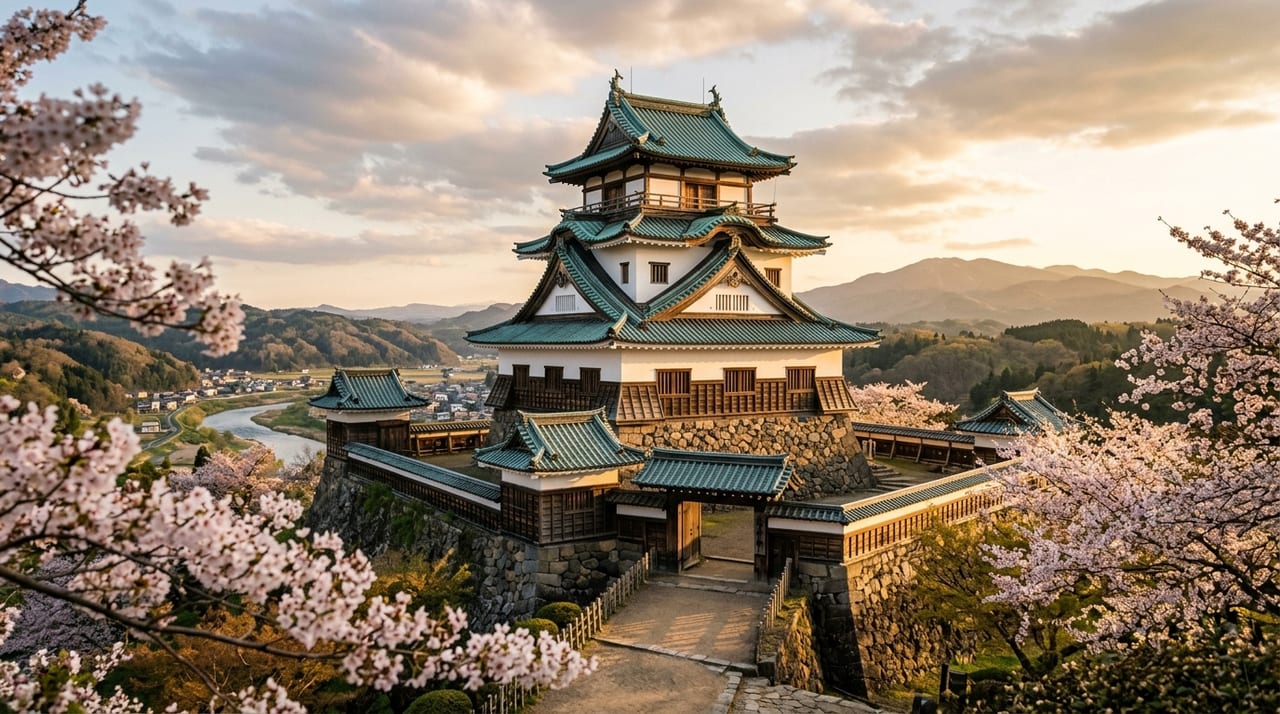
 * Image is for illustrative purposes only.
Shiroishi Castle
白石城
Shiroishi Castle is a historic castle in the Tōhoku region (Year of construction unknown (renovated into an early-modern castle by Gamō Satonari after Tenshō 19 (1591))). Its lord was Katakura Kagetsuna (Kojūrō).
Overview
About the Castle
Shiroishi Castle is a hirayama-style castle built on the northern tip of an isolated hill in the Shiroishi Basin, in Shiroishi City, Miyagi Prefecture (elevation 76 meters). It is renowned as the castle held by Katakura Kagetsuna (Kojūrō), a clever strategist known as the right hand of Date Masamune, and it occupied an important strategic position as the southern guard of the Date family. The current three-tier, three-story wooden main tower was fully rebuilt in wood based on historical records in Heisei 7 (1995), and it is highly regarded as an outstanding example of a reconstructed wooden main tower. Shiroishi Castle is also called the “three-story turret” (sankai yagura), and although it is not formally a “tenshu” (main keep), its imposing appearance has the dignity of a splendid main keep.
The Life of Katakura Kojūrō Kagetsuna
Katakura Kagetsuna (1557–1615) was the younger brother of Kita, Date Masamune’s wet nurse, and supported Masamune his entire life as the most trusted of his close aides. Kagetsuna was a clever strategist known within the Date house as the “Wise Katakura,” and he is said to have been skilled in swordsmanship as well. During the Odawara campaign he advised Masamune to submit to Toyotomi Hideyoshi, and he is known for sound counsel. During the Battle of Sekigahara, he followed Masamune and fought against the Uesugi forces (Battle of Shiroishi Castle). Shiroishi Castle was developed as Kagetsuna’s residence and became an important political and diplomatic hub of southern Ōu, serving as the southern gateway of the Date family.
Katakura Shigenaga, the Osaka Campaigns, and Sanada Yukimura
Katakura Shigenaga, son of Katakura Kagetsuna, is famous as the commander who clashed with Sanada Yukimura (Nobushige) at the Osaka campaigns. At the Osaka campaigns, Shigenaga fought valiantly, and through achievements such as slaying Gotō Mototsugu, he was called “Oni no Kojūrō” (Demon Kojūrō). After the war, Oume, daughter of Sanada Yukimura (Nobushige), became Shigenaga’s second wife, and through that connection, Yukimura’s son Daihachi (later Katakura Morinobu) and daughter Oshōbu are said to have also relied on the Katakura house. This human bond between the “Sanada family after the fall of Osaka” and the “Katakura family” has been passed down through the ages as a tale conveying the sense of duty and compassion between former enemies of the Sengoku period, and even today it is a reason both Sanada fans and Date fans visit Shiroishi Castle.
Shiroishi’s Land, Industry, and Culture
Since ancient times, Shiroishi has been known as a producing area for Shiroishi washi and Shiroishi ūmen noodles, and the industrial culture of the castle town developed richly. Shiroishi ūmen are thin noodles made without oil, and there is a legend that Suzuki Asaemon of Shiroishi devised them for his father, who had a weak stomach; they remain widely loved today as a Shiroishi specialty. “Hitome Senbon Zakura” along the Shiroishi River embankment, running from Ōgawara Town to Shibata Town on the lower reaches of the Shiroishi River, is renowned as one of Japan’s representative cherry-tree avenues, and many tourists visit during the spring cherry blossom season. The wooden main tower of Shiroishi Castle is especially beautiful in cherry blossom season, and the contrast of “white castle and cherry-blossom pink” has become a scene representing spring in Miyagi.
The Significance of the Reconstructed Wooden Main Tower
The reconstructed wooden main tower of Shiroishi Castle, completed in Heisei 7 (1995), boasts a high level of finish, faithfully reproducing the architectural techniques, materials, and construction methods of the Edo period as closely as possible. It also attracted attention in the worlds of Japanese architectural history and castle studies as a model case for reconstructed wooden main towers. At the adjacent Shiroishi Castle History Exploration Museum, the history of Shiroishi Castle and the Katakura family is introduced.
Connection to Swords
The connection between Shiroishi Castle and swords can be discussed through the sword culture of Katakura Kagetsuna and Shigenaga, father and son, who were among the foremost commanders of the Date family, and through the history that Shiroishi Castle accumulated as the Katakura family’s residence. Katakura Kagetsuna was a clever strategist known as “the Wise Katakura,” and he is said to have been skilled in swordsmanship as well. When Katakura Shigenaga clashed with Sanada Yukimura at the Osaka campaigns, he fought a fierce close-quarters battle against the Sanada troops. After this Battle of Dōmyōji, Yukimura, resolved to die, is said to have entrusted his young children to Katakura Shigenaga, and Shigenaga protected Yukimura’s daughter Oume and his son Daihachi (later Sanada Morinobu). Morinobu later entered the service of the Sendai Domain and continued as the Sendai Sanada family. In southern Ōu, where Shiroishi Castle is located, swordsmiths who made blades under the patronage of the Sendai Domain also were active. Shiroishi Castle has become a multifaceted historical site beloved by three communities: Sanada fans, Date fans, and sword enthusiasts.
Highlights
- Fully wooden reconstructed main tower — The wooden main tower built in 1995 is a masterpiece of reconstructed architecture. The adjacent history exploration museum introduces the history of the Katakura family
- Shiroishi River embankment “Hitome Senbon Zakura” — a cherry-tree avenue of about 1,200 trees running from Ōgawara Town to Shibata Town
- Historic sites associated with Katakura Kojūrō Kagetsuna and Shigenaga — a historical walk following the story of the bond between the Date’s right-hand man and the Sanada family
- Shiroishi ūmen — oil-free thin noodles, a Shiroishi specialty with a tradition of more than 400 years
- Shiroishi washi — a traditional craft of the Tōhoku region. Workshop tours that let visitors experience the industrial culture of the Shiroishi castle town are also popular
- Obara Onsen — a quiet hot-spring area within Shiroishi City, ideal for a leisurely hot-spring stay after exploring the history
* Opening hours and admission fees are subject to change. Please check the official website before visiting.