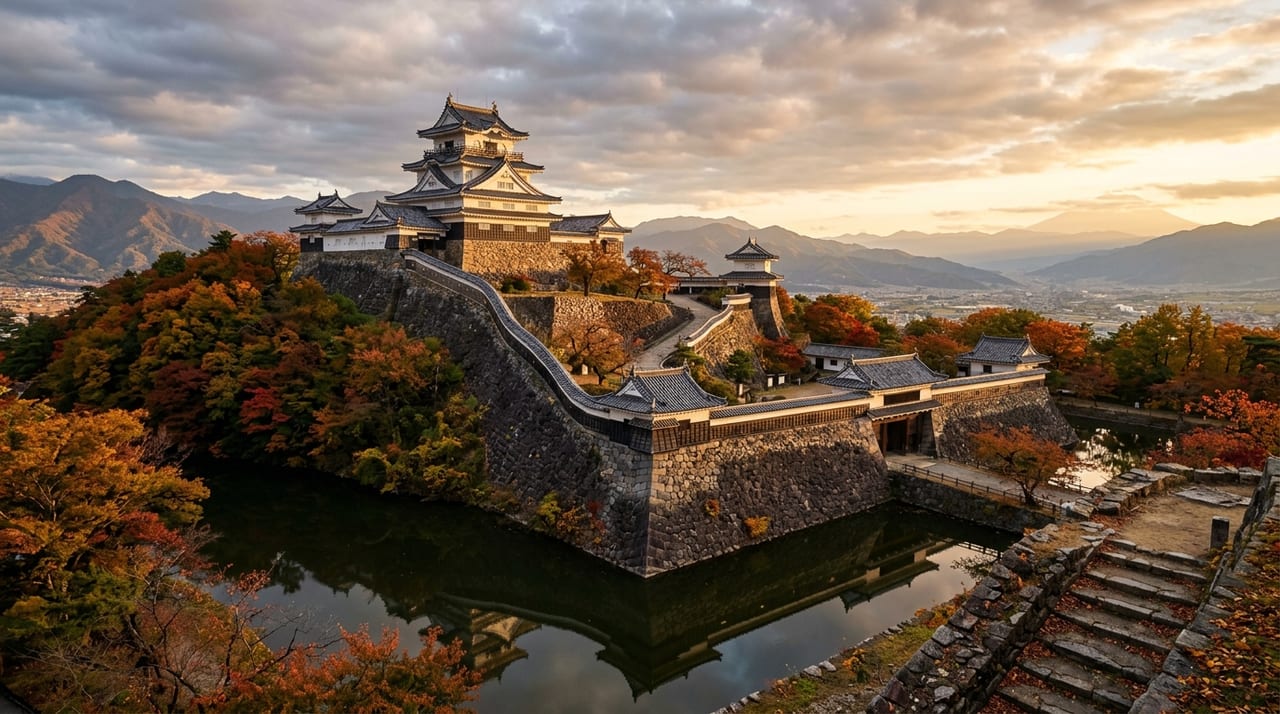
 * Image is for illustrative purposes only.
Shichinohe Castle (Kashiwaba Castle)
七戸城(柏葉城)
Shichinohe Castle (Kashiwaba Castle) is a historic castle in the Tōhoku region (Northern and Southern Courts period to Meiji (late 14th century–1873, when the castle was abandoned)). Its lord was Shichinohe Clan (Nanbu Clan branch) → Nanbu Clan → Shichinohe Domain (Nanbu Clan sub-domain).
Overview
Construction and the Origins of the Shichinohe Clan
Shichinohe Castle was a hirayama-jō (a hill castle built on a plateau near the plains) constructed on a terrace about 40 meters high, near the confluence of the Sakuta River and the Wada River in Kita District, Mutsu Province (present-day Shichinohe Town, Kamikita District, Aomori Prefecture). It is also known as Kashiwaba Castle. The date of construction and the builder are disputed. A tradition handed down since early times credits Nanbu Masanaga with building it, but recent archaeological research has made the theory that Nanbu Masamitsu built it in the latter half of the 14th century the leading view. The Shichinohe clan, the castle's lords, is said to have been a branch of the Nanbu clan, which held estates in Mutsu from the Kamakura period. A family originating from the Nanbu estate in Kai Province is said to have moved to the area and ruled the Shichinohe lands.
Activities During the Nanboku-chō Period
During the Nanboku-chō period, Shichinohe Castle, together with Hachinohe Nejō, served as a major stronghold on the Southern Court side and showed its political and military importance in northern Tōhoku. In this period, branches of the Nanbu clan in northern Ōu each established strongholds in various places and maintained their own spheres of influence. The Shichinohe clan kept a certain distance from the Nanbu main house and survived as a powerful local family.
The Kunohe Masazane Rebellion and Shichinohe Iekuni
The event singled out as the most important in the castle's history is the Kunohe Masazane Rebellion of Tenshō 19 (1591). Kunohe Masazane challenged the authority of the Nanbu main house and rose in revolt, and Shichinohe Iekuni sided with Masazane. The rebellion was suppressed by a large army dispatched under the order of Toyotomi Hideyoshi as part of the Ōshū Shioki, and Masazane was executed after surrendering. Shichinohe Iekuni was also held to account for supporting the rebellion; he was stripped of his lands and his house was destroyed, and Shichinohe Castle passed under the direct control of the Nanbu main house.
From the Edo Period to Abandonment and Restoration
Shichinohe Castle was dismantled in Tenshō 20 (1592), the year after the rebellion, but members of the Nanbu family continued to reside there. From Kanbun 4 (1664), a magistrate's office of the Morioka Domain was placed within the castle. With the return of the domains and registers in Meiji 2 (1869), Shichinohe Domain was established and its domain office was set up on the castle site. The domain was abolished in Meiji 4 (1871) with the abolition of the domains and establishment of prefectures, and the castle was abandoned in 1873. The castle remains retain the forms of earthen ramparts, moats, and enclosures, and the site was designated a National Historic Site in Shōwa 16 (1941). It is now developed and open to the public as Kashiwaba Park, where visitors can view the earthen ramparts and dry moats of the castle site.
Present Day
The Shichinohe Town Board of Education continues to carry out excavations. Excavations of the Kitadate have yielded artifacts mainly dating to the 15th century. Explanatory signboards for Shichinohe Castle have been installed in the castle park, and the site is used as a place to learn about the political history of northern Ōu from the Nanboku-chō period to the Sengoku period.
Connection to Swords
The Nanbu clan was a powerful warrior family in northern Mutsu Province, and the Shichinohe clan, which made Shichinohe Castle its base, was one of its branches.
Highlights
- Medieval hilltop castle, a national historical site known by the alternate name Kashiwaba Castle
- Southern Court stronghold during the Northern and Southern Courts period
- Historic site where Shichinohe Iekuni participated in the Kunohe Masasane Rebellion
- Headquarters of the Shichinohe Clan, a branch of the Nanbu Clan
- Developed and open to the public as Kashiwaba Park
* Opening hours and admission fees are subject to change. Please check the official website before visiting.