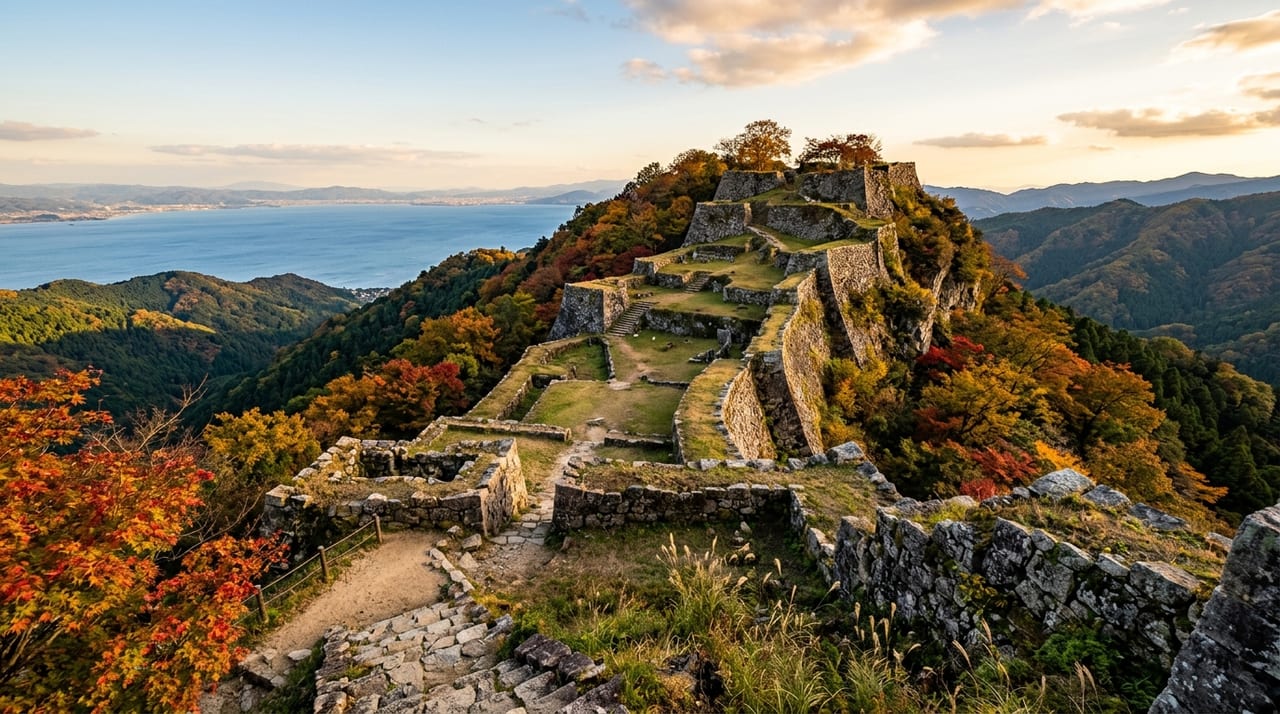
 * Image is for illustrative purposes only.
Namioka Castle
浪岡城
Namioka Castle is a historic castle in the Tōhoku region (Traditionally built around the Ōnin era (c. 1467); fell and was abandoned in 1578 (Tenshō 6)). Its lord was The Namioka Kitabatake clan (including its founder Kitabatake Akiyoshi).
Overview
Overview
Namioka Castle was a medieval hirayama-jiro (hill castle) in Namioka, Aomori City, Aomori Prefecture, and served as the stronghold of the Namioka Kitabatake clan, said to descend from Kitabatake Chikafusa and Akiie, who were active during the Nanboku-chō period. It was the first castle site in Aomori Prefecture to be designated a National Historic Site, and it has also been selected as one of the Continuation of the 100 Fine Castles of Japan.
Construction and the Namioka Kitabatake Clan
The date of construction is debated, with theories placing it in the Chōroku, Ōnin, or Bunmei eras; the Ōnin era (around 1467) is considered the most likely. It is said to have been built by Kitabatake Akiyoshi, the fourth-generation head of the Kitabatake clan. From then until the ninth generation, under Akimura, the castle served as the seat of the Namioka Kitabatake clan.
Structure
The designated site extends roughly 940 meters east-west and 245 meters north-south, covering an area of about 136,300 square meters. Within it, multiple baileys were divided by double moats 10 to 30 meters wide, including the Uchidate, Kitadate, Higashidate, Nishidate, Sarugakudate, Kengyōdate, and Shindate. The central Uchidate measures roughly 120 meters east-west and 85 meters north-south.
Fall and Abandonment
In 1578 (Tenshō 6), during the tenure of the ninth-generation head, Akimura, the castle was attacked by Ōura Tamenobu (later known as Tsugaru Tamenobu). It fell and was subsequently abandoned.
Designation and Excavations
On February 10, 1940, it became the first site in Aomori Prefecture to be designated a National Historic Site as "Namioka Castle Ruins." Excavations have been conducted continuously since fiscal year 1977, uncovering more than 50,000 artifacts, including tableware, cooking utensils, weapons, farming tools, everyday goods, and religious implements. The excavated ceramics include many Chinese-made celadon, white porcelain, and blue-and-white wares, which reflect the trading power and cultural sophistication of the Namioka Kitabatake clan. On April 6, 2017, it was selected as No. 103 in the Continuation of the 100 Fine Castles of Japan.
Present State and Access
The site is now maintained as a historical park where earthworks and moat remains can be seen. The adjacent "Aomori City Medieval Hall" displays excavated artifacts and estimated reconstruction models. It is about a 15-minute walk from Namioka Station on the JR Ōu Main Line, or about a 15-minute drive from the Namioka Interchange on the Tōhoku Expressway.
Highlights
- A stronghold of the Namioka Kitabatake clan, said to descend from the Kitabatake clan of the Nanboku-chō period, which held the castle until the ninth generation
- A hirayama-jiro divided into multiple baileys, including the Uchidate and Kitadate, by double moats 10 to 30 meters wide
- Designated as Aomori Prefecture's first National Historic Site in 1940
- Excavations have uncovered more than 50,000 artifacts, including Chinese-made ceramics
- Selected as No. 103 in the Continuation of the 100 Fine Castles of Japan; artifacts are displayed at the adjacent Aomori City Medieval Hall
* Opening hours and admission fees are subject to change. Please check the official website before visiting.