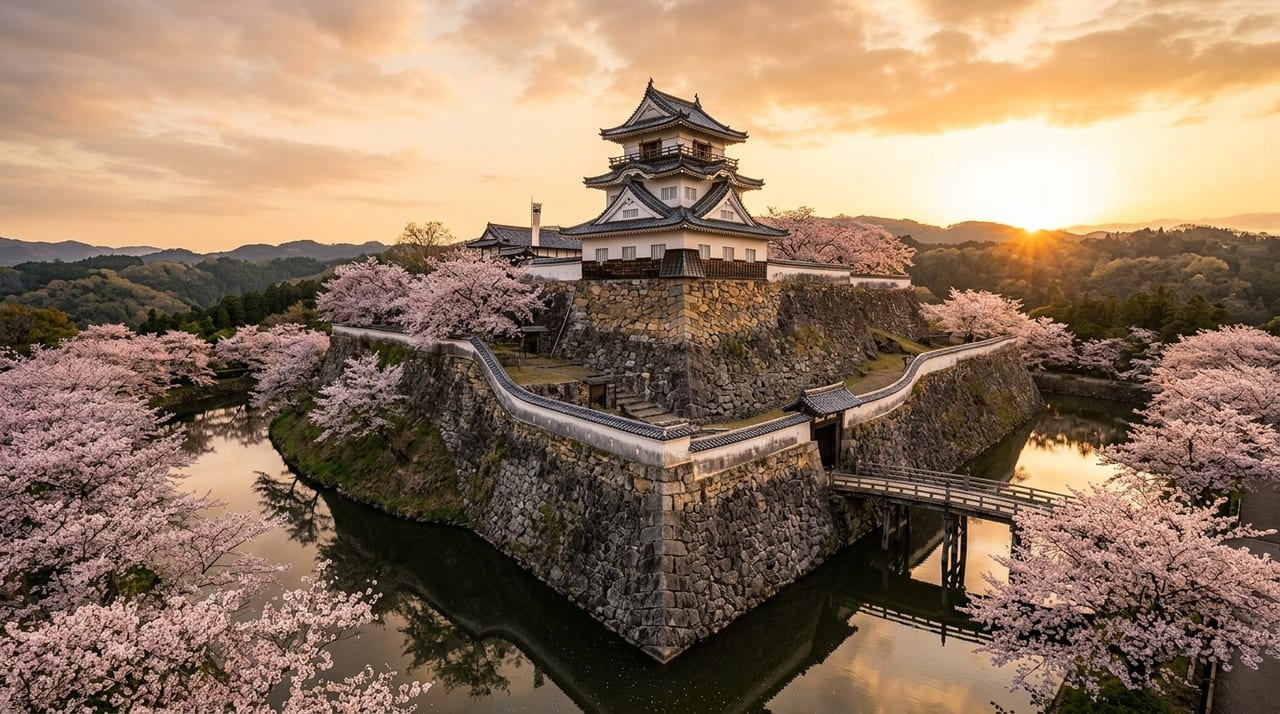
 * Image is for illustrative purposes only.
Mukaihaguroyama Castle
向羽黒山城
Mukaihaguroyama Castle is a historic castle in the Tōhoku region (Sengoku to Azuchi–Momoyama period (construction begun in 1561 and completed in 1568; decommissioned in 1601)). Its lord was Ashina Moriuji (builder), Ashina Moriaki, Moritaka and Yoshihiro, Date Masamune, Gamō Ujisato, and Uesugi Kagekatsu.
Overview
Overview
Mukaihaguroyama Castle was an immense mountain castle on Mt. Hakuhō in Aizumisato, Fukushima Prefecture. Spanning three peaks — Kannon-yama, Haguro-yama, and Iwasaki-yama — it measured roughly 1.4 km east to west and 1.5 km north to south, covering some 50 hectares, making it one of the largest Sengoku-period mountain castles in the Tōhoku region and indeed in all Japan.
Founding by Ashina Moriuji
Construction began in 1561 under Ashina Moriuji, sixteenth head of the family that ruled Sengoku-era Aizu, and took eight years to complete, finishing in 1568. Even after passing the headship to his son Moriaki, Moriuji retained real power and governed Aizu from this castle in retirement. Overlooking the Aga River and the Aizu basin and commanding the highway to the south, the mountain was also a strategic bulwark against the Uesugi of Echigo and rival powers of southern Mutsu.
The Fall of the Ashina and Later Rebuilding
In 1589 Ashina Yoshihiro was defeated by Date Masamune at the Battle of Suriagehara, the Ashina were destroyed, and Aizu passed to Masamune. Gamō Ujisato, installed after Toyotomi Hideyoshi's settlement of the northeast, and then Uesugi Kagekatsu, transferred to Aizu in 1598, both worked on the castle. The Uesugi in particular are said to have carried out a large-scale reconstruction between 1598 and the following year, designed for siege warfare and modelled on the Japanese-built castle of Ungcheon on the Korean peninsula. In 1601, when the Uesugi were transferred to Yonezawa after the Battle of Sekigahara, the castle was abandoned.
Structure and Remains
Around the first bailey at the summit, the second and third baileys, the Ochayaba bailey, and others sprawl across ridges and valleys. Baileys, earthworks, trench cuts, vertical moats, and stone walling all survive in good condition; the enormous trench cuts and the ranks of vertical moats in particular represent the culmination of late-Sengoku castle engineering. This was not an early-modern castle crowned by a tenshu but the fully realised form of a castle made from the terrain itself.
Connection with Swords
Uesugi Kagekatsu, the castle's last rebuilder, is known as a daimyo who inherited the famous blades handed down from Uesugi Kenshin and assembled many celebrated swords of his own. The sword register he compiled, the Uesugi Kagekatsu Koshimono Mokuroku, became the basis for the group of blades later known as the Uesugi-ke Ote-erabi Sanjūgo-koshi, the thirty-five swords personally selected by the Uesugi house. The thirty-five include two National Treasures, ten Important Cultural Properties, and ten Important Art Objects, most of which are still preserved in Yonezawa. Mukaihaguroyama was the frontier stronghold that Kagekatsu prepared during his years in Aizu.
Present State and Access
The site is maintained as Hakuhō Park, with walking trails and local volunteer guides available. The Mukaihaguroyama Castle Site Study Room (the Mukaihaguro Gallery) exhibits the results of excavation. The castle was designated a National Historic Site in 2001 and selected in 2017 among the Continuation of Japan's Top 100 Castles (No. 111).
Connection to Swords
Uesugi Kagekatsu, transferred to Aizu in 1598 and the last to rebuild this castle, is known as a daimyo who inherited the famous blades passed down from Uesugi Kenshin and gathered many celebrated swords himself. His sword register, the *Uesugi Kagekatsu Koshimono Mokuroku*, became the basis for the thirty-five blades later known as the *Uesugi-ke Ote-erabi Sanjūgo-koshi*, which include two National Treasures, ten Important Cultural Properties, and ten Important Art Objects, most of them still preserved in Yonezawa.
Highlights
- One of the largest Sengoku mountain castles in Tōhoku, about 1.4 km by 1.5 km and some 50 hectares in area
- The retirement castle Ashina Moriuji spent eight years building, begun in 1561 and completed in 1568
- Successively rebuilt by Date Masamune, Gamō Ujisato, and Uesugi Kagekatsu, the last adapting it for siege warfare on the model of Ungcheon Castle
- The frontier stronghold prepared by Uesugi Kagekatsu, who selected the thirty-five famous blades of the Uesugi house
* Opening hours and admission fees are subject to change. Please check the official website before visiting.