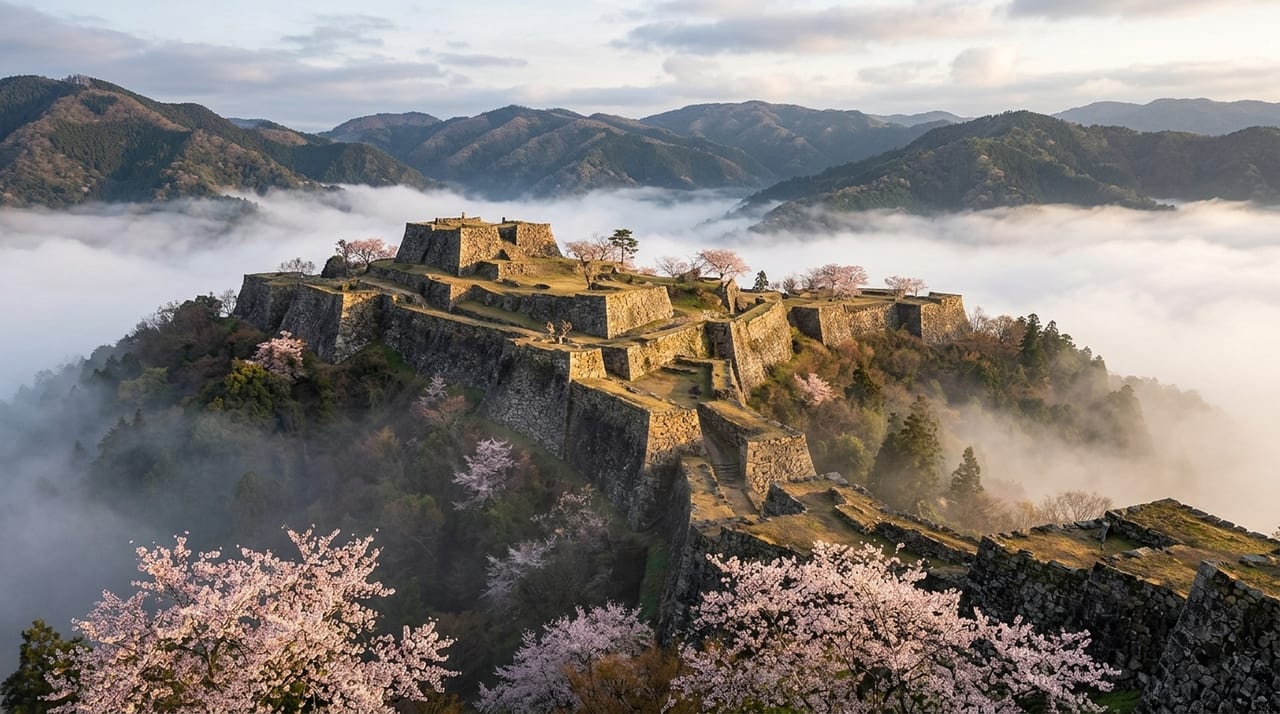
 * Image is for illustrative purposes only.
Kuroishi Castle
黒石城
Kuroishi Castle is a historic castle in Tōhoku dating from the Early Edo period to Meiji period (1656–1871; abandoned as a castle in 1871), whose lord was Tsugaru Nobuhide (first daimyo of Kuroishi Domain, subsidiary of Hirosaki Domain) and successive Tsugaru clan lords.
Overview
Kuroishi Castle was a hirajiro (flatland castle) built in Tsugaru District, Mutsu Province (present-day Kuroishi City, Aomori Prefecture), and served as the administrative seat (hankyo) of Kuroishi Domain, which was established as the Kuroishi-Tsugaru family, an alternate-attendance hatamoto (5,000 koku) branch fief separated from Hirosaki Domain in 1656 (Meireki 2). [The Kuroishi domain as a daimyo domain was officially established in 1809.] The Tsugaru region came under Tsugaru clan control after Tsugaru Tameshin, lord of Hirosaki, achieved independence from the Nanbu clan at the end of the Sengoku period. With the advent of the Edo period, subsidiary domains branched off from the main Tsugaru family's Hirosaki Domain were established throughout the region. Kuroishi Domain was founded when Tsugaru Nobuhide, second son of Tsugaru Nobutsugu, the second Hirosaki daimyo (and brother of the third daimyo Tsugaru Nobuyoshi), was granted 5,000 koku and established the Kuroishi-Tsugaru family as hatamoto. Kuroishi Castle served as the political and administrative center of this domain. The castle's structure followed the typical Edo-period hirajiro design, with the inner citadel (honmaru) at its center, surrounded by the secondary (ninomaru) and tertiary (sannomaru) citadels. No tenshu (castle keep) was built, but administrative facilities including a palace (goten), study hall (shoin), and long gate-house (nagayamon) were constructed to serve domain government functions. The castle town developed along the Asase River and became a commercial and distribution hub, serving as a waystation on routes connecting Hirosaki to the Nanbu territories. Though Kuroishi Domain was a small han with only 10,000 koku, its high status as a branch of the Tsugaru clan afforded its lords a place in the daimyo succession and required them to participate in the sankin kotai (alternate attendance) system. The castle town developed distinctive local cultures, including itokonnnyaku (vermicelli konjac), Kuroishi komise (an arcade shopping street), and Kuroishi yosare (local folk song). Today, Komise Street is designated as an Important Traditional Building Preservation District. With the Meiji Restoration's abolition of the han system in 1871 (Meiji 4), the castle was abandoned. Most of its buildings were removed, though portions of the earthen ramparts and moats remain. Today the site is maintained as a historic site park, with a museum displaying materials related to the Tsugaru clan and Hirosaki Domain. The Tsugaru region, alongside the Nanbu domain, was a major center of sword culture in northeastern Japan. The sword-collecting culture of the main Hirosaki branch influenced Kuroishi Domain as well. Lords from Tsugaru Nobuhide onward actively collected and appreciated famous swords, following the practices of daimyo culture in Edo. Smiths of the Tsugaru region supplied swords to the warrior classes of both Hirosaki and Kuroishi, contributing to the development of a sword-culture sphere in northeastern Japan. The areas around Kuroishi featured granite formations containing iron sand (satetsu), which served as a source of raw materials for iron production and sword-smithing throughout Tsugaru Domain.
Connection to Swords
The Tsugaru clan of Kuroishi Domain, like the main Hirosaki branch, placed great emphasis on sword culture, and records survive of daimyo personally collecting and appraising famous blades. Smiths of the Tsugaru region, influenced by Nanbu iron-making traditions but developing their own techniques, produced a wide range of swords—from practical fighting blades (uchigatana) to ceremonial tachi. The iron-sand deposits around Kuroishi supplied raw materials for Tsugaru smiths and supported the provision of swords to warriors in both Hirosaki and Kuroishi castle towns.
Highlights
- Administrative seat of Kuroishi Domain, subsidiary of Hirosaki Domain
- Edo-period cultural heritage of the Tsugaru region
- Komise Street, Important Traditional Building Preservation District
- Home of Kuroishi yosare and Tsugaru folk songs
- History of Tsugaru sword-smithing and iron-sand deposits
* Opening hours and admission fees are subject to change. Please check the official website before visiting.