 * Image is for illustrative purposes only.
Hirosaki Castle
弘前城
Hirosaki Castle is a historic castle in the Tōhoku region (Built in 1611 (Keichō 16)). Its lord was Tsugaru Tamenobu / Tsugaru clan.
Overview
About the Castle
Hirosaki Castle was first envisioned by Tsugaru Tamenobu, who unified the Tsugaru region, and was completed by the second lord, Tsugaru Nobuhira, in Keichō 16 (1611). It is the only surviving main keep in Tōhoku and a renowned castle. Tamenobu originally served as a retainer of the Nanbu clan, but during the Siege of Odawara in Tenshō 18 (1590), he boldly had a direct audience with Toyotomi Hideyoshi and was recognized as an independent daimyō, which gave him control of the Tsugaru region. This political skill became the foundation for the later prosperity of the Tsugaru family. A five-story main keep was built when the castle was first constructed, but it burned down after being struck by lightning in Kan'ei 4 (1627).
Architecture and Structure
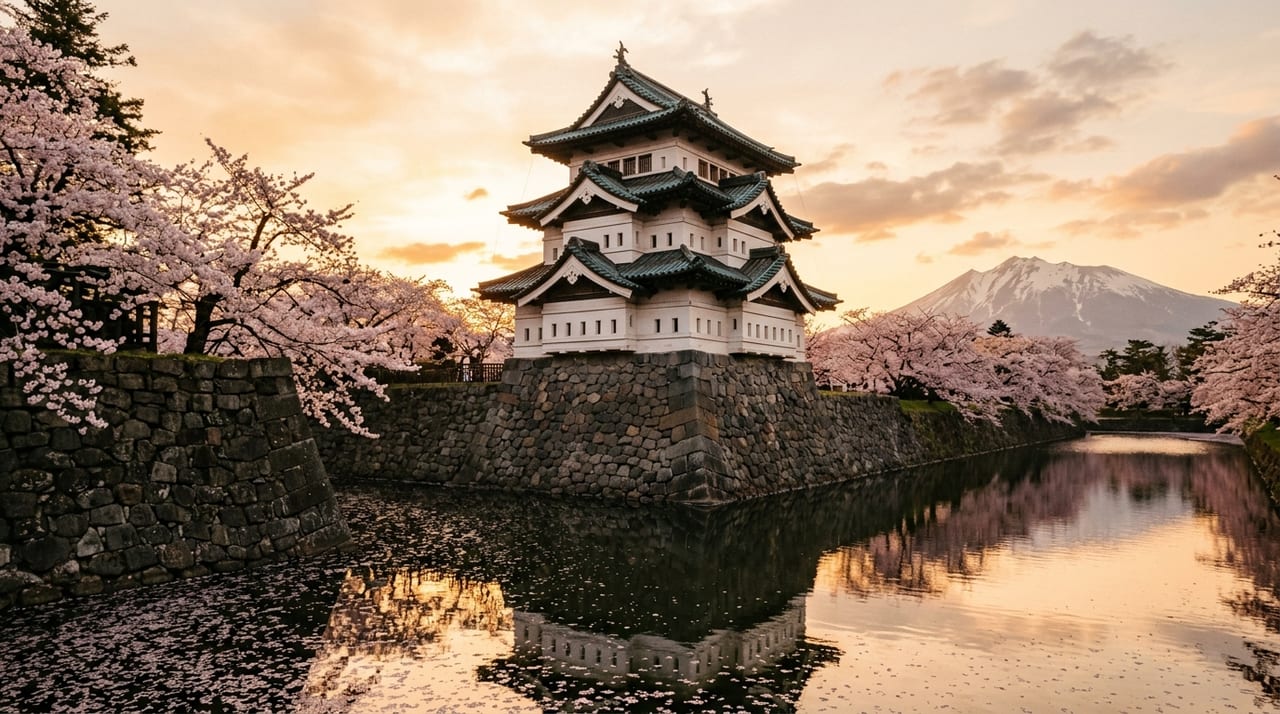
The current main keep was rebuilt in Bunka 7 (1810) by Tsugaru Yasuchika, the 9th lord, under the pretext of renovating the Tatsumi-yagura in the Honmaru. Its neat, three-tiered, three-story form makes it a representative example of castle beauty in Tōhoku. The domain reported to the shogunate that it was a "turret renovation," but in reality it was a rebuilding of the main keep, which shows the Tsugaru family's skillful political sense even here. Hirosaki Castle is known nationwide as a famous cherry blossom spot. In spring, approximately 2,600 Somei-yoshino, shidare-zakura, and yae-zakura trees bloom in full, coloring the castle grounds a pale pink.
Culture and Crafts
The sight of cherry petals floating on the surface of the outer moat, known as hanaikada, is recognized worldwide as one of the most beautiful spring scenes in Japan. The castle, viewed with Mount Iwaki in the background, leaves a deep impression on visitors as a landscape that condenses the climate and history of Tsugaru. To repair the stone walls of the Honmaru, the main keep was moved to a temporary keep base in 2015 (Heisei 27) in a hikiya (moving the building) operation. After the stone walls were repaired, it was moved back to the original keep base in 2026 (Reiwa 8).
Development of the Castle Town
Hirosaki Castle is a castle that has endured the harsh winters of the Tōhoku region, and the main keep covered in snow has a mysterious beauty distinct from its cherry blossom season. The simple, robust strength nurtured by the Tsugaru climate is the greatest appeal of this castle. During the Hirosaki Neputa Matsuri season (August), the castle town is swept up in excitement as giant fan-shaped lanterns painted with warrior pictures (musha-e) parade through the streets. This heroic festival is also a cultural heritage that conveys the spirit of the Tsugaru samurai to the present day. The Hirosaki domain also devoted itself to learning, establishing the domain school Keikokan and working to educate its retainers.
Connection to Swords
The tradition of the Tsugaru family, which excelled in both the literary and martial arts across generations, still lives on today not only in the castle but throughout the city of Hirosaki. Tsugaru Nobumasa, the 4th lord of the Hirosaki domain, is known as a ruler who encouraged both learning and martial arts.
Connection to Swords
The first lord, Tsugaru Tamenobu, was a warlord who became independent of the Nanbu clan and gained control of the Tsugaru region. In Hirosaki Park, the Hirosaki City Museum displays materials related to the Tsugaru family and the Hirosaki domain.
Highlights
- Extant main keep (Important Cultural Property) — the only surviving main keep in Tōhoku, with a neat three-tiered, three-story form
- Hirosaki Sakura Matsuri — approximately 2,600 cherry trees and hanaikada, one of Japan's foremost cherry blossom spots
- Hirosaki City Museum — located within Hirosaki Park, displaying materials related to the Tsugaru family and the Hirosaki domain from its collection
- Hikiya of the main keep — the main keep was moved in 2015 to repair the stone walls and moved back to the original keep base in 2026, a major undertaking
- Castle beauty with Mount Iwaki — a view of the castle with Mount Iwaki, known as Tsugaru Fuji
- Five surviving gates (Important Cultural Property), including the Ōtemon and Higashi-mon
* Opening hours and admission fees are subject to change. Please check the official website before visiting.