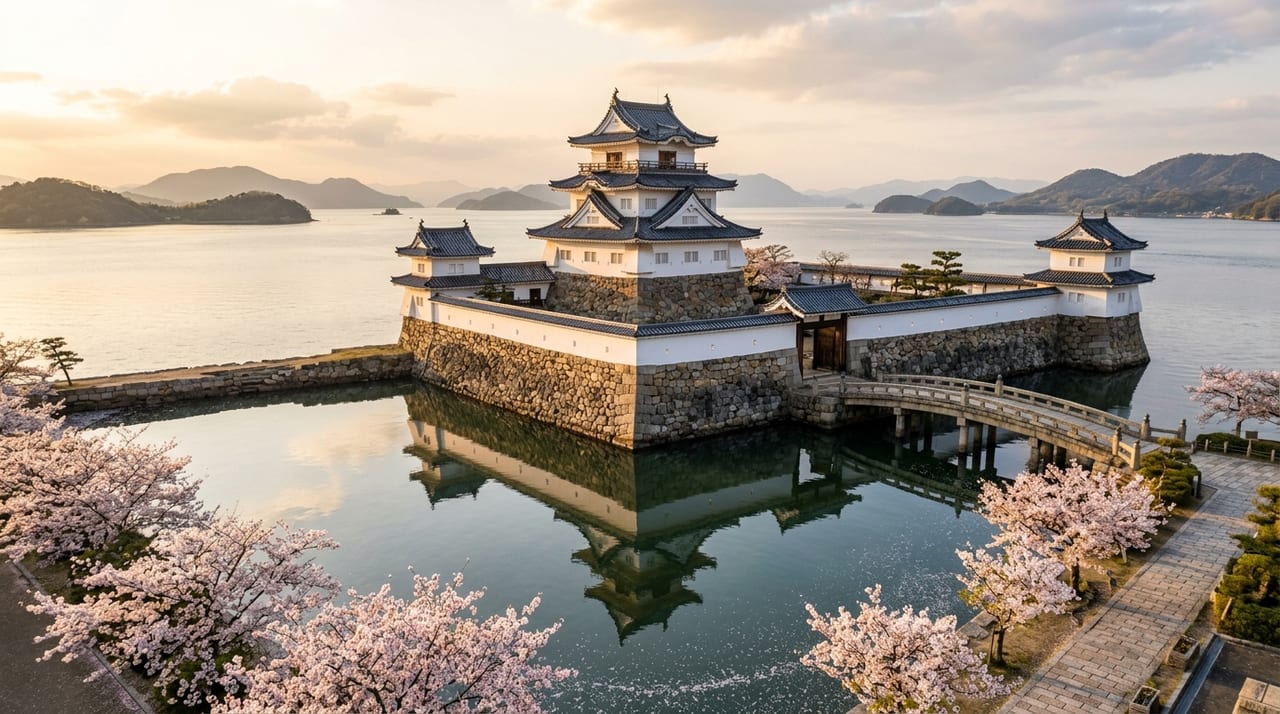
 * Image is for illustrative purposes only.
Hiyama Castle
檜山城
Hiyama Castle is a historic castle in the Tōhoku region (1456 (Kōshō 2) to 1620 (Genna 6), when it was abandoned). Its lord was Andō Masasue and his son Andō Tadaki (builders); five successive generations of the Hiyama Andō clan, later renamed the Akita clan.
Overview
Overview and Location
Hiyama Castle (Hiyama-jō) is a medieval mountain castle on Mt. Kiriyama (elevation 147 meters) in Hiyama, Noshiro City, Akita Prefecture. It served as the seat of five generations of the Hiyama Andō clan. The castle site includes Hiyama Castle itself along with the Ōdate, Chaōda, and Kokusenji temple ruins. On March 21, 1980, it was designated a National Historic Site as the "Hiyama Andō Clan Castle and Residence Ruins."
Construction and the Hiyama Andō Clan
In 1456 (Kōshō 2), Andō Masasue began construction of the castle. His son Andō Tadaki is said to have completed the renovations around 1495 (Meiō 4). From Tadaki onward, the castle served as the base of the Hiyama Andō clan for five successive generations. During this time, the clan expanded its power as a Sengoku daimyo that controlled maritime transport and trade in northern Tōhoku.
Union with the Minato Andō and Renaming to Akita
In the latter half of the 16th century, during the reign of head Chikasue, the Hiyama Andō absorbed their kinsmen, the Minato Andō clan. The Andō grew into a daimyo who ruled the northern part of Dewa Province. In 1589 (Tenshō 17), a large-scale siege known as the Minato Kassen broke out, stemming from internal strife within the household. The Andō eventually adopted the name Akita clan. In 1598 (Keichō 3), they moved their base to Minato Castle. After the Battle of Sekigahara, in 1602 (Keichō 7), they were transferred to Shishido in Hitachi Province.
Structural Features
The castle covers an extensive mountain site of approximately 1,500 meters east to west and 900 meters north to south. Numerous enclosures (kuruwa) are arranged in terraces, and the layout divides the ridgelines with ridge-cutting moats (horikiri). It is regarded as a remnant that shows the peak of medieval mountain castle construction technology in northern Tōhoku.
Current State and Highlights
The castle was abandoned in 1620 (Genna 6) under the shogunate's one-castle-per-domain policy. However, the ridge-cutting moats and terraced earthworks remain in good condition today. Noshiro City is developing the site as a historic park that includes the Hiyama Castle ruins. Together with the nearby Ōdate and Chaōda ruins, visitors can experience the base structure of the medieval Andō clan firsthand.
Highlights
- National Historic Site "Hiyama Andō Clan Castle and Residence Ruins" (1980)
- Seat of five generations of the Hiyama Andō clan, later renamed Akita
- Large mountain castle, 1,500m by 900m, with terraced enclosures and ridge-cutting moats
- Site of the union with the Minato Andō clan and the 1589 Minato Conflict
* Opening hours and admission fees are subject to change. Please check the official website before visiting.