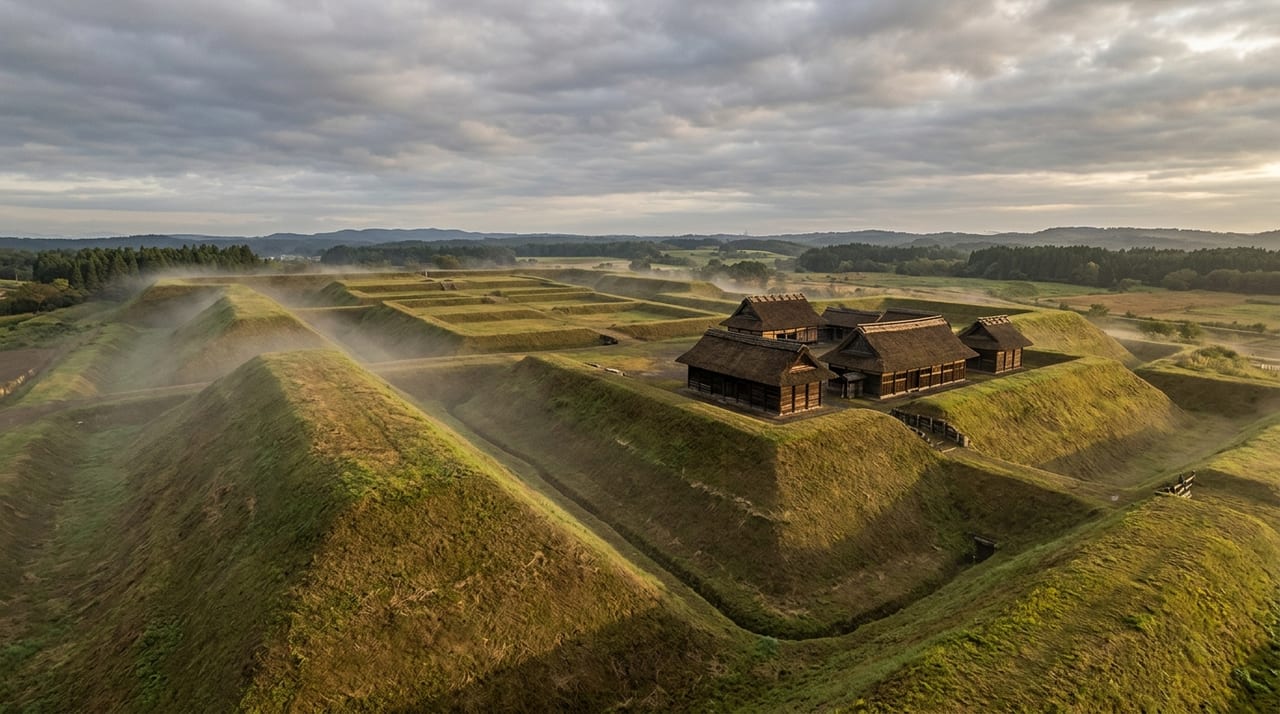
 * Image is for illustrative purposes only.
Nejō Castle
根城
Nejō Castle is a historic castle in the Tōhoku region (Founded in 1334 (Kenmu 1)). Its lord was Nanbu Moroyuki / Nanbu Clan.
Overview
About the Castle
Nejō Castle was built in Kenmu 1 (1334) by Nanbu Moroyuki, who came north during the upheaval of the Nanboku-chō period, accompanying Kitabatake Akiie, provincial governor of Mutsu, and served as kokudai of Nukanobu District. It is a medieval castle that represents northern Tōhoku. The Nanbu clan was a warrior house originating in Kai Province (Yamanashi Prefecture). By order of the Kamakura shogunate it acquired domains in Mutsu Province, put down roots in Tōhoku, and thereafter reigned for a long time as the rulers of the Nanbu region (present-day southern Aomori and northern Iwate Prefectures). As the stronghold of this Nanbu clan, Nejō continued to function as the political and military hub of northern Tōhoku throughout the Muromachi and Sengoku periods. The castle is a hirayama-jō located on the river terrace on the south bank of the Mabechi River at the western edge of Hachinohe's urban area, and has a layout of multiple enclosures defended by large earthen ramparts (doduki) and dry moats (karabori).
Architecture and Structure
Nejō's defining feature is that it is a purely medieval castle built only of earth and wood, without stone walls. The five enclosures of Honmaru, Nakadate, Tōzenji-date, Okamae-date and Sawasato-date lie in a line from east to west, a linear arrangement that preserves the typical style of medieval Tōhoku castles. Excavations carried out from the late Shōwa period into the Heisei period revealed the traces of building post holes, hearths, a well, and an armory, and the main buildings have since been reconstructed based on the excavation results. The reconstructed main residence, workshops, forge, and horse stables are recreated to represent the appearance of the Honmaru in the Azuchi-Momoyama period, making it one of the rare historic parks in Japan where visitors can experience the living space of medieval warriors. Of particular note is the excavated forge hearth, which confirmed that metalworking of weapons and farm tools was carried out within the castle.
Nanboku-chō and Sengoku History
Nanbu Moroyuki, as a loyal retainer of the Southern Court, supported Kitabatake Akiie in Ōu, and in Engen 2 (1337) accompanied Akiie's army on its march toward Kyoto. In Engen 3 (1338) Moroyuki was killed in action at the Battle of Ishizu (Izumi Province) together with Kitabatake Akiie, and his younger brother Masanaga inherited the Nanbu clan's position in Tōhoku. The Nanbu clan continued as a major power in northern Mutsu, surviving from the upheaval of the Nanboku-chō period through the Sengoku period. In the Sengoku period the Sannohe Nanbu clan rose as the main house, and a complex kinship relationship developed with the Hachinohe Nanbu clan (Nejō Nanbu clan). In Tenshō 18 (1590) the Nejō Nanbu clan (Hachinohe clan) was incorporated under the control of the Sannohe Nanbu clan. When Hachinohe Naoyoshi was moved to Tōno in Kan'ei 4 (1627), Nejō was abandoned.
Warrior Culture of Northern Tōhoku
The Nanbu region has long been renowned as a producer of horses, and the Nanbu horse was a superior breed rated among the finest military horses in Japan. The combination of this horse-breeding culture and warrior culture made the Nanbu clan one of the strongest military groups in northern Tōhoku. The Nanbu warriors, who governed a vast territory under a harsh climate, valued plain simplicity and frugal fortitude, and nurtured a distinctive warrior culture that prized practicality over ornament. This spirit also connects with the tradition of practical crafts represented by Nanbu ironware (Nanbu tetsubin).
Sightseeing and Experiences
The Nejō historic park (Nejō, Hachinohe City) is designated as a national historic site, and the reconstructed main residence, workshops, and forge can be visited for a fee. The adjoining Hachinohe City Museum offers detailed study of the history of Nejō and the Nanbu clan, and its exhibits cover a wide range of subjects from the Jōmon culture of northern Tōhoku to the modern period.
Connection to Swords
The forge workshop at Nejō is one of the most important archaeological pieces of evidence conveying the actual state of sword and weapon production in Japanese medieval castles. The forge hearths, iron slag (tessai), and tool traces discovered through excavation indicate that weapons were manufactured and repaired on a daily basis within the castle. For a medieval castle, having a forge workshop was a military necessity. To quickly repair swords, spears, bows, and horse gear damaged on campaign, smiths had to be stationed within the castle, and the forge workshop at Nejō performed exactly that function. To survive the fierce warfare of the Nanboku-chō upheaval, the Nanbu clan had to keep equipping and maintaining a variety of weapons, including swords, bows, and spears. The forces led by Moroyuki and his successors have records of campaigns from Ōu all the way to Kyoto, and carrying and maintaining weapons for long expeditions was a matter directly tied to life and death. The sword culture of the Nanbu clan placed greater value on practical sharpness and durability than on decorative splendor, embodying a plain aesthetic born of the harsh climate of northern Tōhoku and the combat experience of long expeditions. The Hachinohe City Museum displays iron products and weapons excavated at Nejō, and as valuable material conveying the reality of medieval sword production sites, it draws the attention of researchers and enthusiasts. The reconstructed forge workshop at Nejō is nearly unique nationwide as a facility where one can experience the environment in which medieval castle smithing functioned, and for sword enthusiasts it is a must-visit sacred site.
Highlights
- Reconstructed main residence, workshops, and forge — living space of medieval warriors recreated in the appearance of the Azuchi-Momoyama period
- Reconstructed forge workshop — a facility nearly unique nationwide that conveys the actual state of sword and weapon production within the castle
- Historic park — walk through the medieval castle remains of earthen ramparts and dry moats and experience them firsthand
- Hachinohe City Museum (adjacent) — history of the Nanbu clan, artifacts excavated at Nejō, and exhibits on northern Tōhoku history from the Jōmon period to modern times
- Nanbu ironware production center (Morioka) — the present-day form of Nanbu forging culture (about 2 hours by car)
- Tanesashi Coast / Kabushima Island black-tailed gull colony — scenic spots near Hachinohe
* Opening hours and admission fees are subject to change. Please check the official website before visiting.