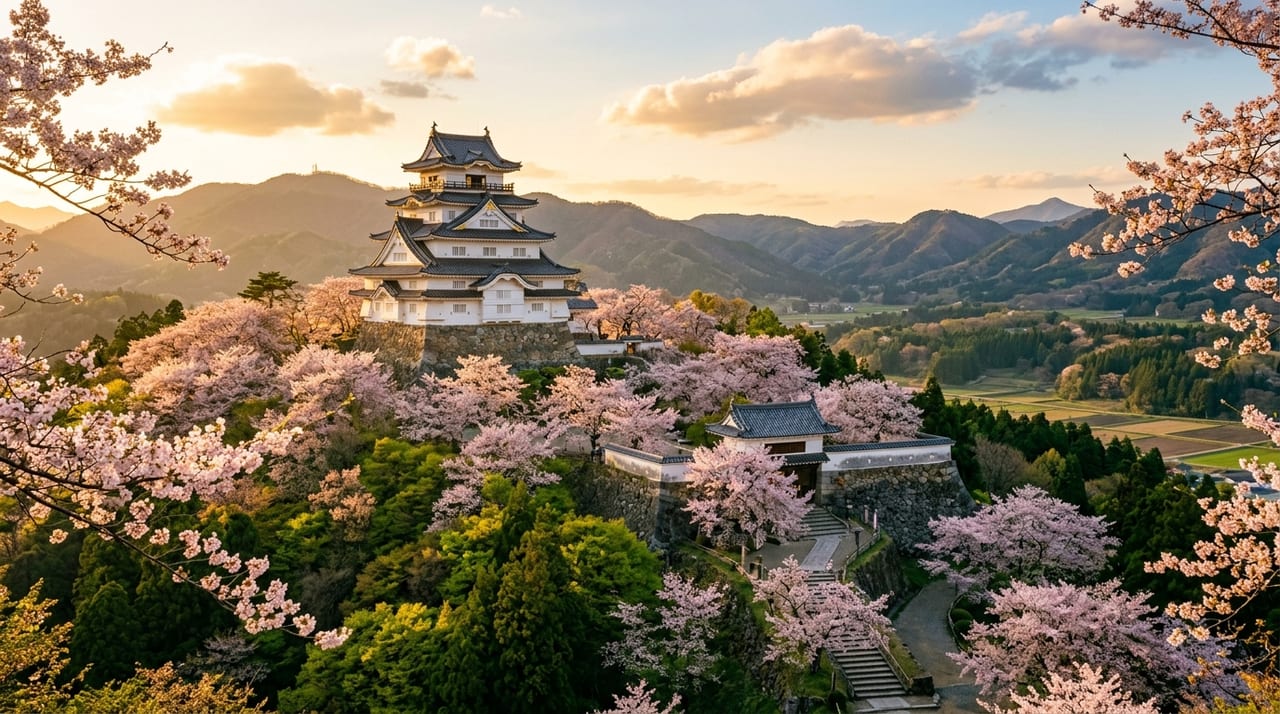
 * Image is for illustrative purposes only.
Nihonmatsu Castle (Kasumi-ga-jō)
二本松城(霞ヶ城)
Nihonmatsu Castle (Kasumi-ga-jō) is a historic castle in the Tōhoku region (Founded around the Ōei era (1394–1428); developed as a modern castle by the Niwa clan). Its lord was Niwa Mitsushige (the first Niwa-family lord of the Nihonmatsu domain).
Overview
A Renowned Castle of Ōshū — The Pride of Kasumi-ga-jō
Nihonmatsu Castle is located in Nihonmatsu City in central Fukushima Prefecture and is beloved under the alternate name Kasumi-ga-jō. In spring, many cherry trees bloom in full splendor across the castle ruins park. It is said that the name “Kasumi-ga-jō” comes from the look of the blossoms, like a haze of flowers. Today the castle is selected as one of Japan's 100 Famous Castles and welcomes many visitors as a castle ruin representing the Tōhoku region.
The history of Nihonmatsu Castle goes back to the Muromachi period. Around the Ōei era (1394–1428), it is said that the Nihonmatsu clan (a branch of the Hatakeyama), a powerful regional house of Ōshū, built a castle on the summit of Shirahatagamine peak, 345 meters above sea level. The Nihonmatsu clan was later conquered by Date Masamune in Tenshō 14 (1586) (Battle of Nihonmatsu Castle) after a fierce struggle for supremacy with him, and the castle was placed under his control.
Nihonmatsu Castle developed as an early-modern castle after the Niwa family, daimyō who had been favored by the Toyotomi, entered it in the early Tokugawa period. Niwa Nagashige (1571–1637) sided with the Western Army at Sekigahara, then returned to the Tokugawa house and became lord of Shirakawa domain. It was his son, Niwa Mitsushige, who entered Nihonmatsu. In Kan'ei 20 (1643) he was granted 100,700 koku and entered the castle as lord of the Nihonmatsu domain. The Niwa family continued as lords of Nihonmatsu until the late Edo period, and the castle functioned as an important castle of Ōshū.
Castle Development under the Niwa Family — Completion of the Early-Modern Castle
Niwa Mitsushige devoted himself to developing the castle. He completed a vast layout centered on the honmaru and ni-no-maru at the summit, extending down through the san-no-maru to the ōte-gomon at the foot of the hill. Minowa Gate (Minowa-mon) has been restored and still stands today, welcoming visitors as the main entrance of Nihonmatsu Castle. Minowa Gate is a stately masugata-mon with tamon-yagura on both sides, and it clearly shows the characteristics of Edo-period castle architecture.
The view from the honmaru is outstanding. Mt. Adatara's majestic form rises in the background, and the castle town of Nihonmatsu and the flow of the Abukuma River spread out below. Mt. Adatara is the mountain sung as “Honto no Sora” in the poetry collection Chieko-shō by the poet Takamura Kōtarō. This scene, where mountain, castle, and literature intersect, symbolizes the cultural richness of Nihonmatsu.
The Boshin War and the Nihonmatsu Shōnentai — Children Who Took Up Swords
The most moving and at the same time most painful event in the history of Nihonmatsu Castle is the Battle of Nihonmatsu in the Boshin War (Boshin Sensō) of Keiō 4 (1868). After Tokugawa Yoshinobu's return of power (taisei hōkan) in 1867, fighting broke out across the country between the forces of the old shogunate and the new government army. In Tōhoku, the Northern Alliance (Ōuetsu Reppan Dōmei) was formed, and Nihonmatsu domain, as one of its members, opposed the new government forces.
In the Battle of Nihonmatsu in the 7th month of 1868 (Keiō 4), Nihonmatsu domain faced an overwhelmingly larger new government army with a small force. Among the fighting, the bravery of the Nihonmatsu Shōnentai (Nihonmatsu Boys' Corps) moves people's hearts in particular. While most of the domain's young men had gone out to the front lines, boys aged 12 to 17 took part in the fight to defend the castle, armed with swords, spears, and matchlock guns. The unit was led by Kimura Jūtarō, the domain's gunnery instructor. The way the children fought to the end with swords in hand has been passed down to later generations as the Nihonmatsu Shōnentai.
This event is recorded as one of the last eras in which the sword was used as a weapon in Japan. Together with its tragedy, it is deeply inscribed in modern Japanese history as one of the cases in which the spirit of bushidō was most purely expressed. The memory of the boys who fought with swords in hand ties Nihonmatsu Castle most deeply to sword culture, and it is also one of the reasons TOUKENZA introduces Nihonmatsu Castle.
A Famed Castle of Cherry Blossoms — Kasumi-ga-jō in Spring
Nihonmatsu, which overcame the scars of the Boshin War, continued after the Meiji period to develop the castle ruins as a park for its citizens. Today many cherry trees are planted in the castle ruins park. At full bloom, the whole castle ruins are wrapped in blossom-mist, a scene that carries on the name Kasumi-ga-jō to this day. The Nihonmatsu Lantern Festival (Nihonmatsu Chōchin Matsuri), held in October and known as one of Japan's three great lantern festivals, is also passed down as a traditional event showing the cultural vitality of this place.
At the present Nihonmatsu Castle ruins, in addition to the restored Minowa Gate and tamon-yagura, the stone walls of the honmaru and the tenshu-dai are preserved in good condition. The imposing stone walls convey the scale and quality of Edo-period castles today. At the foot of the castle ruins is Nihonmatsu Jōhōkan, the city's history and tourism facility, where visitors can view exhibits on Nihonmatsu's history.
Nihonmatsu Castle and TOUKENZA
Sendai, the base of TOUKENZA, was the castle town of the Date family, the dominant house of Tōhoku, located north of Nihonmatsu. In the Sengoku period, a fierce struggle took place between Date Masamune and the Nihonmatsu clan over Nihonmatsu Castle, and the fall of the castle was an important step toward Masamune's supremacy in Ōshū. In the Boshin War, Sendai domain also fought the new government forces as a member of the Northern Alliance, and in that sense shared the fate of Nihonmatsu domain.
As warrior houses of the same Tōhoku region, Sendai and Nihonmatsu shared their fate in many historical moments and lived through the end of the age of the sword together. The year 1868, when the Nihonmatsu Shōnentai fought with swords in hand, was only eight years before the Sword Abolishment Edict (Haitōrei) of 1876. It was a symbolic event of the very last era in which swords were used as weapons. In that sense, Nihonmatsu Castle, as a castle that tells the final chapter in the history of Japanese swords, holds a special weight for TOUKENZA.
Connection to Swords
The connection between Nihonmatsu Castle and Japanese swords is most deeply and movingly tied through the battle of the “Nihonmatsu Shōnentai” in the Boshin War. On 15 September 1868 (Keiō 4/7/29), when the new government forces approached the castle town of Nihonmatsu, the weapons the boys carried included swords. Born as sons of samurai, they had known the sword from early childhood as a familiar symbol of the warrior. It may be said that taking swords into their final battle was the last expression of the spirit of bushidō.
As a sword website based in Sendai, TOUKENZA considers it one of its missions to keep alive for a long time the memory of the Nihonmatsu Shōnentai fighting with swords.
Highlights
- Minowa Gate (reconstructed) and tamon-yagura: the main entrance of Nihonmatsu Castle with a masugata structure, a typical example of Edo-period castle architecture
- Cherry-blossom Kasumi-ga-jō: one of “Japan's 100 Famous Cherry Blossom Sites,” with the castle ruins wrapped in blossom-mist
- Honmaru stone walls and tenshu-dai: stone walls on the summit with a view of Mt. Adatara, conveying the scale of Edo-period castles
- Nihonmatsu Jōhōkan: the city's history and tourism facility at the foot of the castle ruins, with a permanent exhibition introducing Nihonmatsu's history
- Nihonmatsu Lantern Festival (October): one of Japan's three great lantern festivals, a fantastical autumn celebration in which thousands of lanterns light up the castle town
- Views of Mt. Adatara: a spectacular scene formed by the famed peak sung as “Honto no Sora” and the castle ruins, showing its different faces through the seasons
* Opening hours and admission fees are subject to change. Please check the official website before visiting.