New Arrivals — Browse our catalog for the latest authentic Japanese sword arrivals. Browse →
October–November 1868 (8th–9th months of Keiō 4)
Aizu, Mutsu Province (present-day Aizu-Wakamatsu City, Fukushima Prefecture)
Forces
Imperial (New Government) Forces
Aizu Domain / Ōuetsu Reppan Dōmei
About 15 min read
In Keiō 4 (1868), the Boshin War over the establishment of the new Meiji government was about to reach its greatest climax. The Aizu Domain, a powerful domain of the northeast, was branded an "enemy of the throne" by the new government's forces, yet under its lord Matsudaira Katamori, who had borne the duty of maintaining public order on the shogunate's side as Protector of Kyoto, it chose the path of fierce resistance. The Aizu War, which began in the 8th month, was thus inscribed in history as the most tragic battle of the late Edo and Meiji Restoration.
The Aizu Domain was bound to absolute loyalty toward the shogunal house by the Fifteen-Article House Code of Aizu (Aizu kakun jūgo-kajō), which the domain's founder, Hoshina Masayuki, established in Kanbun 8 (1668). The strict samurai education of "What must not be done must not be done" (naranu koto wa naranu) took root within the domain, and its retainers had permeated their very bodies with that spirit.
Domain lord Matsudaira Katamori took up the post of Protector of Kyoto (Kyōto shugoshoku) in Bunkyū 2 (1862), and placed the Shinsengumi under his command to suppress imperial-loyalist activists. His achievements in the Ikedaya Incident (1864) and the Kinmon Incident (1864) raised the trust of the shogunate, but at the same time they brought him the hatred of anti-shogunate domains such as Chōshū and Satsuma. When the shogunate's forces were defeated at the Battle of Toba-Fushimi (January 1868), the Aizu Domain was branded with the stigma of "enemy of the throne" and became a target for subjugation by the new government's forces.
The Aizu War is also an important turning point in the history of Japanese warfare. The new government's forces were already equipped with large numbers of Western-style firearms, such as Gebēru muskets and Snider rifles, as well as cannon. The Aizu Domain did not rely solely on outdated swords and spears, and it possessed a certain number of Western-style guns. However, in modern military training and organizational strength, the gap with the new government's forces was plain.
Nevertheless, swords continued to play an important role in this battle, both spiritually and practically. For the samurai of the Aizu Domain, the worn sword was not merely a weapon but a symbol of the soul that embodied the teaching of "What must not be done must not be done." In the phase of the siege when close-quarters hand-to-hand combat (hakuhei-sen) took place, records also remain of swords actually being used.
The Aizu swordsmith line known as "Aizu Kanesada" was widely used as a practical sword by local samurai in this period. Aizu Kanesada, said to descend from the Kanesada tradition of Mino, is also known as "Izumi-no-kami Kanesada," the sword beloved by Hijikata Toshizō, and it represents the practical swords of the late Edo period. The fact that the land of Aizu and the name of the swordsmith Kanesada are so closely linked in this war is interesting even from the perspective of sword history.
Aizu Kanesada is also highly renowned among modern sword enthusiasts as the foremost of the late-Edo practical swords. Its temper line (hamon) and steel texture (jihada), which emphasize durability and combat practicality rather than merely pursuing sharpness, show the swordsmith's stance of assuming the blade would be used on the battlefield. By wearing this sword, the Aizu samurai may be said to have embodied the pride of their domain and the spirit of bushidō.
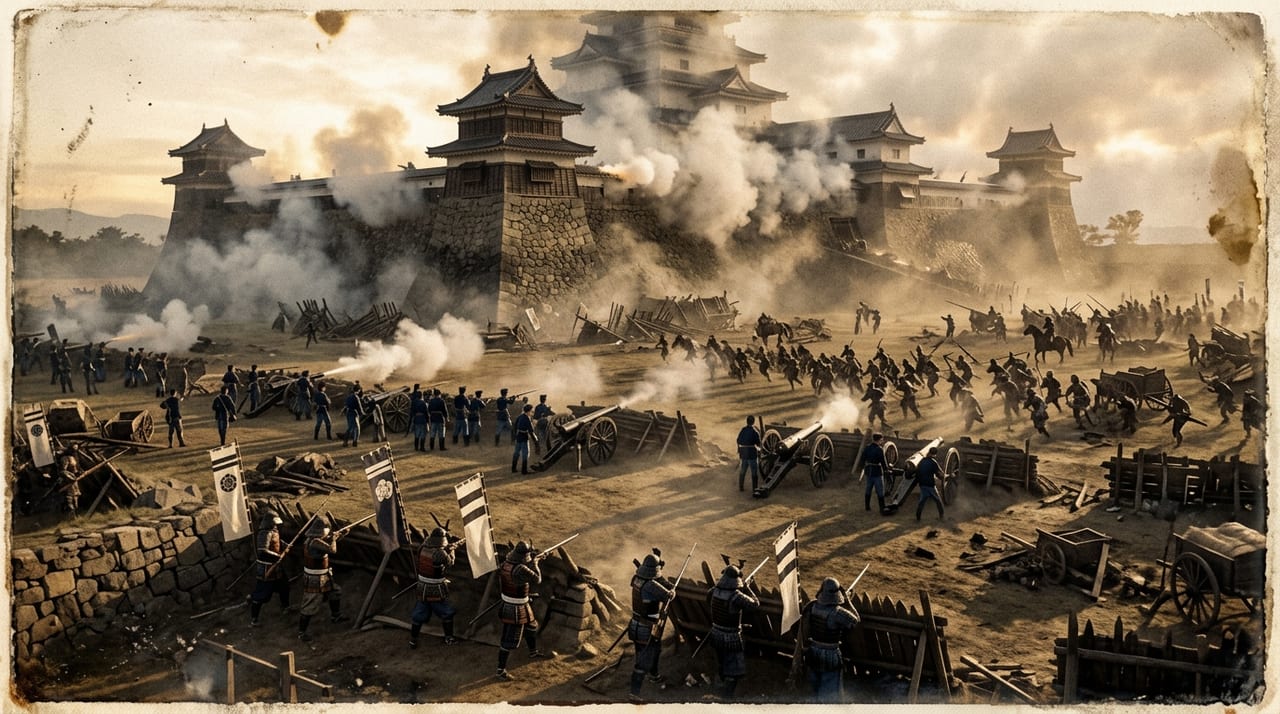
On the 23rd day of the 8th month, a large force of the new government's army began its invasion of Aizu-Wakamatsu. Against the imperial forces pressing in from every direction, the Aizu retainers unfolded fierce defensive fighting in various parts of the castle town.
On this day, the tragedy of the "Byakkotai" became especially something to be passed down to later generations. The Byakkotai was a unit formed of young samurai aged 16 to 17. When the 20 members of the Second Shichū Company retreated to Iimoriyama, the castle town was enveloped in smoke and flame. For a long time it was said that they had committed seppuku mistakenly believing that Tsuruga Castle (Tsuruga-jō) had fallen. However, the memoir of Iinuma Sadakichi, the sole survivor, records a heated debate over whether to return to the castle or charge into the enemy, and they are said to have chosen seppuku to avoid the shame of being captured. Tsuruga Castle had not yet fallen at that point. Of the 20, Iinuma Sadakichi survived, and 19 died.
The tragedy of the Byakkotai has been deeply engraved on later generations as a pure outpouring of bushidō. Iimoriyama remains a sacred site visited by many worshippers even today, and young people from across the country visit the graves of the Byakkotai members.
The siege lasted for about one month. Inside the castle, food and ammunition began to run out, and many non-combatants, including women and children, had also taken refuge there. Matsudaira Katamori tried to keep resisting until the end, but on the 22nd day of the 9th month (by the old lunar calendar), he finally resolved to surrender.
A notable feature of the Aizu War is that women, too, took part in the fighting. The women called the "Jōshigun" (women's corps) took the field with naginata in hand, and some met their end there. Among them, Nakano Takeko fought valiantly with a naginata at the Battle of Namidabashi on the 25th day of the 8th month, but she was struck by a bullet and fell. Her mother Kōko and her younger sister Yūko performed kaishaku (the mercy stroke) for her. Her age at death is said to have been 20, though other accounts exist. Her naginata has been passed down as a relic and has become an artifact symbolizing the martial skill and spirit of the women warriors.
At the residence of the chief retainer Saigō Tanomo, a total of 21 members of the clan, including his wife Chieko, his mother, younger sisters, and daughters, committed suicide and died. The sword was the soul of the samurai, but in this war the women also took up swords and naginata, and met their end with the pride of samurai.
Since ancient times the naginata has been positioned as a weapon of women, and there is a history in which women were encouraged to master it as a martial art. In samurai households of the Edo period, naginata practice was also regarded as part of bridal training. The fact that the women of Aizu displayed their skill in actual combat was not a mere gyokusai (a glorious last stand), but a proud choice made by those born into samurai families.
After the surrender, the Aizu Domain received the punishment of a reduction in its domain holdings, and Matsudaira Katamori was placed under confinement. The retainers were forced to move to the Tonami domain on the Shimokita Peninsula and compelled to live under harsh conditions. Resentment over the handling of the bodies of the dead has been passed down to the present day as the "Aizu grievance" (Aizu no ikon).
The bodies of the fallen were buried at various places within the city in the month after the surrender. In Meiji 2 (1869), they were reinterred at Amida-ji temple. Tsuruga Castle was dismantled in Meiji 7 (1874), but it was restored in Shōwa 40 (1965), and today it welcomes many tourists as a symbol of Aizu-Wakamatsu City.
Aizu-Wakamatsu City has several facilities and archives that exhibit swords related to the Aizu Domain.
Every year in late September, the Aizu Festival (Aizu Matsuri) is held, and the Aizu Domain Lord's Procession (Aizu Hankō Gyōretsu), with participants dressed as the Byakkotai, the Jōshitai, and others, parades through the castle town. The sight of participants walking in the attire of Aizu samurai with swords at their waist shows that the spirit of Aizu bushidō continues to be passed down vibrantly even today.
The Aizu War, as an event condensing "the loyalty and tragedy of the samurai" in the turbulent era of the late Edo period, is a historical event that cannot be left out when discussing Japanese swords and bushidō culture. Its memory brings back, each time the main keep of Tsuruga Castle is tinged orange by the evening sun, the scene the young men of the Byakkotai saw at the end. The souls of the samurai who lived with swords and died with swords still dwell in the land of Aizu.