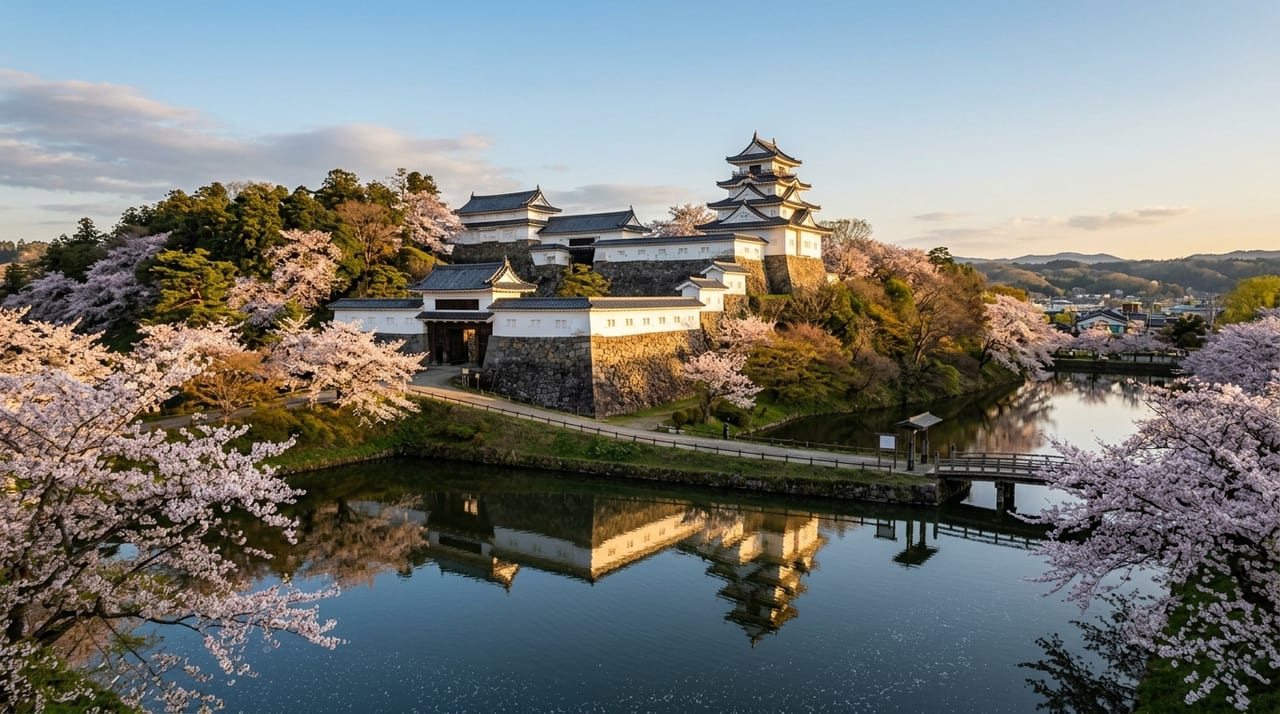
 * Image is for illustrative purposes only.
Kubota Castle (Akita Castle)
久保田城(秋田城)
Kubota Castle (Akita Castle) is a historic castle in the Tōhoku region (Built in Keichō 8 (1603)). Its lord was Satake Yoshinobu.
Overview
About the Castle
Kubota Castle (Akita Castle) is a hirayama-jō (hill castle) built in Keichō 8 (1603) by Satake Yoshinobu, who was transferred to Akita from Hitachi (Ibaraki Prefecture). Because the Satake household was judged to have taken a 'wait-and-see' (hiyorimi) stance at the Battle of Sekigahara, neither joining the Western nor the Eastern army, Tokugawa Ieyasu greatly reduced its holdings, moving it from 540,000 koku in Hitachi to just over 200,000 koku in Dewa. Yoshinobu endured this humiliation, settled in the Akita region, and devoted his full effort to establishing domain governance in his new territory. The castle is distinctive for its unusual structure without a tenshu (main keep). In place of a tenshu, a turret-style reception chamber called the Odashi-shoin (Dashi-goshoin) was placed on a raised area of the honmaru known as the 'dashi.' This is interpreted both as a consideration to show submission to the Tokugawa shogunate and as reflecting that a tenshu was originally unnecessary for the defense of this area.
Architecture and Layout
The layout of Kubota Castle makes skillful use of the hilly terrain. The highest point of Mount Shinmei (about 40 m above sea level) was made the honmaru, the ninomaru was placed on a lower terrace to its east, and the sannomaru was arranged to enclose the north, east, and south sides of the ninomaru. Many of the moats have been filled in, but some still survive today as the moats of Senshū Park. The Omonogashira Gobansho (guardhouse), the oldest extant building within the castle, is estimated to date from the late 18th century and is designated an Akita City Registered Tangible Cultural Property. The Osumi-yagura (corner turret), reconstructed in Heisei 1 (1989), and the main gate of the honmaru, rebuilt in wood in Heisei 13 (2001), have been maintained and convey the atmosphere of the honmaru in its heyday. As daimyō of 205,800 koku, the Satake household governed Akita until the end of the Bakumatsu period, a span of nearly 270 years.
Culture and Crafts
The Satake household was a prestigious family with deep ties to Kyoto culture. Over generations its members enjoyed poetry, painting, and the tea ceremony, cultivating a distinctive and refined culture that fused warrior and courtier traditions. The Satake-bon Thirty-Six Immortal Poets scroll, transmitted in the Satake household, is renowned. In Taishō 8 (1919) it was divided by individual poet, and many of the pieces have been designated Important Cultural Properties. Namahage, a folk custom representative of Akita, is an event held on the Oga Peninsula, away from the castle town, but it is widely known as a tradition that developed uniquely within the cultural sphere of the Akita domain. The rich forest resources of Akita cedar, combined with the techniques of kijishi (woodturners), formed the foundation of Akita crafts.
Development of the Castle Town
Akita, the castle town, was a key hub where goods and culture flowed, serving as a port of call for kitamaebune cargo ships. It was also a distribution base where products from Kyoto and Osaka reached the northern provinces. The commercial prosperity brought by the kitamaebune raised the cultural level of the castle town and, together with the Satake household's refined cultural tastes, gave rise to Akita's unique artistic climate. The flowering here of a distinctive school of painting that adopted Western painting techniques, known as Akita ranga (Akita Dutch-style painting), is a fine example of the enlightened cultural outlook of the Akita domain.
Sightseeing and Experiences
Today Senshū Park is loved as a place of rest for citizens, and its cherry blossoms in spring and autumn foliage are especially beautiful. The interior of the reconstructed Osumi-yagura serves as an exhibition room, where visitors can learn about the history of the Satake household and the culture of Akita. The Akita City Satake Historical Museum displays armor, swords, and fine art objects transmitted by the Satake household.
Connection to Swords
The Satake household was a prestigious warrior family deeply involved in sword culture since the period of Hitachi Province, and it continued this tradition after its transfer to Akita. In the Hitachi period, the Satake household belonged to the sword culture sphere of the Kantō and eastern provinces, where smiths of the Sōshū-den school were active, and it possessed many famous swords from the Kamakura and Muromachi periods. When it was relocated, Satake Yoshinobu brought many family treasures with him, and he maintained and enriched the sword collection in the Akita region as well. In the Akita domain, swords of a sturdy, practical style were made to meet the demands of domain retainers, and local smiths supplied swords fit for practical use. In the late Bakumatsu period, the Akita domain fought in the Boshin War on the side of the new government forces. Its territory was attacked by forces including those of the Shōnai Domain and Morioka Domain, and most of it became a battlefield. Shōnai Domain forces advanced to Tsubakidai, about 12 km from the castle town, but Kubota Castle escaped the ravages of war. The Akita City Satake Historical Museum displays swords, armor, and sword fittings transmitted by the Satake household, making it an ideal place to explore the little-known sword culture of the Tōhoku region.
Highlights
- Omonogashira Gobansho (designated Akita City Registered Tangible Cultural Property) — the oldest extant building within the castle (estimated to date from the late 18th century)
- Reconstructed Osumi-yagura — the interior is a Satake household history exhibition room that recreates the atmosphere of the honmaru
- Cherry blossoms of Senshū Park and the outer moat — the moat surrounding the castle survives as the park's pond, a spectacular sight in spring
- Akita City Satake Historical Museum — houses swords, armor, and paintings and crafts transmitted by the Satake household
- Akita City Senshū Museum of Art — exhibits art connected with the region, including Akita ranga
- Namahage Museum (Oga Peninsula) — representative folk culture of Akita, about 1 hour by car from the castle
* Opening hours and admission fees are subject to change. Please check the official website before visiting.