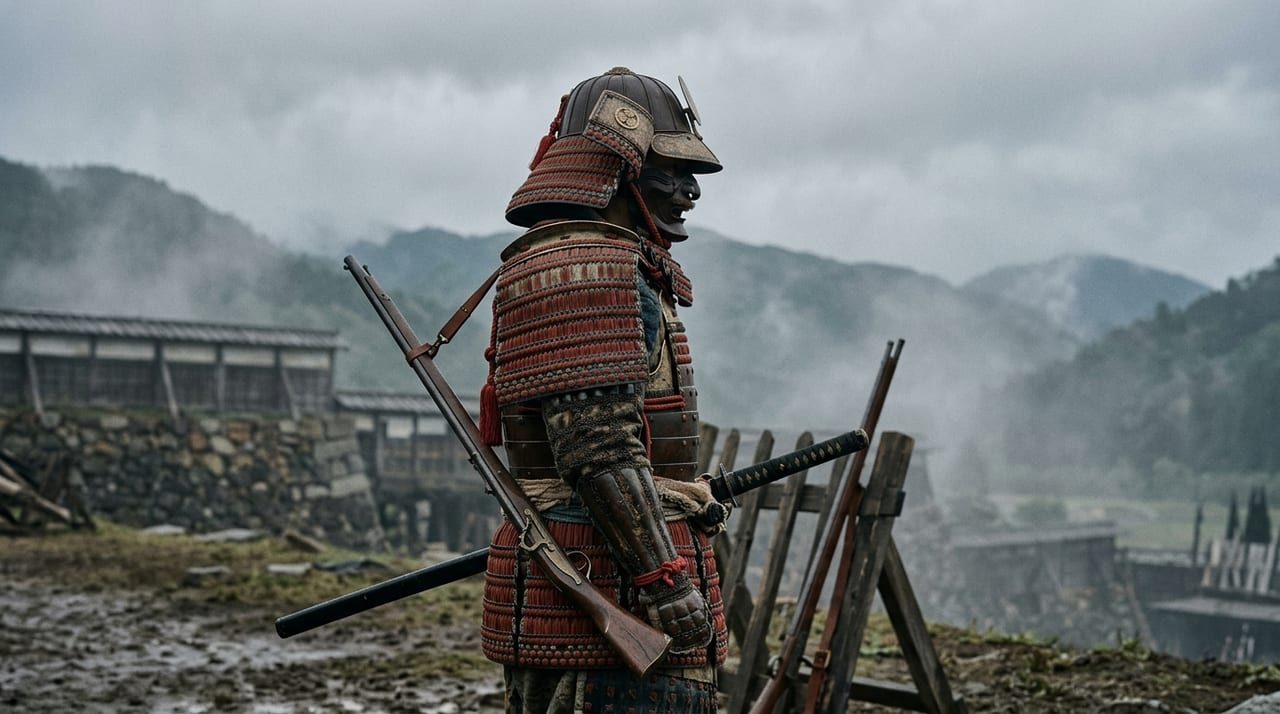
 * Image is for illustrative purposes only.
Kawai Tsuginosuke
河井継之助
Treasure of Nagaoka Domain, Echigo — Revolutionary Military Reformer Who Introduced the Gatling Gun, Tragic Hero of the Northern Boshin War
Description
A Treasure of Echigo Nagaoka
Kawai Tsuginosuke was born in Bunsei 10 (1827), the son of Kawai Daiemon, a samurai of Nagaoka Domain in Echigo Province (present-day Nagaoka City, Niigata Prefecture). He is one of the most individualistic and revolutionary warriors of the late Tokugawa and Meiji Restoration period. Although he held the post of senior retainer (karō) of Nagaoka, a small domain, he devoted his passion to modern military reform and arms procurement. He is known for purchasing two of the latest multi-barrel machine guns, Gatling guns, of which only three were said to exist in Japan at the time, and for using them in actual combat. His life was short, just over forty-one years (forty-two by the traditional count), but his desperate resistance in the Hokuetsu Boshin War still captivates the hearts of many people.
Tsuginosuke as a Man of Ambition: His Years of Study
Tsuginosuke was a man of ambition who, while still young, did not stay within the domain but traveled widely across the country to study. In Kaei 5 (1852) he went to Edo to study, and in Ansei 6 (1859) he traveled to Bitchū-Matsuyama, Nagasaki, Higo (Kumamoto) and other places, deepening his exchanges with men of purpose, scholars and warriors in each region. In particular, his studying under Yamada Hōkoku, the Yōmeigaku scholar of Bitchū-Matsuyama Domain, had a decisive influence on the formation of Tsuginosuke's thought. The practicality of Yōmeigaku, which teaches “chi ryōchi” (extension of innate knowledge), became the philosophical foundation of Tsuginosuke's way of life, “action rather than words.” His keen curiosity about conditions overseas and about weapons technology was also a characteristic of Tsuginosuke, and he had an enlightened attitude of actively adopting the latest Western technology.
Military and Administrative Reforms of Nagaoka Domain
As Tsuginosuke took up key posts in Nagaoka Domain, his reforms extended to domain administration as a whole. He pursued fiscal reconstruction, industrial promotion and military system reform in parallel, and although the domain was small, he succeeded in organizing an elite modern army. The most emblematic of these reforms was the purchase, in Keiō 4 (1868), of two Gatling guns (American-made) through a trading house in Yokohama. The Gatling gun was the most advanced rapid-fire weapon in the world at the time, and Tsuginosuke recognized its military potential early on. This foresight is recorded in modern Japanese history as an event symbolizing the transition from the age of swords to the age of firearms.
Samurai Views of the Sword and Modern Weapons
Tsuginosuke's era was a transitional period in which, for samurai, the sword was changing from a “symbol of the soul” into an “outdated weapon.” The sword remained at the core of the samurai's identity, but the realities of the Boshin War showed the overwhelming superiority of firearms and cannon. It is said that Tsuginosuke himself, even regarding swordsmanship, valued practical usefulness over forms and schools, and in actual combat he calmly recognized the superiority of modern weapons. Tsuginosuke's life in this period of transition also symbolizes the change in the samurai's view of the sword in modern Japan.
The Hokuetsu Boshin War (Northern Boshin War): A Tragic Resistance
In the 5th month of Keiō 4 (1868), Tsuginosuke met with Iwamura Seiichirō, gunkan (inspector) of the new government army, at Jigen-ji temple in Ojiya, and sought armed neutrality for Nagaoka Domain. However, the negotiations broke down, and Nagaoka Domain was forced to fight the new government army. In the Hokuetsu Boshin War, Tsuginosuke made full use of Gatling guns to resist the new government army fiercely, and at one point mounted a counterattack strong enough to retake Nagaoka Castle. In the end, however, he was overwhelmed by the new government army, which had overwhelming superiority in troops and equipment, and Nagaoka Castle fell once again.
Tsuginosuke's Final Days
After defeat in battle, Tsuginosuke, though seriously wounded by gunfire, continued his retreat, crossing Hachijūri Pass and heading for Aizu. However, his wounds did not heal, and he died on October 1, 1868 (Keiō 4/8/16) in Shiozawa village (now Tadami Town, Fukushima Prefecture) in Aizu Domain territory. He was 41 at death (42 by the traditional count). Tsuginosuke's death meant the defeat of Nagaoka Domain, but the spirit he showed, that “a small domain resists a large domain with pride,” has continued to deeply move later generations. His life is still widely known today through Shiba Ryōtarō's novel “Tōge” and other works.