New Arrivals — Browse our catalog for the latest authentic Japanese sword arrivals. Browse →
July 4, 1868 (Keiō 4, 5th month, 15th day)
Ueno, Edo, Musashi Province (present-day Ueno, Taitō-ku, Tokyo)
Forces
Imperial (New Government) Forces
Shōgitai / former Tokugawa loyalists
About 16 min read
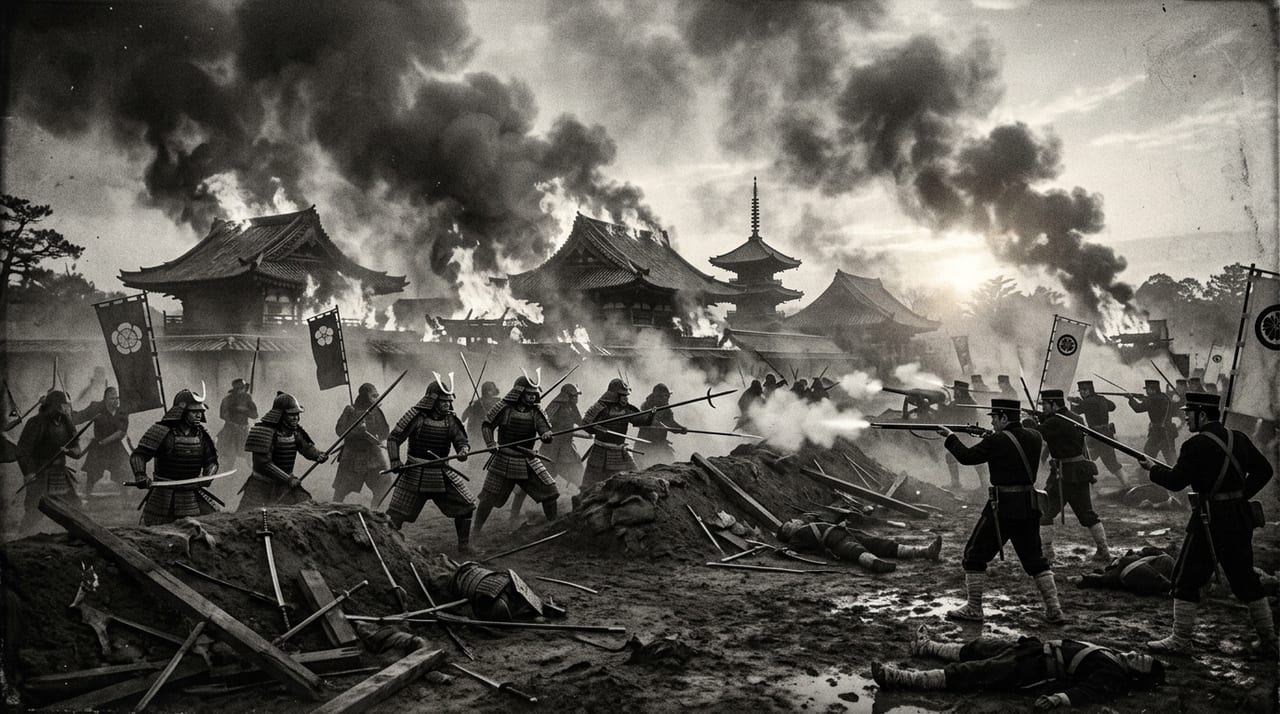
On the morning of July 4, 1868 (Keiō 4/5/15), the roar of artillery resounded over Ueno hill in Edo (Tokyo). The clash between the Shōgitai—entrenched at Tōeizan Kan'eiji, the ancestral temple of the Tokugawa clan—and the Meiji government forces became known as the Battle of Ueno (the Shōgitai's War). This battle, decided in barely half a day, marked not only the end of organized Tokugawa resistance in Edo, but also symbolized the poignant twilight of the samurai as a class.
After the defeat at the Battle of Toba-Fushimi (January 1868), the old Tokugawa military collapsed. Shogun Tokugawa Yoshinobu returned to Edo and displayed an attitude of submission. However, among former Tokugawa retainers dissatisfied with Yoshinobu's surrender, those determined to resist gathered and formed the "Shōgitai."
The name Shōgitai means "to illuminate righteous conduct," and the unit was organized in the 2nd month of Keiō 4 (1868) centered on former samurai such as Shibusawa Sei'ichirō (later the older cousin of businessman Shibusawa Eiichi). Initially intended to protect and safeguard Tokugawa Yoshinobu, it gradually transformed into an armed body opposed to the overthrow of the shogunate and advocating for restoration of the bakufu. At its height, an estimated 3,000 to 4,000 members gathered within the precincts of Kan'eiji in Ueno, demonstrating their stance of opposition to the new government.
The Shōgitai's ranks included hatamoto and gokenin (former shogunal guards), rōnin from various domains, and swordsmen who had trained in Edo during the late Edo period. Most of them were accomplished swordsmen, men who had lived in an age when the wearing of swords was the very emblem of samurai status.
Parallel to the Shōgitai's activities, a momentous event occurred in the 4th month of Keiō 4 (1868): as the Meiji government forces prepared for their final assault on Edo, negotiations between Katsu Kaishū and Saigō Takamori resulted in the bloodless opening of Edo Castle (Keiō 4/4/11; May 3, 1868).
Prior to this meeting, Yamaoka Tesshū was the envoy Tokugawa Yoshinobu sent to Saigō. Yamaoka rode alone to where Saigō was stationed in Suruga and succeeded in negotiations that would save the million inhabitants of Edo from the ravages of war. This Yamaoka Tesshū was himself a master of the sword and was renowned as a sword sage who founded the "Mukatō-ryū" (School of No-Sword). The Mukatō-ryū is the school Yamaoka founded in the Meiji era, known for emphasizing spiritual cultivation grounded in the unity of swordsmanship and Zen. A sword-bearer who wielded no sword yet moved history through negotiation—this contradiction-laden fact reveals the true essence of the late Edo period.
The Shōgitai warriors came from diverse backgrounds—former samurai, gokenin, rōnin—and the swords they carried were equally varied. Some warriors received swords and spears supplied from the shogunate's armories, while many brought their own blades.
Particularly noteworthy is the prominence among their ranks of swordsmen who had trained at the dojo of Edo's martial arts tradition—the Hokushin Ittō-ryū, Shintō Munen-ryū, and Kagami Shin'mei Chigiryu schools. Like the Shinsengumi before them, the Shōgitai warriors possessed formidable martial training in the sword arts, yet the modern firepower arrayed against them gave them no opportunity to demonstrate their mastery.
Furthermore, it is believed that among the Shōgitai were former members of the Shinsengumi. Four years had passed since the Ikeda-ya Incident (1864), and swordsmen tossed about by the waves of history gathered on Ueno hill, determined to demonstrate one final act of defiance.
The strategy was devised by Ōmura Masujirō (of the Chōshū domain, an authority on Western military organization). Ōmura analyzed the terrain where the Shōgitai had taken their stand on Ueno and planned an attack combining artillery bombardment from the direction of Shinobazu Pond with simultaneous assaults from multiple directions.
At around 7 a.m. on July 4, the two sides clashed. From around noon, Armstrong cannon positioned by the Saga domain forces on the Hongō rise rained shells onto the Kan'eiji precinct, and fire immediately broke out. The Shōgitai attempted to resist with rifles and swords, but they were powerless against the modern firepower. By around 5 p.m., the fighting had ended, and the Shōgitai retreated in defeat toward the Negishi area.
The battle was decided in just one day. In a single day, the limitations of traditional arms centered on sword and spear—when faced with modern artillery—stood revealed in daylight. The Battle of Ueno was among the most eloquent testimonies to the end of the age of the sword.
The number of Shōgitai members who fell in this battle varies by historical record, but is said to number 266. Many of the surviving members subsequently either joined the Northern Alliance (Ōuetsu Reppan Dōmei) or proceeded toward the final confrontation at Goryokaku (Hakodate).
The Kuromon gate of Kan'eiji, where the fighting took place, has been relocated to Entsū-ji temple in Minami-Senju, Arakawa Ward, where bullet-scarred pillars and other parts silently convey the final battle of the Shōgitai warriors.
For a time after the war, the Kan'eiji precinct bore the marks of battle, but in 1873 (Meiji 6) it was designated as a park. Today, in one corner of Ueno Park stands the "Tomb of the Shōgitai," where each year on May 15 volunteers conduct a memorial service.
From the perspective of sword history, the Battle of Ueno is remembered as "the day that proved the helplessness of renowned swordsmen and master swordsmen before cannon and rifle." No matter how excellent one's blade or how refined one's swordsmanship, such skills cannot be displayed in the face of the concentrated firepower of modern weapons—this cold historical fact symbolizes a major turning point in the history of Japanese arms and warfare.
In the Battle of Ueno, Kan'eiji lost its major buildings, including the Konpon Chūdō, to fire, and its vast precinct was seized by the new government. In 1873 (Meiji 6) it was designated one of Japan's first parks, becoming the foundation of the present-day Ueno Onshi Park. From the modern appearance of Ueno Park—lined with the Tokyo Zoo, the Tokyo National Museum, and the National Museum of Science and Nature—it is difficult to imagine that this place was once the scene of fierce combat.
The Tokyo National Museum (formerly the Imperial Museum) was built on one corner of the former Kan'eiji precinct, and its halls contain many masterpieces of Japanese swords on display and in storage. The historical irony that a museum displaying swords as art objects was constructed on the very battlefield where swords once served as weapons symbolizes the vast transformation of the period from the late Edo through the Meiji era.
The "Tomb of the Shōgitai," erected to soothe the spirits of the fallen warriors, remains today in one corner of Ueno Park (now near the statue of Saigō Takamori). The remnants of the Shōgitai retreated to the northeast, and some would later take part in the Battle of Goryokaku (the Hakodate War). Together with survivors of the Shinsengumi such as Hijikata Toshizō, they proceeded toward the last battle of the late Edo period.
The Battle of Ueno was a clash fought at the intersection of sword and Western firearm, an event that illuminated the process by which the samurai rapidly lost their place in the modern nation-state. This battle, decided in half a day, symbolized the great historical tide by which sword-bearing samurai were compelled to exit the stage of world history.
The Shōgitai included many swordsmen who had studied at Edo's "three great dojo"—the Hokushin Ittō-ryū, Shintō Munen-ryū, and Kagami Shin'mei Chigiryu. Those who trained at the Genpūkan, the dojo of Chiba Shūsaku, founder of the Hokushin Ittō-ryū, were representative figures of the late Edo sword-arts world, and many of his students would fight on both sides of the bakumatsu conflict.
For the swordsmen who joined the Shōgitai, the sword was far more than a mere weapon—it was the embodiment of the techniques and spirit inherited from their masters. Yet on the modern battlefield where shells fell like rain, even the most accomplished swordsmanship found no opportunity for display. After the Battle of Ueno, many martial arts dojo found their purpose questioned, and with the enactment of the Edict Prohibiting the Wearing of Swords (Meiji 9), they rapidly declined. However, the techniques and spirit of swordsmanship were reborn as "kendō" (the way of the sword) and passed down to the present day. The spirits of the swordsmen who fell in the battle on Ueno hill dwell today as part of the source of kendō throughout dojo across the nation.
Saigō Takamori
Imperial forces leader who accepted Edo Castle's surrender and ordered the Ueno assault
Katsu Kaishū
Negotiated Edo Castle's bloodless surrender with Saigō Takamori
Yamaoka Tesshū
Sword-saint of Mutō-ryū; served as envoy in the Edo Castle negotiations
Hijikata Toshizō
Symbol of Tokugawa loyalist resistance who continued fighting north after Ueno