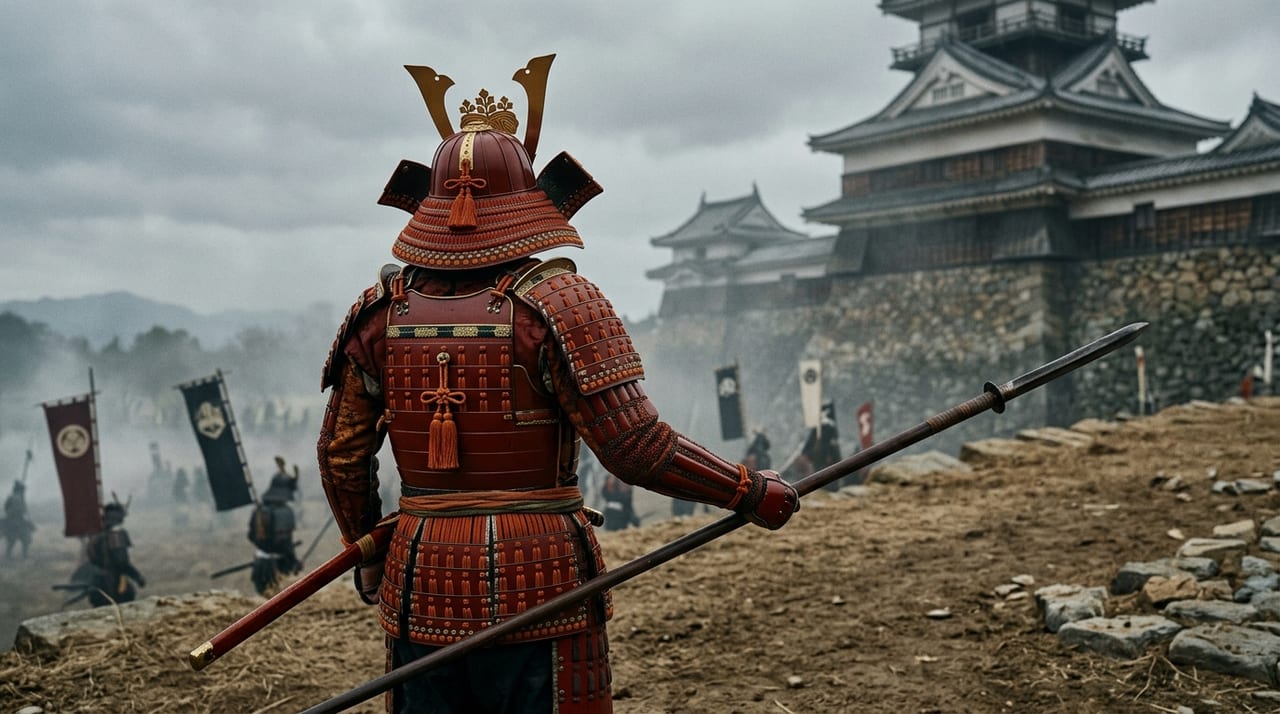
 * Image is for illustrative purposes only.
Ii Naomasa
井伊直政
The Red Devil — Youngest and Fiercest of the Tokugawa Four Heavenly Kings
Description
The Birth of the Red Demon
Ii Naomasa was born in Iinoya in Tōtōmi Province in Eiroku 4 (1561). He is known as a fierce warrior who was second to none in martial prowess, even though he was the youngest of the Four Heavenly Kings of the Tokugawa (Honda Tadakatsu, Sakakibara Yasumasa, Sakai Tadatsugu, Ii Naomasa). He grew up in misfortune: his father, Ii Naochika, was murdered by treachery, and he was separated from his mother. In Tenshō 3 (1575), at the age of fifteen, he was noticed by Tokugawa Ieyasu, who appointed him a page. Naomasa was handsome and also skilled in strategy, and Ieyasu favoured him exceedingly. However, Naomasa did not rest on that favour. He devoted himself to the martial path and came to display a prowess that stood out even among the Tokugawa warriors.
Inheriting the Akazonae
What made Naomasa's name resound across the land was his inheritance of the akazonae. The akazonae was a military equipment in which the armour, horse gear and battle standards were all unified in vermilion red. It had once been used by the unit of Yamagata Masakage, who commanded the elite cavalry corps of Takeda Shingen. After the Takeda house was destroyed in the Conquest of Kai (Tenshō 10, 1582), Ieyasu took many of its former retainers into his service. Naomasa was appointed to command these former Takeda warriors and was ordered to inherit Yamagata's akazonae. This order, in which the commander of the victors inherited the equipment of the vanquished, also wounded the pride of the former Takeda warriors. Naomasa, however, won their hearts through his personal esteem and martial prowess. He built the strongest cavalry corps known across the land as the 'Red Demon of Ii'. Naomasa's army, which had inherited Yamagata Masakage's akazonae, swept across battlefields as if the ghost of Takeda had possessed it, and it struck terror into enemy forces.
Martial Prowess at Sekigahara
In the Battle of Komaki and Nagakute (Tenshō 12, 1584), he led the akazonae for the first time. He fought against the forces of Ikeda Tsuneoki and Mori Nagayoshi of the Hashiba side and distinguished himself. He continued to build his military record, including by launching a night raid inside Odawara Castle in the Odawara campaign (Tenshō 18, 1590). Then, at the Battle of Sekigahara (Keichō 5, 1600), his martial prowess reached its peak. Serving as military inspector (gunkan) of the Eastern Army together with Honda Tadakatsu, Naomasa is said to have opened the battle with Matsudaira Tadayoshi by a nukegake (an unauthorized advance ahead of the assigned vanguard), even though the vanguard had been assigned to Fukushima Masanori. Some view it instead as an accidental encounter in the fog. During the battle, while pursuing the retreat of the Shimazu army, Naomasa was struck by a bullet and seriously wounded. Before the wound healed, he died at Sawayama Castle in Keichō 7 (1602), aged 42.
Heirlooms of the Ii Family
The Ii family of Hikone Domain, whose foundations Naomasa laid as its first lord, supported the shogunate throughout the Edo period as the foremost of the fudai daimyo. Today, the Hikone Castle Museum holds many suits of armour and swords associated with successive Ii family lords, beginning with Naomasa. Together with the akazonae armour adorned in vermilion, a number of famous swords convey the radiance of that era to the present day.
The Legacy of the Red Demon
Naomasa is highly regarded not only as a man of martial prowess but also as a statesman who laid the foundations of the Tokugawa house during the transition from the Sengoku to the Edo period. After the Battle of Sekigahara, Naomasa had 60,000 koku added to his holdings, bringing them to 180,000 koku. He was moved to Sawayama in Ōmi Province (present-day Hikone), the former domain of Ishida Mitsunari. Naomasa devoted himself to establishing the domain's administrative foundations while his wound had not yet healed, and his achievements have become the foundation of Hikone's prosperity today. The epithet 'Red Demon of Ii' eloquently conveys to later generations the life of Naomasa, who was fierce as flame, red as blood, and as valiant as a demon god guarding the Tokugawa realm.