New Arrivals — Browse our catalog for the latest authentic Japanese sword arrivals. Browse →
September 17–18, Keichō 5 (1600)
Sawayama Castle, Sakata District, Ōmi Province (present-day Sawayama-chō, Hikone City, Shiga Prefecture)
Forces
Eastern Army (Tokugawa)
Western Army (Ishida clan)
About 16 min read
On September 15, 1600, the Western Army collapsed at the Battle of Sekigahara, and Ishida Mitsunari fled the field. Sawayama Castle, Mitsunari's seat of power, immediately became the Eastern Army's next target. Just two days later, on September 17, a large Tokugawa force descended on the town beneath Sawayama Castle. Defending it were Mitsunari's father, Ishida Masatsugu, and his elder brother, Ishida Masazumi.
Ishida Mitsunari was a native of Ōmi Province who rose to prominence after being discovered by Toyotomi Hideyoshi, serving as a magistrate (bugyō) and displaying formidable administrative skill in matters such as the Taikō's cadastral surveys and the logistics of the Korean campaigns — the practical work that underpinned the Toyotomi regime. Though regarded as a leading figure of the "civil administration faction," valued more for bureaucratic ability than battlefield prowess, after Hideyoshi's death Mitsunari grew increasingly alarmed at Tokugawa Ieyasu's high-handed conduct. In Keichō 5 (1600), he raised an army against Ieyasu, installing Mōri Terumoto as nominal commander-in-chief — the uprising of the Western Army that led directly to the Battle of Sekigahara. Mitsunari himself effectively commanded the Western Army and took the field for the main battle on September 15. Though the fighting initially appeared to favor the Western Army, several hours into the engagement Kobayakawa Hideaki, stationed on Mount Matsuo, defected to the Eastern Army, triggering a chain reaction as commanders including Wakizaka Yasuharu, Ogawa Suketada, Kutsuki Mototsuna, and Akaza Naoyasu likewise turned their coats. This mass defection shattered the Western Army's formation, and the main battle ended in a crushing Eastern Army victory in barely half a day. For Ieyasu, securing a firm foundation for his new regime required swiftly crushing the home bases of the Western Army's ringleaders and stamping out any seed of resistance. Sawayama Castle, the seat of Mitsunari — the very architect of the uprising — was a symbolic target above all others, meant to show every other daimyō what defiance of Ieyasu would bring. Deploying the very commanders who had defected during the main battle, including Kobayakawa Hideaki, as the vanguard of the assault on Sawayama is also thought to have served a further purpose: giving them the chance to prove their newfound loyalty to the Eastern Army in deed.
Sawayama Castle stood in Sakata District, Ōmi Province (present-day Hikone City, Shiga Prefecture). Though an ancient fortress predating the Nanbokuchō period, it was massively rebuilt after Tenshō 18 (1590) by Ishida Mitsunari, who had risen as a magistrate of the Toyotomi regime, and made into his personal seat. The castle boasted a grand layout with the main keep, second bailey, and third bailey arranged in terraces, and because it commanded both the Tōsandō highway and the shipping routes of Lake Biwa, Mitsunari is believed to have used it also as a base for managing tax-rice collection and gathering intelligence. So formidable was the castle that a contemporary saying held "Mitsunari has two things beyond his station: Shima no Sakon and the castle of Sawayama" — meaning that both his retainer and his castle were too magnificent for a man of his rank, an anecdote widely remembered as testimony to both Mitsunari's power and Sawayama's strength. Because Mitsunari himself was away commanding the Western Army at Sekigahara, only his father Masatsugu, his brother Masazumi, and a skeleton garrison remained to hold the castle, along with Mitsunari's own children and wife, who are said to have remained within its walls.
When the Western Army collapsed at the main battle on September 15, Tokugawa Ieyasu ordered his commanders to attack the Ishida family's home base. Kobayakawa Hideaki, Wakizaka Yasuharu, Kutsuki Mototsuna, Ogawa Suketada, and Akaza Naoyasu — commanders who had defected from the Western to the Eastern side in the final stages of Sekigahara — were joined by Ii Naomasa, one of the Four Guardians of the Tokugawa, and Tanaka Yoshimasa, a Toyotomi-affiliated lord who had aligned early with Ieyasu. Together they marched roughly 15,000 troops on Sawayama. Sawayama Castle lay barely a day's march from the Sekigahara battlefield, and the Eastern Army commanders, riding the momentum of their victory, wheeled around and advanced on it immediately. Inside the castle, chaos reigned as news of the defeat at Sekigahara had only just arrived, leaving almost no time to shore up the defenses. With Mitsunari absent, the garrison consisted of little more than hastily gathered reinforcements drawn from allied domains, and the disparity in numbers against the Eastern Army was stark.
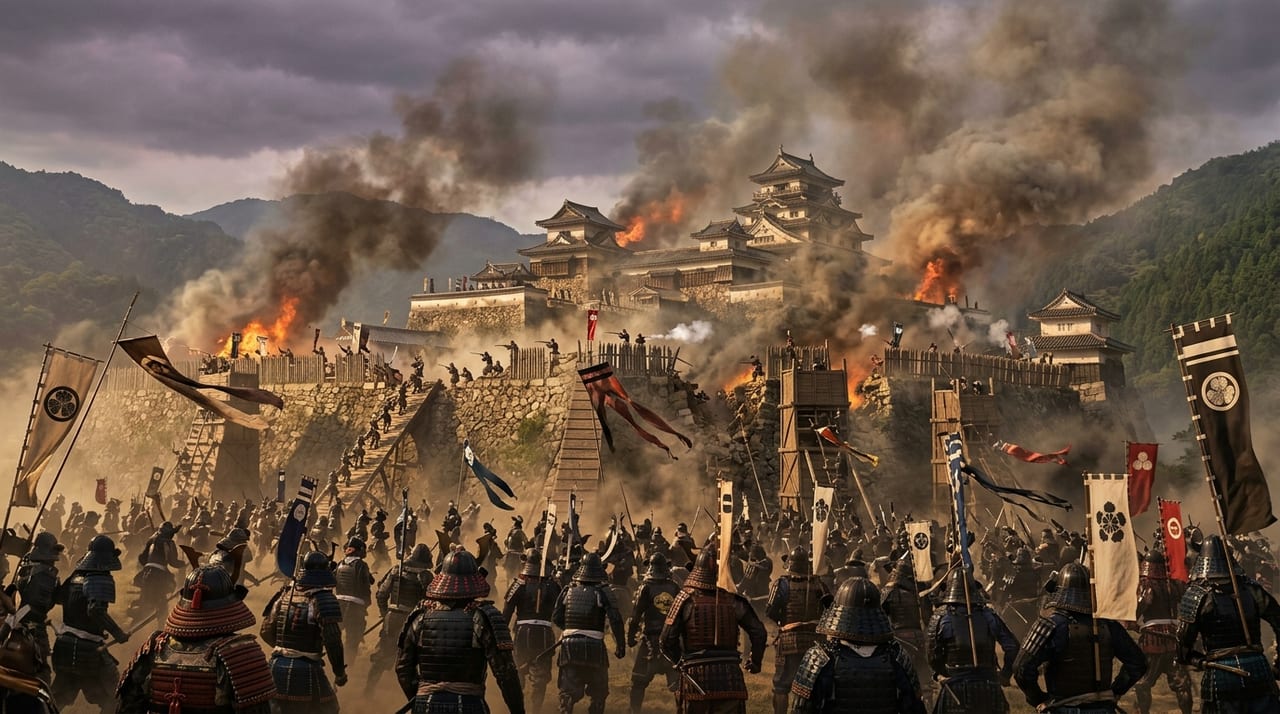
On the morning of September 17, the Eastern Army encircled Sawayama Castle and launched a full assault. The Kobayakawa and Wakizaka forces struck the main gate while Tanaka Yoshimasa's troops attacked the rear gate. Ishida Masatsugu commanded from the main keep while Masazumi fought on in the third bailey alongside reinforcements sent from Osaka. But with only about 2,800 defenders against 15,000 attackers, holding out for long was never a realistic possibility. After fierce fighting, the castle finally fell the following day, September 18. Some accounts suggest that defectors within the castle colluded with the Eastern Army, hastening the collapse of the defenses.
As the castle fell, Ishida Masatsugu and Masazumi, along with Masatsugu's wife and much of Mitsunari's own family, are said to have taken their own lives or died fighting. The base that Mitsunari had built at the height of his power was reduced to ashes in barely two days of fighting, and the Ishida clan was nearly annihilated. Mitsunari himself was still fleeing the field of Sekigahara when word of the castle's fall reached him. He was captured shortly afterward and executed at Rokujō-gawara in Kyoto on October 1 of that year. That Mitsunari alone survived as the defeated commander, only to be executed later, while his father and brother died defending the castle to the last, has long been remembered as emblematic of the Ishida family's tragedy.
The siege of Sawayama Castle is closely tied to the sword administration of the Toyotomi regime. Mitsunari, as one of Hideyoshi's magistrates, had overseen the enforcement of the Tenshō 16 (1588) Sword Hunt Edict (Katanagari), the policy at the heart of separating warrior and farmer by confiscating weapons from the peasantry. Ironically, Mitsunari's own castle was itself brought down by warriors wielding sword and spear against one another. Sawayama Castle is said to have housed a substantial collection of fine swords and arms that Mitsunari had gathered in his capacity as magistrate, much of which was scattered after the castle's fall. His father Masatsugu is also said to have had a discerning eye for swords, suggesting the Ishida family possessed a considerable collection of its own. Contemporary records indicate that the property confiscated from the Ishida clan after their defeat at Sekigahara included numerous swords. Shima Sakon, the retainer immortalized alongside Sawayama Castle in the contemporary saying, was known as a fiercely brave warrior said to have wielded his spear in person during the fighting at Sekigahara, and he stood as an emblem of the martial spirit of the Ishida house's retainers who gathered at Sawayama.
After its fall, Sawayama Castle was seized by the Tokugawa side and Ii Naomasa entered it as castellan. But Naomasa reportedly disliked the idea of using Mitsunari's own castle, considering it ill-omened, and before long began building a new fortress at Hikoneyama — Hikone Castle — and relocated there, leaving Sawayama Castle to fall into disuse. Tradition holds that building materials and portions of the stonework from Sawayama were repurposed in the construction of Hikone Castle, so that in a sense the memory of Sawayama lives on, transformed, within the city of Hikone. Today only scattered stonework and portions of the baileys survive at the site, but it endures as an important historical landmark of Hikone City, forever linked to Mitsunari's tragic downfall. A stone monument to Mitsunari stands at the summit, drawing many history enthusiasts along its mountain trail. The valiant last stand and deaths of Masatsugu and Masazumi are still told locally as a symbol of loyalty to their lord. Alongside the roughly contemporaneous sieges of Tanabe and Ōtsu castles — often recounted together with the main battle of Sekigahara — the fall of Sawayama Castle is remembered as one scene in the sequence of events marking the end of Toyotomi rule and the dawn of the Tokugawa age in the history of Ōmi and Hokuriku.
Ishida Mitsunari
Lord of Sawayama Castle and de facto leader of the Western Army at Sekigahara, absent from the castle and hearing of its fall from afar
Kobayakawa Hideaki
Defected to the Eastern Army during Sekigahara and led the main assault on Sawayama Castle
Ii Naomasa
One of the Four Guardians of the Tokugawa who took part in the assault; briefly held Sawayama Castle after its fall
Tanaka Yoshimasa
One of the Eastern Army commanders who attacked Sawayama Castle's rear gate