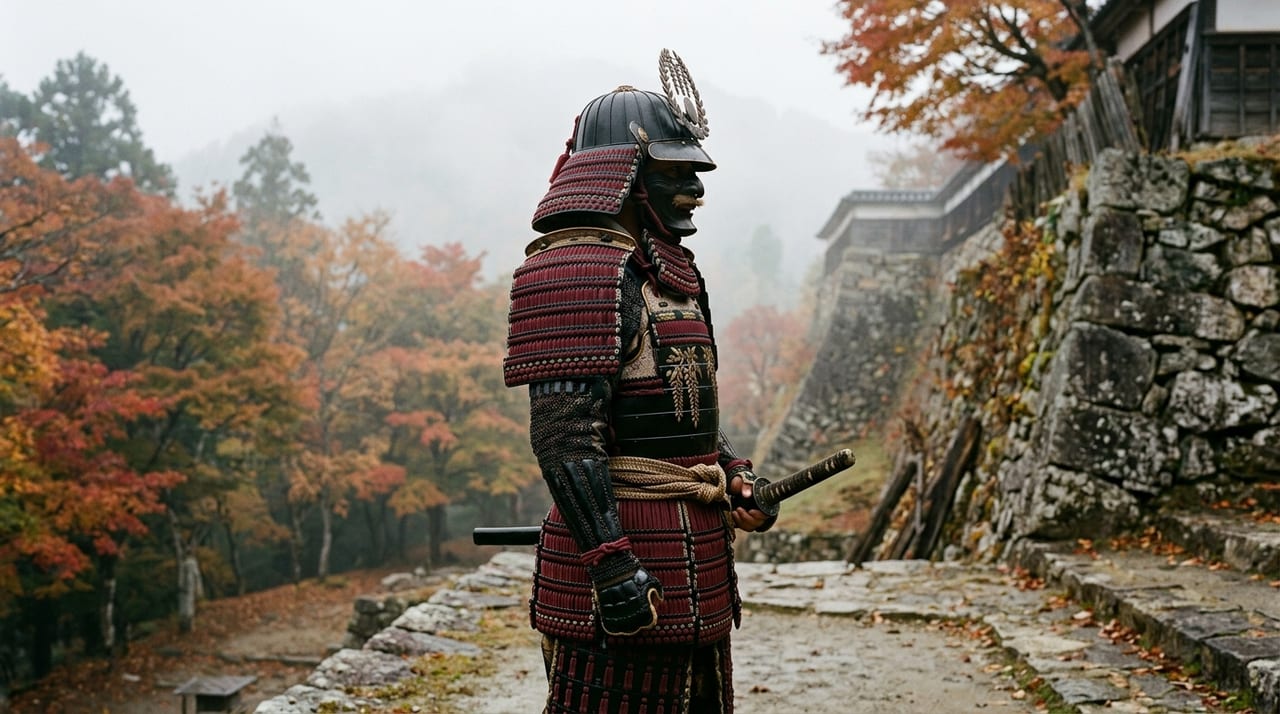
 * Image is for illustrative purposes only.
Ishida Mitsunari
石田三成
The Loyal Strategist of Sekigahara
Description
The Sankencha Anecdote and Rise to Prominence
Born in Eiroku 3 (1560) in Ishida village, Sakata District, Ōmi Province, Ishida Mitsunari became the most capable administrator who supported Toyotomi Hideyoshi's rise to power, and he is remembered in later generations as a symbol of loyalty. The anecdote of the Sankencha ('three cups of tea') about Mitsunari's first meeting with Hideyoshi is widely known. On a falconry outing, Hideyoshi stopped at a temple in Ōmi Province (said to be Kannon-ji on Mount Ibuki). Mitsunari, serving as a temple page (tera-koshō), first served him tea in a large bowl that was somewhat lukewarm, then in a medium-sized bowl that was slightly hot, and finally in a small bowl of hot tea. Hideyoshi was impressed by this thoughtfulness, which moved from plenty of lukewarm tea to small amounts of hot tea for a thirsty guest, and he is said to have taken Mitsunari into his service. This anecdote clearly shows Mitsunari's essence. Attention to detail, the intelligence to anticipate the other person's situation, and the executive ability to carry out a decided policy step by step all foreshadowed Mitsunari's later role in the unification of the realm.
Command Center of the Toyotomi Regime
As one of the Five Commissioners (Go-Bugyō) of the Toyotomi regime, Mitsunari displayed outstanding skill in administration, diplomacy, and land surveys (kenchi). In the Bunroku and Keichō campaigns (the invasions of Korea), he handled logistics and diplomatic negotiations, and he managed these complex duties with outstanding skill. Mitsunari's administrative ability continued to function as a pillar of the House of Toyotomi even after Hideyoshi's death, but his rational, uncompromising character deepened his conflict with military-minded generals such as Fukushima Masanori and Katō Kiyomasa. Sawayama Castle was praised with the saying 'Mitsunari has two things too good for him: Shima Sakon and Sawayama Castle.' It was the base of Mitsunari's governance, and its solid construction reflected his cautious and steady temperament.
Road to Sekigahara
In Keichō 4 (1599), after Hideyoshi's death, a power struggle within the Toyotomi regime came to the surface. As Tokugawa Ieyasu expanded his power through private marriage alliances with daimyō, Mitsunari, as one of the Five Commissioners, denounced Ieyasu's arbitrary conduct. However, military-minded generals moved to raise arms against Mitsunari, and he was forced to retire to Sawayama. It is said that Ieyasu himself, ironically, was the one who protected Mitsunari at this time. In the 7th month of Keichō 5 (1600), taking advantage of the moment when Ieyasu set out to subjugate Uesugi Kagekatsu of Aizu, Mitsunari formed the Western Army with Mōri Terumoto as supreme commander and raised troops to overthrow Ieyasu.
The Battle of Sekigahara and Death
On the 15th day of the 9th month of Keichō 5 (October 21, 1600), the decisive Battle of Sekigahara broke out. Mitsunari's Western Army held the advantage in both troop strength and terrain, but the situation was overturned by the betrayal of Kobayakawa Hideaki. Mitsunari continued to direct the battle from the front until the end, but defeat could not be avoided. After the battle, Mitsunari fled into the mountains of Mount Ibuki but was captured. He was paraded through the streets of Kyoto and then beheaded at Rokujō-gawara. He was aged 41. Just before his execution, someone offered Mitsunari a persimmon, but he declined, saying, 'Persimmons are bad for phlegm.' This anecdote symbolically conveys the essence of Mitsunari as a person: a rational spirit that cared for his own body until the very end of his life.
Swords Associated with Mitsunari
Mitsunari is often portrayed as a figure with a strong civil-official character. Among swords associated with him, the unsigned blade by the swordsmith Masamune that he gave to Yūki Hideyasu is especially famous. Hideyasu served as Mitsunari's escort when Mitsunari retreated to Sawayama Castle after the seven generals' attack (Seven Generals Incident). Hideyasu was delighted with the blade, named it 'Ishida Masamune,' and is said to have used it as a favorite. This sword has been designated an Important Cultural Property and is now held by the Tokyo National Museum. It is also said that when Mitsunari was captured after the Battle of Sekigahara, he gave his favorite tantō to Tanaka Yoshimasa and his son, who had treated him kindly.
Legacy of Righteousness and Wisdom
Ishida Mitsunari has long been portrayed with the image of 'the loser of Sekigahara' and 'the unpopular commissioner.' However, in recent historical research, his administrative ability and single-minded loyalty to the House of Toyotomi are being reassessed. The roles Mitsunari played in the Toyotomi regime, including carrying out the Taikō land surveys in various regions and conducting diplomatic negotiations with daimyō, were indispensable in laying the foundations of early modern Japanese society. The image of Mitsunari as 'a wise commander who lived for righteousness' eloquently shows that the sword is not merely a tool of violence but embodies the soul and pride of the samurai. Both Sawayama Castle and the fields of Sekigahara still convey to the present the brilliance of the sword called 'righteousness' that Mitsunari never let go of to the end.
Notable Swords
- Ishida Masamune (Important Cultural Property, held by the Tokyo National Museum) — an unsigned blade by the swordsmith Masamune, owned by Mitsunari. After the seven generals' attack, it was given to Yūki Hideyasu, who escorted Mitsunari when he retreated to Sawayama Castle, and Hideyasu named it 'Ishida Masamune'