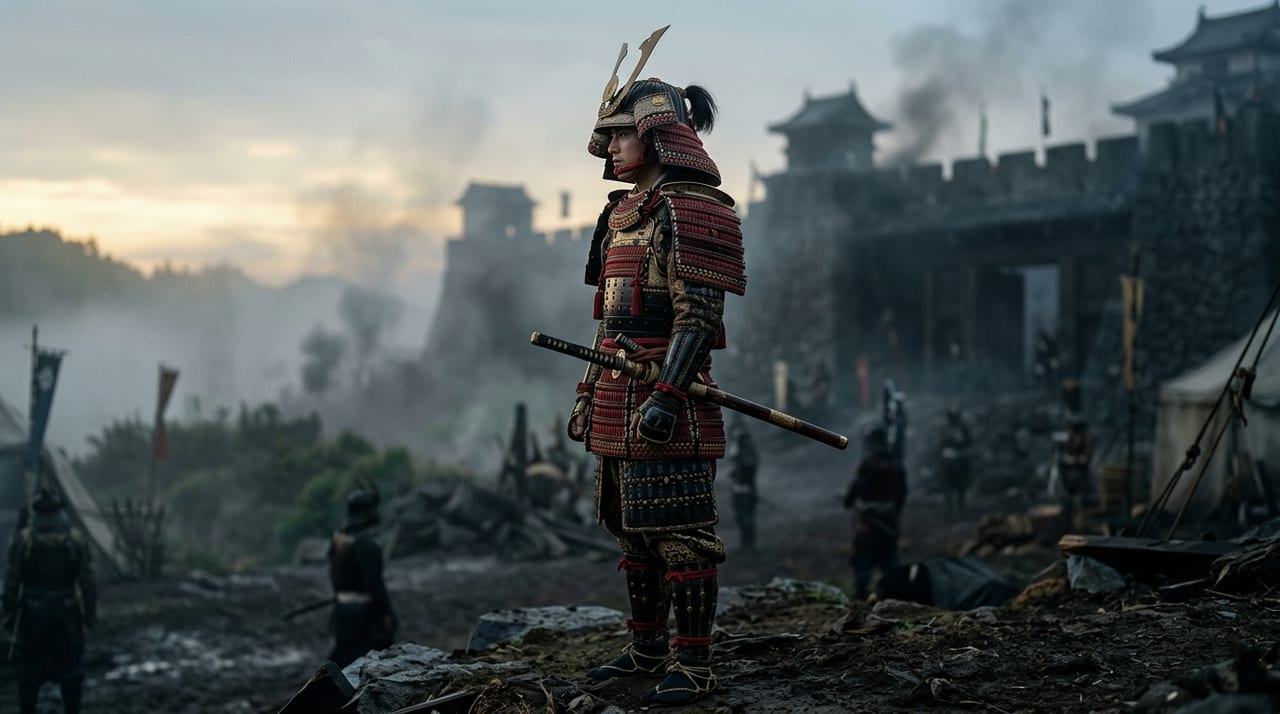
 * Image is for illustrative purposes only.
Mori Ranmaru
森蘭丸
Oda Nobunaga's page—the young hero who fell with his lord during the Honnō-ji Incident
Description
The Page Most Favored by Nobunaga
Mori Ranmaru (Nagasada), born in Eiroku 8 (1565), served Oda Nobunaga as a close attendant page. He is remembered in history as a man who received Nobunaga's overwhelming favor because of his outstanding appearance and wit. His father, Mori Yoshinari, was a prominent commander under Nobunaga, and his elder brother Nagayoshi (known by the epithet "Oni Musashi") was also a fierce warrior of the Sengoku period. Born into this family of fierce warriors, Ranmaru is known, unlike his father and brother, as an attendant of great intelligence. In the Honnō-ji Incident of the 2nd day of the 6th month of Tenshō 10 (1582), Ranmaru died fighting alongside his lord Nobunaga at the age of eighteen.
The Honnō-ji Incident and Ranmaru's Death
Before dawn on the 2nd day of the 6th month of Tenshō 10 (1582), Honnō-ji was surrounded following the rebellion of Akechi Mitsuhide. Ranmaru is said to have fought at Nobunaga's side to the very end. As Akechi's soldiers rushed into Honnō-ji, Ranmaru fought bravely to protect Nobunaga, but he could not hold back the enemy forces against their overwhelming numbers. According to the Shinchōkōki, when Ranmaru, who had gone out to scout, reported, "It appears they are Akechi's men," Nobunaga replied, "It cannot be helped." Ranmaru also died in battle at Honnō-ji. The manner of his death, at only eighteen years old, combined with his beauty and the precocity of his talent, has been deeply engraved in the hearts of Japanese people ever since. Ranmaru's death has been interpreted not as a mere sacrifice in service to his lord, but as "the complete burning-out of a being who embodied beauty and martial prowess."
Ranmaru's Duties
The role of attendant page was not merely that of a personal servant but carried the important duty of protecting the lord's person. The Shinchōkōki frequently records Ranmaru serving as Nobunaga's messenger. In Tenshō 9 (1581), he also served as the messenger when Nobunaga presented a short sword by Okazaki Masamune to Oda Nobutada, and short swords by Awataguchi Yoshimitsu to Oda Nobutaka and Oda Nobukatsu.
An Embodiment of the Sword and Beauty
The figure of Mori Ranmaru has been interpreted in Japanese sword culture as a symbolic person who embodies the "fusion of beauty and martial prowess." Just as a sword is both a "practical weapon" and a "crystallization of beauty," Ranmaru has been described as a person who combined both martial skill and beauty.
Oda Family Sword Culture and Ranmaru
Oda Nobunaga is known as a great collector who possessed many famous swords of the realm, and it is said that many of these blades were lost in the flames together with Nobunaga during the Honnō-ji Incident. Ranmaru served close at Nobunaga's side in this way and shared his lord's fate at Honnō-ji.
Later Influence and Legend
From the Edo period onward, Mori Ranmaru has appeared in many literary works as "a beautiful young samurai," "a model of loyalty," and "Nobunaga's most beloved page," and his legend has been passed down through the ages. Even today, Ranmaru appears in various media, including kabuki, novels, manga, and anime, and holds a special place in the culture of bushidō in Japan. The theme of "the premature death of a young hero who embodied beauty and martial prowess" simultaneously expresses both the nobility and the tragedy that people find in bushidō. Ranmaru's existence demonstrates that Japanese sword culture is a spiritual and aesthetic endeavor that goes beyond the history of mere weapons.