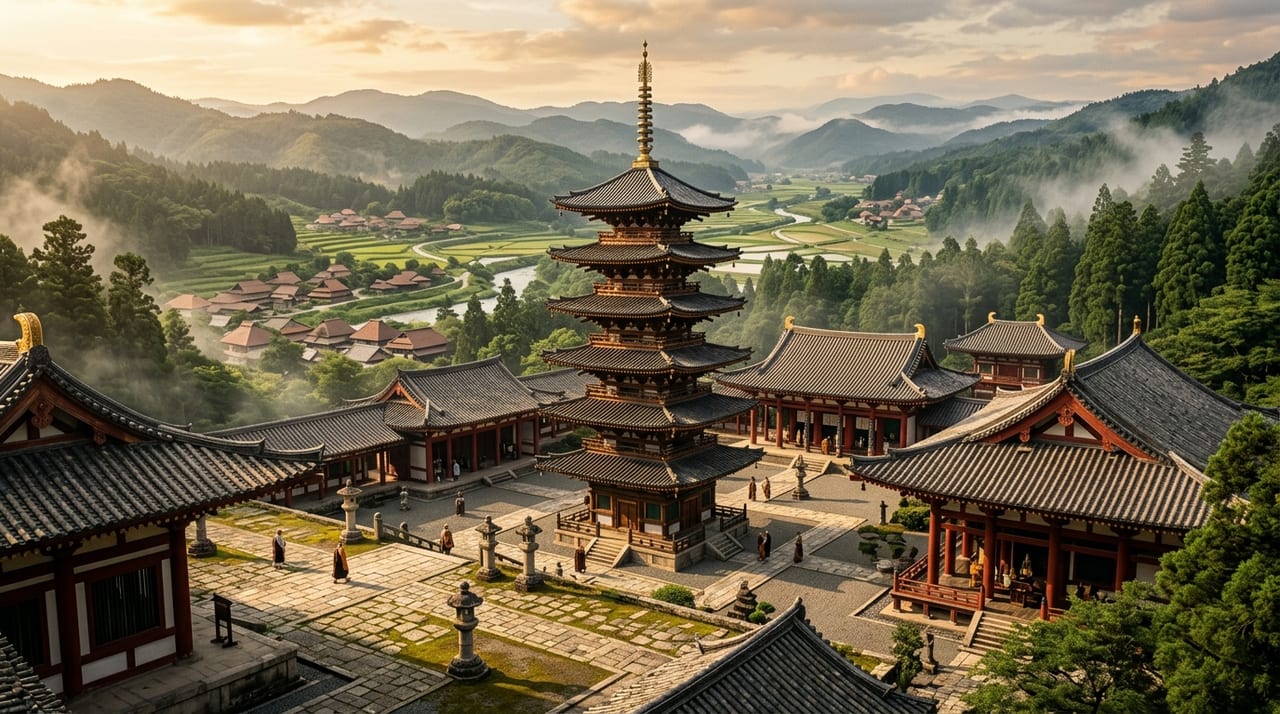
 * Image is for illustrative purposes only.
Azuchi-Momoyama Period — Japanese Swords, 1568–1600
安土桃山時代の刀剣
The Azuchi-Momoyama period (1568–1600) was a roughly thirty-year span during which sword culture changed dramatically in the course of the unification of the realm by Oda Nobunaga and Toyotomi Hideyoshi. With the spread of firearms the battlefield role of swords changed, yet the political and diplomatic value of famous blades rose in turn; Hideyoshi carried out the sword hunt, and Nobunaga and Hideyoshi collected meibutsu. The uchigatana became established as the principal carried sword in place of the tachi, and blade shapes shifted toward the broad, shallow-curved and imposing. The Horikawa school, founded by Horikawa Kunihiro, arose in Kyoto and became the forerunner of the shintō era (Keichō shintō).
Description
Nobunaga's Hegemony and Sword Policy
Oda Nobunaga (1534–1582) used swords as political tools rather than mere weapons as he pushed from Owari toward the unification of the entire country. The exchange of famous swords as gifts was essential to the rituals of alliance and submission with the various daimyo. Nobunaga was especially fond of the splendid works of Osafune Mitsutada, and he collected more than twenty of them. In the Honnōji Incident of 1582, famous swords such as Jikkyū Mitsutada were destroyed by fire, but the surviving swords passed to the Toyotomi family as part of Nobunaga's legacy.
The innovation in firearms tactics, represented by the Battle of Nagashino (1575) that Nobunaga pursued, greatly changed the battlefield role of the sword. Battles fought by large formations with firearms and spears became the mainstream, and the sword came to be positioned as the final weapon for close-range, hand-to-hand combat.
Toyotomi Hideyoshi's Sword Hunt and Meibutsu Policy
In 1588, Toyotomi Hideyoshi (1537–1598) issued the Katanagari edict, which confiscated weapons from farmers and confirmed the hierarchical separation between commoners and samurai. As a result, swords were institutionally established as the exclusive property of the samurai class, and their meaning as proof of samurai status was further strengthened.
Hideyoshi was also enthusiastic about collecting famous swords, and he oversaw the control and management of historically significant swords known as meibutsu. Because unifiers of the realm such as Nobunaga and Hideyoshi collected works by Awataguchi Yoshimitsu, many of them were burned in the Honnōji Incident or the Summer Siege of Ōsaka. Some burned pieces that Tokugawa Ieyasu had searched for were reforged by the first Echizen Yasutsugu, and such reforged swords have also been handed down.
The Establishment of the Uchigatana and Changes in Blade Shape
The Azuchi-Momoyama period was the era in which the mainstream portable sword made a complete transition from the tachi to the uchigatana. The tachi is a long-bladed sword suspended from the waist with the edge facing down, and it developed as the weapon of mounted warriors. By contrast, the uchigatana is a shorter sword worn at the waist with the edge facing up, and it is suited to close combat on foot.
Momoyama-period uchigatana are characterized by a bold blade shape that is wide and has a large width near the tip. The curvature is relatively shallow, and the kissaki is large, giving a powerful impression. This shape was inspired by the bold tachi of the Nanboku-chō period and was carried on as the form of Keichō shintō.
The Rise of the Horikawa School
At the end of the Azuchi-Momoyama period (1590s), a group of swordsmiths centered on Horikawa Kunihiro emerged, having established a workshop on the Horikawa in Kyoto. Kunihiro was a swordsmith from Hyūga, and he served the Itō clan of Hyūga, a Sengoku-period daimyo. After his former lord's fall, he traveled through various provinces making swords, and from around 1599 he settled at Ichijō Horikawa in Kyoto, where he trained many disciples.
From the Horikawa school came influential swordsmiths such as Dewa Daijō Kunimichi, Kuniyasu, Izumi no Kami Kunisada, and Kawachi no Kami Kunisuke, who formed the mainstream of early Edo-period shintō (Keichō shintō). Kunihiro also left works with horimono, such as the "Yamabushi Kunihiro" (1584), which bears carvings of the image of Fudō Myōō and bonji characters. Kunihiro himself received high praise both for his own works (honsaku) and for the works of his disciples (deshi-saku), and he established the foundations of the shintō period.
Characteristics of This Era
- The Azuchi-Momoyama period (1568–1600) was an age in which the battlefield role of swords changed with the spread of firearms; the sword was positioned as the last weapon in close-quarters melee, and blades with a broad body, shallow curvature and a large point became established.
- Toyotomi Hideyoshi's Sword Hunt Edict of 1588 institutionally fixed swords as the exclusive property of the samurai class, and formed the direct foundation of the Edo-period sword culture in which swords functioned as proof of status and of the lord–retainer bond.
- The political use of famous swords by Oda Nobunaga and Toyotomi Hideyoshi (gift diplomacy and control of meibutsu) sharply raised the economic and cultural value of swords, and established the distinctively Japanese culture of meibutsu, in which rulers monopolized and managed famous blades as “meibutsu of the realm.”
- The shift in carrying style from tachi to uchigatana was completed: the uchigatana, worn edge-up at the waist, became the standard sidearm of the samurai, and this reshaped the whole Japanese sword culture, down to blade shape, manufacturing techniques and styles of appreciation.
- The establishment of the Horikawa school centered on Horikawa Kunihiro in Kyoto (around 1599) embodied the bridge from late-Sengoku kotō to Keichō shintō, and formed the technical starting point of the mainstream shintō schools of the early Edo period.
- Some of Horikawa Kunihiro's works bear horimono, such as the “Yamabushi Kunihiro” (1584), which is carved with an image of Fudō Myōō, Sanskrit seed syllables (bonji) and the characters “Bun'un chōkyū”; blade carving is thus one of the highlights of Momoyama-period swords.