New Arrivals — Browse our catalog for the latest authentic Japanese sword arrivals. Browse →
June 21, 1582 (Tenshō 10, 6th month, 2nd day)
Kyoto, Honnō-ji
Forces
Rebel Forces
Oda Forces
About 9 min read
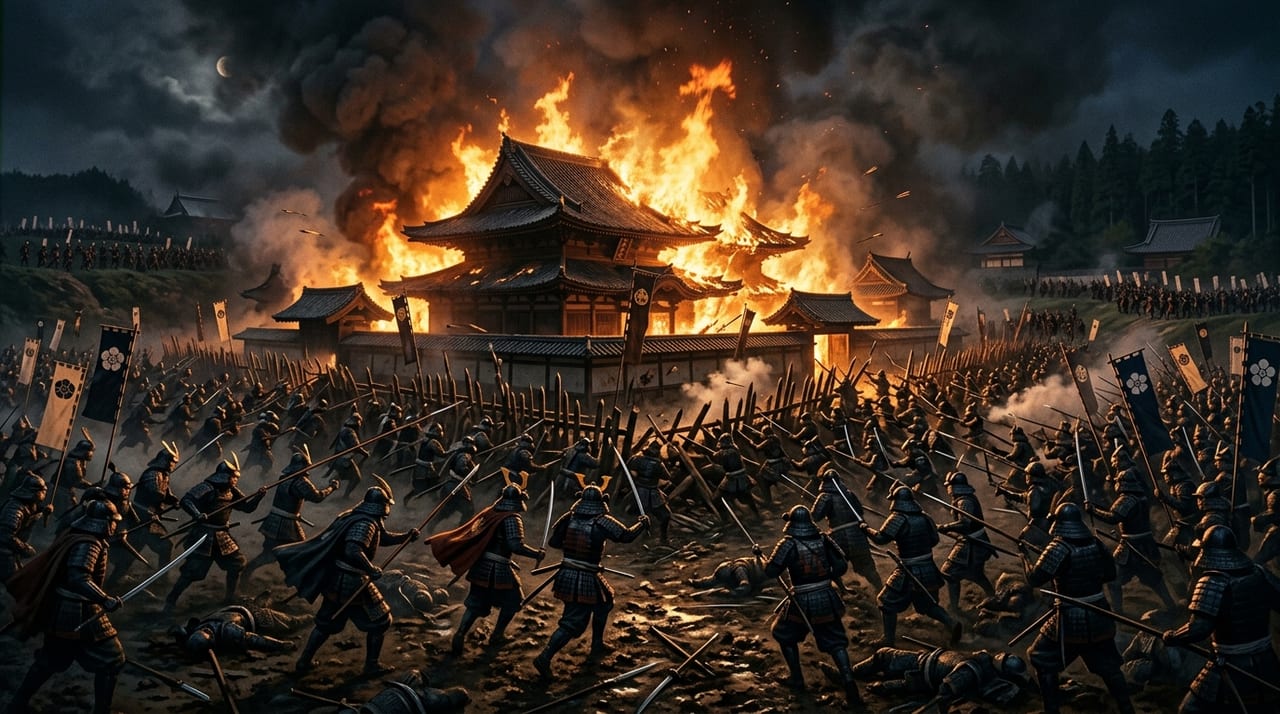
Before dawn on the 2nd day of the 6th month of Tenshō 10 (June 21, 1582), Japanese history took a dramatic turn. Oda Nobunaga, the ruler of the realm, who was lodging at Honnō-ji in Kyoto, was surrounded by 13,000 troops under his retainer Akechi Mitsuhide. With no way to escape, he took his own life. This event is known as the Honnō-ji Incident.
Oda Nobunaga is known as a warlord with an unusual attachment to swords. As ruler of the realm, he collected famous blades from across the country, and the number he held far surpassed that of other sengoku daimyō. One of the swords Nobunaga loved most was Heshikiri Hasebe. This blade is known as one that Oda Nobunaga bestowed on Kuroda Yoshitaka (Kanbei). Nobunaga not only prized it as a weapon, but it was also a symbol of the keen intellect suggested by its finely honed point (kissaki).
Sōsan Samonji (Yoshimoto Samonji) is also famous as the sword Nobunaga took from Imagawa Yoshimoto, whom he defeated at the Battle of Okehazama. The blade bears a gold-inlaid inscription reading “On the 19th day of the 5th month of Eiroku 3, the sword carried by Yoshimoto, whom we subdued,” and is said to have been kept by Nobunaga for the rest of his life as a commemoration of victory. In an age when owning famous swords was proof of authority, Nobunaga's sword collection itself expressed his aspiration to rule the realm.
Nobunaga also engaged with the culture of swords through tea utensils, not just blades. At the time, famous tea implements were political gifts on a par with famous swords, and Nobunaga established a form of governance built on these treasures, known as “ochanoyu goseidō” (“tea-ceremony politics”). The combination of swords and tea utensils symbolizes an image of Nobunaga who joined martial power with refined culture.
Why Akechi Mitsuhide launched his rebellion remains debated today as “the 400-year mystery.” Various theories exist: a grudge theory (humiliation at Nobunaga's hands), an ambition theory (that he aimed for the realm himself), and a mastermind theory (that the imperial court or Toyotomi Hideyoshi was involved). In any case, Mitsuhide is known as a man of cultivated learning, skilled in both letters and arms.
After the Honnō-ji Incident, it is confirmed from historical records that Mitsuhide took possession of Nobunaga's treasures, and it is presumed that these included swords.
In the early hours of the 2nd day of the 6th month, Nobunaga was lodging at Honnō-ji with only a small group of pages. The page Mori Ranmaru (Mori Naritoshi) also accompanied him as a close attendant. When Mitsuhide's forces broke in, Nobunaga is said to have taken up his bow and then fought with a naginata (polearm), but as flames rose around him, he took his own life. Ranmaru also shared his lord's fate.
At this time, many of the famous swords Nobunaga possessed are said to have vanished in the flames of Honnō-ji or to have been seized by Mitsuhide's forces. The tantō (dagger) Fudō Yukimitsu, known as one of Nobunaga's beloved blades, is said to have been destroyed by fire in the Honnō-ji Incident, though there is also a tradition that it was later passed down in the Ogasawara family.
The Honnō-ji Incident brought a major break to the sword culture Nobunaga had assembled. Nobunaga's surviving retainers each inherited famous swords, or fought over them. Toyotomi Hideyoshi defeated Mitsuhide at the Battle of Yamazaki, and in succeeding to the position of ruler of the realm, he collected and organized famous swords formerly owned by Nobunaga as symbols of authority. The inheritance of famous swords was inseparable from the succession of the regime.
Another cultural effect the Honnō-ji Incident had on sword culture was a transformation of the spirit of “suki.” Nobunaga's death signified the defeat of his ideal of unifying the realm by force, and at the same time it prompted his successors, Hideyoshi and Ieyasu, to pursue rule through culture. The lineage of sword appraisal culture, which continued through Hideyoshi's golden tea room and sword collecting, and later through the compilation of the Kyōhō Meibutsuchō at the command of the eighth shogun, Tokugawa Yoshimune, demonstrates the enduring strength of Japanese culture, which carried on across the break the Honnō-ji Incident caused.
Honnō-ji still stands in Nakagyō Ward, Kyoto (later relocated and rebuilt), and every year on June 2 a memorial service for Nobunaga is held. The sword Heshikiri Hasebe, associated with Nobunaga, is now held by the Fukuoka City Museum and designated a National Treasure. Sōsan Samonji passed from Toyotomi to Tokugawa, and is now dedicated to Takeisao Shrine (Kyoto). These swords are living witnesses that carry the historical event of the Honnō-ji Incident into the present, and they remain widely cherished as masterpieces at the core of Japan's sword culture.
1582年の本能寺の変では、信長とともに多くの名物や名刀が炎に包まれた。火災で刃を傷めた「焼身(やけみ)」の刀がたどる運命と、本能寺で失われたと伝わる信長愛刀の逸話を史料に即して紹介する。
2026-07-06
三日月宗近、鬼丸国綱、へし切長谷部、薬研藤四郎など、名刀に付く「号」はどう生まれたのか。銘との違いと、姿・逸話・信仰・身近な物に基づく命名の型を解説する。
2026-10-13
戦国武将・織田信長が構築した刀剣文化の後援体制を分析する。安土城への刀工集結、部下・大名への刀剣下賜・受納の慣行、そして「天下布武」の権威を刃に込めた政治的意図を解き明かす。
2026-05-11
応仁の乱以降の戦国時代に激増した刀剣需要の中で、量産型の数打ち物(かずうちもの)と最高品質の名刀という二極化した需要に応えた刀工の実態と、孫六兼元ら名工の系譜、そして実戦経験から生まれた刀の形状変化を解説する。
2026-05-06