New Arrivals — Browse our catalog for the latest authentic Japanese sword arrivals. Browse →
January 20, 1587 (12th day, 12th month, Tenshō 14)
Hetsugigawa River, Bungo Province (present-day Handa area, Oita City, Oita Prefecture)
Forces
Toyotomi Vanguard (Sengoku / Chōsokabe / Sogō coalition)
Shimazu Forces
About 13 min read
On January 20, 1587 (Tenshō 14/12/12), on the riverbank of the Hetsugigawa in Bungo Province (near present-day Handa, Ōita City), a tragic battle took place that colors the final phase of the Sengoku period. The Battle of Hetsugigawa, in which the vanguard sent ahead of Toyotomi Hideyoshi's Kyushu campaign was annihilated by the great strength of the Shimazu army, is deeply etched into history for the death in battle of Chōsokabe Nobuchika, eldest son of Chōsokabe Motochika, master of Shikoku.
Having defeated Ryūzōji Takanobu at the Battle of Okitanawate (1584), the Shimazu clan further accelerated its conquest of Kyushu. Ōtomo Sōrin, whose power had been diminished, had an audience with Toyotomi Hideyoshi at Osaka Castle in Tenshō 14 (1586) and requested reinforcements in exchange for submission. In autumn of Tenshō 14 (1586), Hideyoshi resolved to launch the Kyushu campaign and ordered the daimyō of Shikoku and Chūgoku to mobilize as the vanguard.
The military inspector (gunkan) of the vanguard was Sengoku Hidehisa, a veteran commander who had served Oda and Toyotomi and had also distinguished himself in the Shikoku campaign (1585). Joining him were the father and son Chōsokabe Motochika and Chōsokabe Nobuchika (aged 22), as well as Sogō Masayasu, the former lord of Awa and Sanuki.
Nobuchika was the eldest son whom his father Motochika had boasted was “no less than Fan Kuai.” Confined to Tosa Province alone after the Shikoku campaign of 1585, Motochika secured the survival of his house by submitting to the Toyotomi regime, and his expectations for Nobuchika as successor were immense. This Kyushu expedition was expected to be the perfect opportunity for Nobuchika to make a name for himself as a commander.
In the 12th month of Tenshō 14, when the Shimazu army under Shimazu Iehisa attacked Tsuruga Castle (present-day Ōita City), which was held by Ōtomo forces, the vanguard set up its camp in front of the Hetsugigawa to relieve the castle. The two armies faced each other across the Hetsugigawa.
Facing the Shimazu army (commander: Shimazu Iehisa), military inspector Sengoku Hidehisa insisted on giving priority to relieving Tsuruga Castle and on crossing the river to attack.
Chōsokabe Motochika opposed the crossing, arguing that they should wait for reinforcements. However, Sogō Masayasu sided with Sengoku, and Motochika too had no choice but to follow the decision of military inspector Sengoku Hidehisa. This judgment was a fatal error.
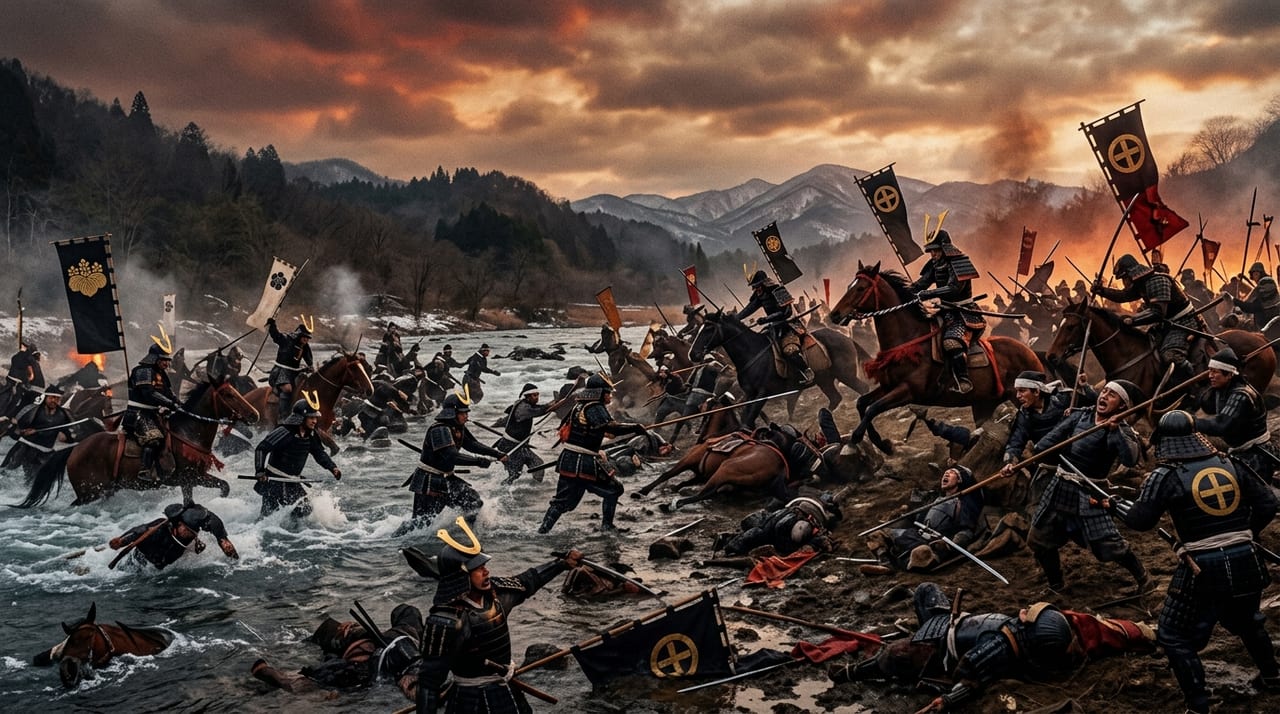
As the Toyotomi vanguard began crossing, it came under a fierce counterattack from the Shimazu army the moment it reached the far bank. Soldiers still in the river could not form up, and the Shimazu elite troops charged in all at once. The Toyotomi army fell into great confusion and collapsed entirely.
While retreating, Chōsokabe Nobuchika chose to serve as the rearguard (shingari). Military inspector Sengoku Hidehisa fled early, but Nobuchika did not withdraw even when urged to, and fought on to the end.
Nobuchika continued his last resistance at the Nakatsuru riverbank of the Hetsugigawa and died in battle. He was 22 years old. Sogō Masayasu also died on the same battlefield, and the Toyotomi vanguard, having lost its commanders, was annihilated.
According to the Motochika-ki, Nobuchika wielded a great naginata of 4 shaku 3 sun and felled eight men. When enemies closed in, he discarded the naginata and cut down six more with a long sword. The Tosa Monogatari gives the length of this sword as 3 shaku 5 sun. It is also said that at his genpuku coming-of-age ceremony he was given the character “Nobu” by Oda Nobunaga, along with a famous blade by Samonji.
Upon receiving word of his eldest son's death, Chōsokabe Motochika's sorrow was extraordinary. Motochika himself tried to die in battle but was rebuked by his retainers and fled to Hiburi Island in Iyo. Later he sent Tani Tadazumi to the Shimazu camp to receive Nobuchika's remains, and upon seeing the disfigured body he is said to have broken down in tears, unable to bear looking directly at it. This episode shows the depth of the expectation and affection Motochika had placed in Nobuchika.
Regarding the succession, Motochika changed his course considerably after losing his eldest son. After Nobuchika's death, he named his fourth son, Morichika, as successor, but this created serious friction with his other children. This succession dispute became the seed of internal strife in the Chōsokabe house, leading to a chain of tragedies: participation on the Western side at the Battle of Sekigahara (1600) and its defeat there, Morichika's killing of his elder brother Tsuno Chikatada, the attainder of the Chōsokabe house in the same year (1600), and later Morichika's execution after the Siege of Osaka (1615).
Nobuchika's death at the Hetsugigawa was not merely a personal tragedy for Motochika. It became a distant cause of the ruin of the Chōsokabe house, masters of Shikoku.
Sengoku Hidehisa, who had fled after the defeat, received severe punishment from Toyotomi Hideyoshi. Hideyoshi regarded Hidehisa's flight and his rash order to cross the river as a serious problem, confiscated his domain, and imposed kaieki (attainder). Afterward, through the mediation of Tokugawa Ieyasu, Hidehisa joined the Odawara campaign (1590), distinguished himself in battle, and was granted 50,000 koku at Komoro in Shinano by Hideyoshi, returning to the status of daimyō (later the first lord of Komoro Domain). However, the failure at the Hetsugigawa remained an indelible stain on his career.
This punishment is an important example of the responsibility for judgment borne by Sengoku commanders. The Battle of Hetsugigawa sharply demonstrated that the essence of a commander lies not only in the courage to wield a sword in battle, but in the judgment of when to cross a river and when to withdraw.
In spring of Tenshō 15 (1587), shortly after the Battle of Hetsugigawa, Toyotomi Hideyoshi personally led a large army into Kyushu. Faced with Hideyoshi's great army, Shimazu Yoshihisa surrendered, and the warring states period in Kyushu came to an end.
Hideyoshi subsequently issued the Sword Hunt Edict (1588), prohibiting peasants and religious forces from possessing swords, and pushed forward a social policy that reserved swords for the warrior class. The swords of the young commanders who fell at the Hetsugigawa symbolize the passing of an era in which blades changed character from “swords of the battlefield” to “swords as symbols of the warrior.”
The Hetsugigawa battlefield, where Chōsokabe Nobuchika and Sogō Masayasu fell, still bears its place name within Ōita City today. Though their swords may have been lost, the spirit of the commanders who fought to the death on that battlefield has been handed down to the present as the aesthetics of a noble death, a legacy inherited by Japan's swordsmanship culture.
Chōsokabe Motochika
Chōsokabe lord and Nobuchika's father, devastated by his heir's death
Shimazu Iehisa
Shimazu commander who destroyed the Toyotomi vanguard
Sengoku Hidehisa
Toyotomi vanguard commander who ordered the disastrous river crossing and was later dismissed
Toyotomi Hideyoshi
Ordered the Kyushu campaign and led the main army after the vanguard defeat