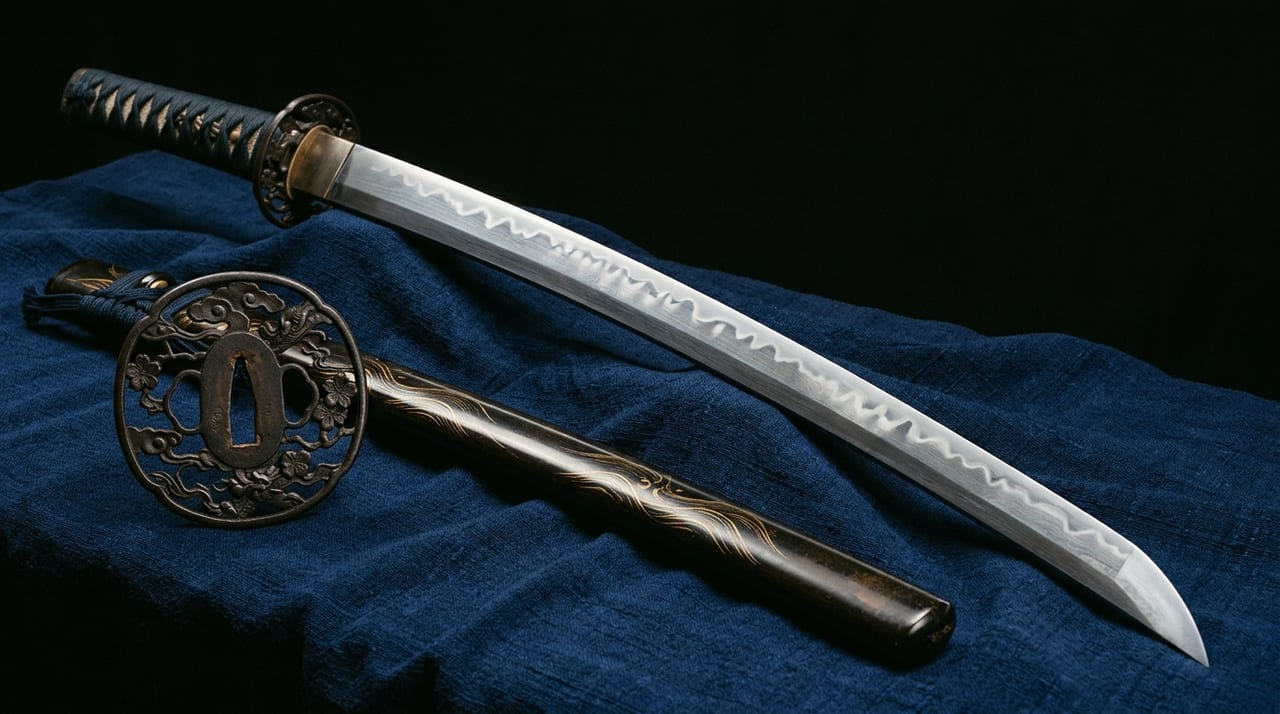
 * Image is for illustrative purposes only.
Yoshimoto Samonji
義元左文字
Also known as: Sōza Samonji / Okehazama Trophy Blade
Description
Overview of the Sword
Yoshimoto Samonji is a legendary sword forged by Samonji (Hidari), a master smith of the Nanboku-chō period, and is deeply tied to the Battle of Okehazama, one of the most dramatic scenes of the Sengoku period. Imagawa Yoshimoto treasured it, and when he was defeated and killed by Oda Nobunaga at Okehazama, the sword was seized as spoils. Nobunaga had the blade shortened (suriage) and inscribed a gold-inlaid inscription on the flat of the tang recording his own achievement, and thus this sword became a living witness to Sengoku history itself. With a practical uchigatana form and a blade length of 2 shaku 2 sun 1 bu (approx. 67.0 cm), it embodies the bold style of the Nanboku-chō period. It is currently designated an Important Cultural Property, owned by Kenkun Shrine (Kita Ward, Kyoto City) and deposited at the Kyoto National Museum, and it continues to hold a special presence as a famous sword where the history of Japanese swords and Sengoku history intersect most vividly.
Samonji School and the Smith Samonji (Hidari)
The smith Samonji (Hidari), who lived in Chikuzen Province (present-day Fukuoka Prefecture) during the Nanboku-chō period, is called Samonji because he chiseled the character 'Sa' into his signature, said to be an abbreviation of Saemon Saburō. The Samonji school was a group of smiths representing northern Kyushu. It independently developed the bold style of the Sōshū tradition (the forging techniques of Kamakura and Sagami) using Kyushu's abundant iron sand and its own forging methods. Its style is characterized by a shift from the earlier plain style of straight hamon to a splendid and refined style in which the hamon undulates and stands out sharply. Surviving works of the Samonji school include the Kōsetsu Samonji, the Taikō Samonji (National Treasures), and the Sayo Samonji (Important Cultural Property), and the school is highly regarded as a sword-making tradition of Kyushu.
The Battle of Okehazama: Yoshimoto's Sword Passes to Nobunaga
The most important and dramatic event in the history of Yoshimoto Samonji is the Battle of Okehazama, which took place on the 19th day of the 5th month of Eiroku 3 (1560). As a daimyō with the greatest power along the Tōkaidō, Imagawa Yoshimoto invaded Owari Province with a large army said to number 25,000. Against the overwhelming size of the Imagawa army, the petty Owari daimyō Oda Nobunaga could muster barely a little over 2,000 troops. However, on the afternoon of the 19th day of the 5th month, a violent storm accompanied by heavy rain struck the Okehazama area. Nobunaga saw this natural upheaval as an opportunity and ordered a full charge into the storm. The Oda army burst into the confused Imagawa forces, whose vision was obstructed, and Yoshimoto's main camp was overrun in an instant. Yoshimoto was killed by Hattori Kazutada and Mōri Yoshikatsu, and along with his head, this sword became Nobunaga's spoils of war.
Nobunaga's Gold Inscription: A Declaration of Victory Carved into History
Nobunaga did not treat this sword as a mere weapon or art object. On the flat of the tang (nakago), he had an inscription inlaid in gold. The inscription reads: 'On the 19th day of the 5th month of Eiroku 3, Yoshimoto was slain and captured; carved on the sword he had possessed: Oda Owari-no-kami Nobunaga.' This gold-inlaid inscription is evidence of Nobunaga's strong self-expression and his sense of history. For Nobunaga, the victory at Okehazama was not merely a win in a single battle but a turning point that became the starting point of his bid to take control of the realm. By permanently carving the record of that victory into the beloved sword of Yoshimoto, Nobunaga deeply inscribed his own presence into history.
The name 'Sōza' derives from the Buddhist name (hōmyō) 'Sōza' of Miyoshi Masanaga (Sōza), a close retainer of Hosokawa Harumoto who once owned this sword, and the sword is transmitted under both the names Sōza Samonji and Yoshimoto Samonji.
From Toyotomi and Tokugawa to the Present Day
After the Honnō-ji Incident (1582), Yoshimoto Samonji passed into the hands of Toyotomi Hideyoshi and then to Tokugawa Ieyasu. During the Edo period it was kept as an okoshimono (personal sword) of the Tokugawa shogunal family and was treasured as a famous treasure of the realm, recorded in the Kyōhō Meibutsuchō. Later it was transmitted within the Tokugawa shogunal family, and it is now owned by Kenkun Shrine (Kita Ward, Kyoto City) and deposited at the Kyoto National Museum. Designated an Important Cultural Property, Yoshimoto Samonji is unique in the history of Japanese swords in that its blade carries concrete historical testimony in the form of a gold-inlaid inscription. Unrivaled elsewhere, it is both a sword of artistic value and a historical record of the most critical moment of the Sengoku period, and it continues to captivate many history enthusiasts and sword fans today.
Form and Artistic Value of the Sword
The blade of Yoshimoto Samonji embodies the bold style of the Nanboku-chō period while also possessing a practical beauty suited for use. Its blade length of 2 shaku 2 sun 1 bu (approx. 67.0 cm) is somewhat long for an uchigatana, and it is a practical length that can handle both drawing from horseback and cutting exchanges on foot. The ground steel (jigane) is itame, the hamon is straight (suguha) with midare mixed in, and the boshi curls back in a slightly pointed shape. Straight grooves (bō-hi) run down both faces. The blade was burned in the Great Fire of Meireki in Meireki 3 (1657) and was re-tempered (saiba), and at that time part of the gold-inlaid inscription on the tang melted and now appears as gold grains. It is currently designated an Important Cultural Property, owned by Kenkun Shrine (Kita Ward, Kyoto City) and deposited at the Kyoto National Museum. The reason this sword ranks first-class both as an art object and as historical testimony is that Samonji's forging technique and Nobunaga's historical intent are condensed into a single blade.
Intersection of Japanese Swords and Sengoku History
The reason Yoshimoto Samonji continues to hold special meaning today is that this sword most directly embodies the moment when Japanese swords and history intersect. Many famous swords were treasured by emperors, shoguns, and daimyō and carry vague provenances of 'owned by someone at some time.' Yoshimoto Samonji, by contrast, has concrete historical facts carved into its blade as a gold-inlaid inscription: a specific day (the 19th day of the 5th month of Eiroku 3), a specific place (Okehazama), and a specific event (the death of Yoshimoto and his seizure by Nobunaga). This is extremely rare in the history of swords. The Battle of Okehazama is one of the turning points of Japanese history, and Yoshimoto Samonji, which transmits that turning-point moment as material evidence, most powerfully demonstrates that a Japanese sword can be a 'witness to history' beyond being a mere weapon or art object.
Legends & Stories
The Eve of Okehazama: Yoshimoto and His Beloved Sword
In the fifth month of Eiroku 3 (1560), Imagawa Yoshimoto, the most powerful daimyo on the Tōkaidō, led a great army said to number 25,000 men into Owari Province. Yoshimoto was known as a skilled commander, accomplished in both the literary and martial arts, and he was also a man of high cultivation who loved renga poetry and courtly culture. It is historically recognized that Yoshimoto combined cultural refinement with real military strength. This sword was one of the blades Yoshimoto kept especially treasured, and from early on it was known throughout the realm as a masterpiece by the renowned smith Samonji (Hidari). There is no clear record of when or from whom he acquired it, but it is said that Miyoshi Masanaga (Sōza) owned it, that it then passed through Takeda Nobutora to Yoshimoto's hands, and that it came to be called Sōza Samonji after Sōza's name. Yoshimoto set out for Owari with this sword at his waist, but his fate was about to change dramatically amid the torrential rain of Okehazama.
The Miracle of Okehazama: History Born of a Storm
It is said that on the 19th day of the fifth month of Eiroku 3 (1560), Oda Nobunaga chanted a passage from the kōwaka-mai "Atsumori" at Kiyosu Castle before setting out: "Human life is fifty years; compared with the span of the heavens below, it is like a dream or an illusion." Nobunaga could gather only a little over 2,000 troops. In a proper pitched battle, they would simply have been wiped out before Imagawa's 25,000. However, in the afternoon a torrential rain and storm struck the Okehazama area directly. Amid the rain that blocked the view, Nobunaga ordered his entire army to charge. The Imagawa army, whose main camp was resting, was suddenly attacked and fell into confusion. Yoshimoto fought bravely and wounded Hattori Kazutada, who was the first to strike at him, but he was killed by Mōri Yoshikatsu. In a battle lasting only some tens of minutes, the great commander who had aimed to take the realm met a regretful end. The Sōza Samonji he wore at his waist passed into Nobunaga's hands as a spoil of war.
The Gold Inlay Inscription of Nobunaga: Engraving Victory Forever
Nobunaga did not treat this sword as a mere spoil of war. On the tang of the blade, he had an inscription inlaid in gold. The inscription reads: "On the 19th day of the 5th month of Eiroku 3 (1560): Yoshimoto slain and taken; inscribed from the sword he carried. Oda Owari-no-kami Nobunaga." This act is one of the episodes that most clearly shows Nobunaga's historical consciousness and the intensity of his self-expression. For Nobunaga, the victory at Okehazama was not merely the win of a single battle but the starting point of his grand ambition to take the realm. Engraving his own name and the date of victory forever on the most beloved sword of the enemy commander shows Nobunaga's fierce will to rewrite the course of history with his own hands. The sword also came to be called "Yoshimoto Samonji" after Yoshimoto's name, and it became a blade that conveys Nobunaga's victory.
From Ruler to Ruler: The Sword's Journey Through History
After Okehazama, Nobunaga steadily advanced on the path to unifying the realm. This sword was treasured in Nobunaga's hands as one of his most important commemorative objects, but even after Nobunaga was killed by Akechi Mitsuhide in the Honnōji Incident of Tenshō 10 (1582), the sword continued on. It passed into the hands of Toyotomi Hideyoshi, and in the era of Toyotomi Hideyori it was presented to Tokugawa Ieyasu. In the Edo period, this sword was recorded in the Kyōhō Meibutsuchō as a treasure of the Tokugawa shogunal house, and it was prized as a famous sword of the realm. That the sword passed through the hands of all three great heroes of the Sengoku period is also a major feature of its provenance. It is currently owned by Kenkun Shrine in Kyoto City (on deposit at the Kyoto National Museum), and its gold-inlaid inscription still vividly tells the "memory of Okehazama" today.
The Historical Inevitability the Sword Speaks Of
The greatest reason the story of Yoshimoto Samonji appeals to people today is that this sword is not a product of chance but embodies the inevitability of history. The finest sword chosen by Yoshimoto, the greatest victory carved by Nobunaga, and the proof of rule over the realm handed on by Hideyoshi and Ieyasu all pile up in a single sword. No other example speaks as eloquently as Yoshimoto Samonji to the fact that a Japanese sword is a "vessel that holds history," beyond being merely a weapon or an art object.
Hideyoshi and Ieyasu: What Yoshimoto Samonji Saw of Unification
The path Yoshimoto Samonji took after leaving Nobunaga's hands also reflects the history of Japan itself. After Nobunaga fell in the Honnōji Incident (1582), Toyotomi Hideyoshi inherited this sword. After Hideyoshi's death (1598), it passed to his son Hideyori, and from Hideyori it was presented to Tokugawa Ieyasu. Ieyasu is believed to have deeply understood the provenance of this sword: the history by which the beloved sword of Yoshimoto, the overlord of the Tōkai, came into hand through Nobunaga's victory and then flowed on to the Toyotomi and the Tokugawa. In the Edo period, Yoshimoto Samonji was strictly preserved as a Tokugawa shogunal koshimono (sword worn at the waist), and it was prominently listed in the Kyōhō Meibutsuchō compiled at the order of the eighth shogun, Yoshimune, becoming a famous sword of the realm. The provenance of a sword held by all three great heroes of the Sengoku period further raises the historical weight of Yoshimoto Samonji.
The Spirit of Yoshimoto Samonji Living On in the Present
Even after the Meiji Restoration, through the era of the sword abolition edict and the "rich nation, strong army" policy, Yoshimoto Samonji was passed on continuously. When the main hall of Kenkun Shrine was built, it was donated by Tokugawa Iesato, and it is now owned by Kenkun Shrine in Kita Ward, Kyoto City (on deposit at the Kyoto National Museum). Even today, Yoshimoto Samonji is one of the most famous swords among history fans and sword enthusiasts, and its name comes up whenever Nobunaga and Yoshimoto are depicted in NHK taiga dramas and historical novels. In the sword game Touken Ranbu, it appears as a character under the name "Sōza Samonji," and the name is widely known among younger generations as well. Even after nearly five hundred years, Yoshimoto Samonji still conveys the storm of Okehazama to the present and continues to speak of the inseparable relationship between Japanese history and the sword.