New Arrivals — Browse our catalog for the latest authentic Japanese sword arrivals. Browse →
6th–10th months of Tenshō 10 (1582)
Kai Province, Shinano Province, and Kōzuke Province (present-day Yamanashi, Nagano, and Gunma Prefectures)
Forces
Tokugawa Ieyasu's Forces
Hōjō Ujimasa's Forces
Uesugi Kagekatsu's Forces
About 10 min read
On the 2nd day of the 6th month of Tenshō 10 (1582), Oda Nobunaga died a violent death in the Honnōji Incident. This sudden political vacuum shocked the whole of Japan, but the area most directly affected was the former Takeda territory. Only a few months after Takeda Katsuyori's downfall at the Battle of Tenmokuzan in the 3rd month of the same year, Nobunaga, who had been administering Kai, Shinano, and Kōzuke, was also gone. Three parties rushed into this "double vacuum": Tokugawa Ieyasu, Hōjō Ujimasa, and Uesugi Kagekatsu. This was the Tenshō Jingo War.
When the Honnōji Incident occurred, Tokugawa Ieyasu was staying in Sakai. His retinue numbered only several dozen men. With Akechi Mitsuhide's forces deployed in Kyoto, Ieyasu needed to return to the eastern provinces, but the route back was extremely dangerous.
The route Ieyasu chose for his return to Mikawa was the Iga crossing (Shinkun Iga-goe). He traversed the treacherous mountain paths of Iga at the risk of his life, and Ieyasu somehow made it back to Okazaki. This experience is also said to have forged Ieyasu and led to the calm, composed judgment he would later be known for.
What reached Ieyasu after his return were a series of surrenders and offers of allegiance from kunishū (local lords) in the former Takeda territory. Kai and Shinano, whose administration Nobunaga had reorganized after the Takeda fall, were left "up in the air" again by Nobunaga's death, and their local lords were searching for a new lord. Ieyasu did not let this opportunity slip away.
At the same time that Tokugawa Ieyasu was pursuing an advance into Kai and Shinano, Hōjō Ujimasa also made his move. After the Honnōji Incident, the Later Hōjō broke their alliance with the Oda family. On the 19th day of the 6th month, they defeated Takigawa Kazumasu of the Oda side at the Battle of Kannagawa, took control of Kōzuke, and then sought to advance into Kai and Shinano.
A large army with Hōjō Ujinao (Ujimasa's son) as commander-in-chief invaded Kai and Shinano, forming a head-on clash with the Tokugawa. The fighting between the two sides centered on Yamanashi, but the choices of the kunishū greatly influenced the course of the war. As more kunishū ultimately came over to the Tokugawa side, the Hōjō advance stalled.
Uesugi Kagekatsu also made moves over northern Shinano and Kōzuke (present-day Gunma Prefecture). The area around Kawanakajima, which had been fiercely contested between the Uesugi and the Takeda, was land that Kagekatsu felt he was "taking back." Kagekatsu seized the former Takeda holdings in northern Shinano. Naoe Kanetsugu, who was emerging as Kagekatsu's close aide, served as liaison with the Shinano retainers. Kagekatsu then formed a complex rivalry with both the Tokugawa and the Hōjō.
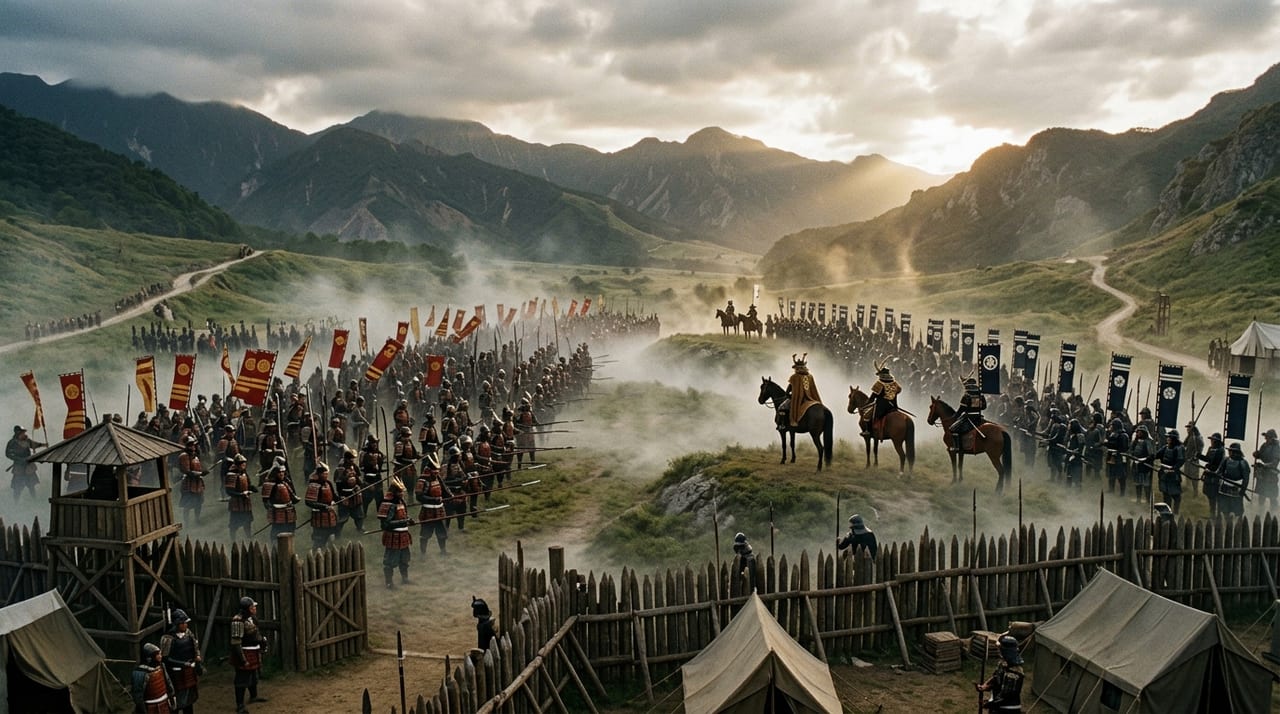
The climax of the Tenshō Jingo War was the standoff between the Tokugawa and the Hōjō at Wakamiko in Kai Province (from late in the 7th month to late in the 10th month). The two armies, led by Tokugawa Ieyasu and Hōjō Ujinao, faced each other at Wakamiko. For a long period they repeated skirmishes while remaining locked in a stalemate.
The defining feature of this Wakamiko standoff is that it never developed into a full-scale battle. Both armies struggled with supply shortages, and both also had to stay wary of Uesugi movements in the north. The balance between the Tokugawa and the Hōjō was ultimately settled in the form of a peace.
On the 29th day of the 10th month, Ieyasu concluded a peace with the Hōjō on the condition that he would marry his second daughter, Toku-hime, to Hōjō Ujinao. It was agreed that Kai and Shinano would go to Ieyasu and Kōzuke to the Hōjō, each to be taken as each side could seize it. Through this "marriage of Toku-hime," the Hōjō of southern Kantō and the Tokugawa of Tōkai and Kōshin became in-law relatives. This peace also became the foundation of Tokugawa–Hōjō relations in the Toyotomi period.
After Ieyasu gained control of Kai and Shinano through the Tenshō Jingo War, he incorporated many former Takeda retainers and kunishū into his own retainer corps.
The Tenshō Jingo War held decisive significance for Tokugawa Ieyasu's historical trajectory.
Before the Honnōji Incident, Ieyasu's domain consisted of three provinces: Mikawa, Tōtōmi, and Suruga. He was a daimyō with a certain amount of power, but he maintained his position within Oda Nobunaga's tenka fubu. Through the Tenshō Jingo War, however, Ieyasu added Kai and Shinano, becoming the greatest power in the east and ruling five provinces.
Without this leap, Ieyasu might never have gained the special position of being the daimyō to be most wary of after Toyotomi Hideyoshi unified the country. The power base that Ieyasu expanded further through the transfer to the Kantō (Tenshō 18 (1590)) would not have existed without his control of Kai and Shinano in the Tenshō Jingo War.
In the autumn of Tenshō 10, sword-bearing warriors faced off in the mountains of Kai. This standoff quietly laid the foundation for the more than 260-year system of the Edo shogunate that followed. Turning points in history often take the form of long standoffs that remain undecided.
Tokugawa Ieyasu
Tokugawa Ieyasu — secured Kai and Shinano in the Tenshō Jingo War, transforming into the dominant lord of eastern Japan.
Hōjō Ujimasa
Hōjō Ujimasa — the Late Hōjō lord who competed with Ieyasu for the former Takeda domains and eventually concluded a peace agreement.
Uesugi Kagekatsu
Uesugi Kagekatsu — deployed forces to northern Shinano and Kōzuke in the Tenshō Jingo War, seeking to recover former Takeda territories.
Naoe Kanetsugu
Naoe Kanetsugu — Kagekatsu's principal adviser during the Tenshō Jingo War, rising to prominence as the senior Uesugi strategist.
Honda Tadakatsu
Honda Tadakatsu — one of the 'Four Heavenly Kings' of Tokugawa; served Ieyasu throughout the Kai and Shinano campaigns.
Takeda Katsuyori
Takeda Katsuyori — the immediate precondition of the Tenshō Jingo War; his destruction at Tenmokuzan in the 3rd month of the same year created the power vacuum that triggered the conflict.