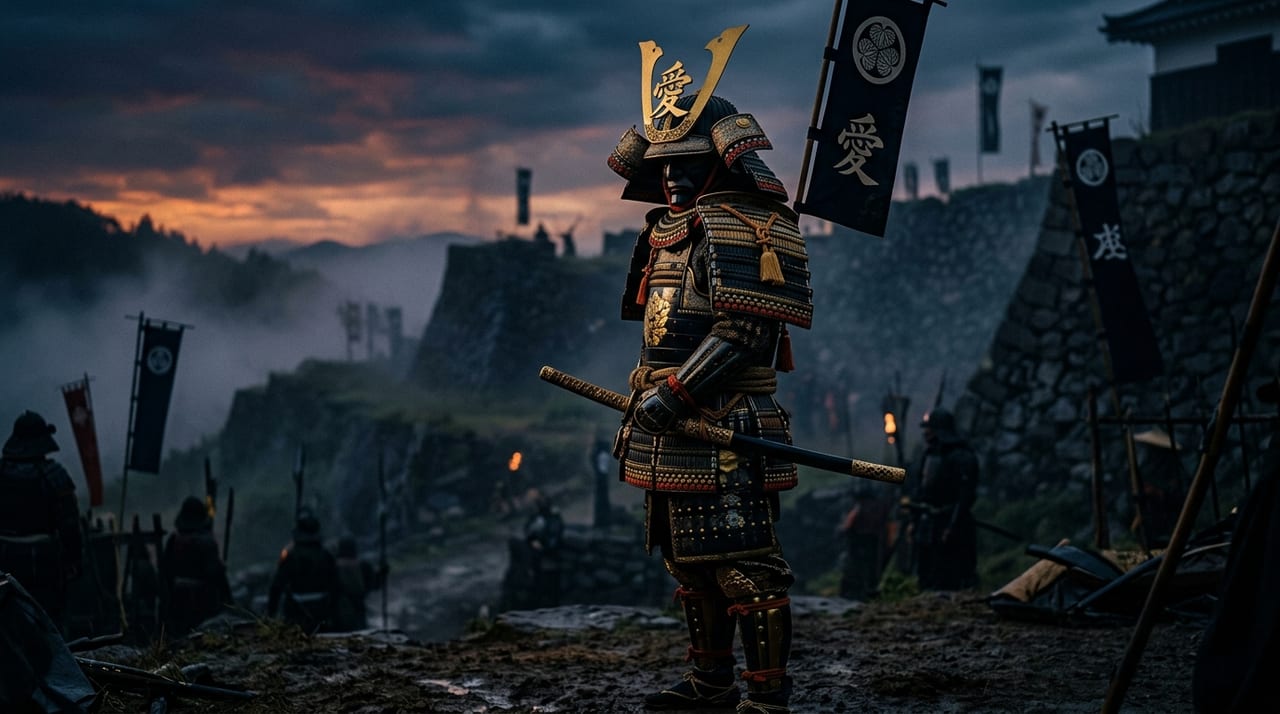
 * Image is for illustrative purposes only.
Naoe Kanetsugu
直江兼続
The Warrior of Love — A Uesugi Master Strategist with an 'Ai' Helmet Crest, Perfecting Both Martial and Literary Arts
Description
The Meaning Behind the "Ai" Helmet Crest
Naoe Kanetsugu, who is said to have been born in 1560 (Eiroku 3) in the castle town below Sakado Castle in Echigo Province, was a renowned strategist who supported the Uesugi family throughout his life as chief senior retainer to Uesugi Kagekatsu. The name Kanetsugu is widely known in modern times because of the single character "Ai" that he displayed on the front crest of his helmet. Various theories exist about what this "Ai" means, and the theory that it derives from faith in Atago Gongen or Aizen Myōō is well known; among these, the view that it refers to the "Ai" of Atago is considered the most likely. In any case, Kanetsugu's spirit in using a helmet bearing the character "Ai" well expresses his essential character as a man who reached the pinnacle of both the literary and martial arts.
Bond with Kagekatsu
According to tradition, Kanetsugu served at the side of Uesugi Kagekatsu, Uesugi Kenshin's successor, from an early age, and the two were bound by a firm bond that never broke for the rest of their lives. During the Otate no Ran (in the 6th year of Tenshō, 1578), in which Kagekatsu contended for the position of Kenshin's successor, Kanetsugu worked tirelessly as Kagekatsu's close aide and is said to have contributed to his victory. Afterward, active as Kagekatsu's aide in both administrative and military affairs, Kanetsugu displayed a wide range of talents, from governing all of Echigo Province to diplomacy in the capital region under the Toyotomi regime, and he earned such renown that, according to the Meishō Genkōroku, Toyotomi Hideyoshi named him as one of the rear vassals (baishin) to whom the governance of the realm could be entrusted.
Practicing the Literary and Martial Arts
Kanetsugu's cultural accomplishments stood out even among the warlords of his day. He was well versed in Chinese classics, Chinese poetry, and renga, and his passion for learning in particular never waned throughout his life. While establishing the foundations of domain governance as the first senior retainer of the Yonezawa Domain, Kanetsugu deepened his devotion to Zen Buddhism and founded the Zenrin Bunko, which became the domain's school of learning, devoting himself to promoting scholarship. This passion for education became the foundation of the Yonezawa Domain's later cultural and educational policies, and it also served as the spiritual origin of the domain reforms promoted by Uesugi Yōzan in the mid-Edo period. Kanetsugu also took part in renga gatherings of the leading cultural figures of his era, and the Confucian scholar Arai Hakuseki of the mid-Edo period praised his poetic talent.
The Uesugi Family's Swords
The collection of famous swords gathered by Uesugi Kenshin was inherited by Kagekatsu after Kenshin's death. Kagekatsu selected particularly favored swords and compiled them into a register called the "Uesugi Kagekatsu Otesen Sanjūgo-koshi" (the thirty-five swords personally selected by Uesugi Kagekatsu), and many of the swords handed down in the Uesugi family are fine works from Bizen Province (Bizen-mono). The tantō "Kenshin Kagemitsu" by Osafune Kagemitsu of Bizen, once Kenshin's personal blade, has been designated a National Treasure and is currently held by the Saitama Prefectural Museum of History and Folklore. In addition, the swordsmith Naoe Sukemasa, who served as an official smith to the Mito Domain in the late Edo period, claimed to be a descendant of Kanetsugu.
Sekigahara and the Survival of the Uesugi
At the Battle of Sekigahara in the 5th year of Keichō (1600), Uesugi Kagekatsu and Naoe Kanetsugu coordinated with Ishida Mitsunari and the Western Army, clearly taking a stance against Tokugawa Ieyasu. The letter that Kanetsugu is said to have sent in reply to the accusatory message he received from Tokugawa Ieyasu is known as the "Naoe-jō." The Naoe-jō thoroughly refutes Ieyasu's accusations and boldly asserts the legitimacy of the Uesugi, and its dignified style and sharp logic astonished people in later generations. However, after the Western Army was defeated at Sekigahara, the Uesugi family received a drastic reduction from 1.2 million koku to 300,000 koku, and they were ordered to relocate from Aizu to Yonezawa. Kanetsugu devoted all his energy to rebuilding the domain's government amid this hardship.
Foundations of the Yonezawa Domain
On the 19th day of the 12th month of Genna 5 (January 23, 1620), Kanetsugu died at the Naoe family residence in Edo (the Uroko Yashiki). He was 60 years old. The grave of Kanetsugu and his wife, O-Fune no Kata, at Rinsen-ji in Yonezawa, remains a place that many people still visit today. Kanetsugu's spirit of loyalty to his lord, consideration for the lives of the people, and dedication to learning took deep root in the land of Yonezawa and became the foundation of the domain's later culture and education.