New Arrivals — Browse our catalog for the latest authentic Japanese sword arrivals. Browse →
January 6, 1586 (Tenshō 13/11/17)
Motomiya, Mutsu Province (present-day Motomiya, Fukushima Prefecture; vicinity of Hitotori Bridge)
Forces
Date Forces
Satake-Ashina-Nikaidō-Shirakawa Coalition
About 13 min read
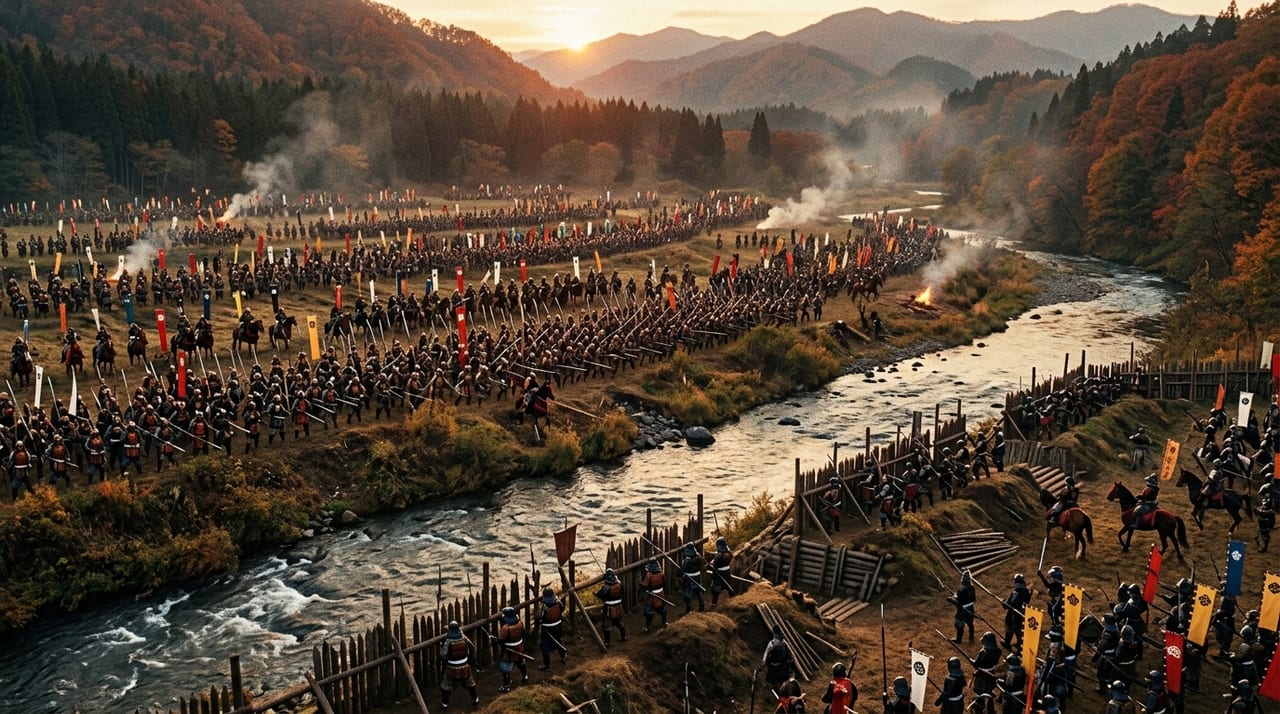
In the 11th month of Tenshō 13 (January 1586), near Hitotorihashi in Motomiya of Mutsu Province (present-day Motomiya City, Fukushima Prefecture), the eighteen-year-old Date Masamune faced the greatest crisis of his life in a struggle for hegemony over the Tōhoku region. The great alliance arrayed against him, led by Satake Yoshishige and including the feudal lords of Hitachi as well as Ōshū warlords such as Ashina, Nikaidō, and Shirakawa, numbered approximately 30,000 in total. In contrast, the Date army numbered only some 7,000. Faced with this seemingly hopeless numerical disadvantage, the young one-eyed dragon stood against the fate of the Tōhoku region with blade and spirit.
Date Masamune (1567–1636) was born in Yonezawa, Dewa Province (present-day Yonezawa City, Yamagata Prefecture). In his childhood, he lost the sight of his right eye to smallpox, earning him the alias of the "one-eyed dragon." In Tenshō 12 (1584), at the age of seventeen, Masamune inherited the family headship from his father Terumune and embarked on a policy of aggressive expansion.
It was Satake Yoshishige of Hitachi (Ibaraki) who grew alarmed at Masamune's rapid series of attacks on Ōuchi Sadatsuna and the Hatakeyama clan. Satake called upon Ōshū warlords such as Ashina, Nikaidō, Shirakawa, Ishikawa, and Iwaki, forming an "alliance to strike down the Date."
In the 10th month of Tenshō 13 (1585), a shocking incident occurred: Date Terumune was taken hostage by Hatakeyama Yoshitsugu, lord of Nihonmatsu Castle (the Awa no Su Incident). Though Masamune killed Yoshitsugu, in the process Yoshitsugu dragged his father Terumune to his death as well—a tragedy that ensued. Still reeling from his father's death, Masamune faced the decisive battle at Hitotorihashi with the alliance army.
The Date clan was a renowned family of Mutsu Province and had deep ties to swords. Among the blades that Masamune collected and possessed throughout his life were works by master smiths from various regions.
The blade culture of the Tōhoku region stood apart, possessing a distinctive character that set it apart from the central blade-forging culture of Kyoto and Yamato. Particularly from the Nanbokuchō period through the Muromachi period, Mutsu smiths, while influenced by the center, established their own distinctive style.
Among the blades particularly beloved by Date Masamune is the famous "Shokudaigiri Mitsutada." This tachi is said to be the work of Mitsutada, the celebrated master smith of Bizen Osafune, and later took its name from a legend in which Masamune cut down a candlestick with it. It is now housed in the Tokugawa Museum in Mito, Ibaraki Prefecture and is widely known as a celebrated blade associated with the Date clan.
Date Shigezane (1568–1646) was Masamune's cousin and a fierce general who supported Masamune at the Battle of Hitotorihashi. Shigezane was renowned for his valor, and his bold manner of fighting was repeatedly depicted in later tales and martial arts narratives.
On the seventeenth day of the eleventh month of Tenshō 13, the alliance army deployed around Motomiya and clashed with the Date forces. Masamune left Motomiya Castle and took up position at Kannondō-yama, and the battle unfolded around the Hitotorihashi bridge over the Setogawa River.
The battle turned into a one-sided assault by the alliance army, and the Date forces broke and fled in disarray. The veteran Oniniwa Sagetsusai (Yoshinao) fell in battle while serving as rear guard, and Date Shigezane's forces also held their ground to buy time, so Masamune barely escaped to Motomiya Castle. With nightfall, the fighting for the day came to an end. It is said that if the alliance army's advance had continued for just a bit longer, the Date clan could not have escaped destruction.
But then a dramatic reversal occurred. News of an urgent problem arising within Hitachi reached Satake Yoshishige, who commanded the alliance army (accounts of the details vary). Yoshishige decided to withdraw, and the alliance army withdrew en masse. The Date army, exhausted to the point of being unable to pursue, miraculously survived.
This survival, achieved through something akin to an "unopposed victory," had an incalculable impact on Masamune. The experience of "having lived through the greatest crisis" honed his decision-making and confidence, becoming the spiritual foundation for his bold expansion policies to come.
Inseparable from any account of the Battle of Hitotorihashi is the death of his father Terumune, which occurred just before the battle. In the Awa no Su Incident (8th day of the 10th month, Tenshō 13), a historical mystery remains: whether Masamune was unable to rescue his father Terumune, who had become a hostage, or whether he deliberately allowed him to be killed.
What impact this death of his father had on the inner world of the eighteen-year-old Masamune is a theme repeatedly taken up by later scholars and writers. The experience of "fighting through the greatest crisis (Hitotorihashi) immediately after his father's death" can be interpreted as the moment Masamune "awakened" as a true Sengoku daimyo.
From the perspective of the blade, the loss of his father and his fierce struggle on the battlefield must have deeply inscribed upon Masamune the meaning of "why a samurai wields a sword." The family headship and swords inherited from his father shone with renewed significance as symbols of "what must be protected" in the defensive war against the alliance's vast armies.
Having overcome the crisis at Hitotorihashi, Date Masamune rapidly established his hegemony over Tōhoku in the five years that followed.
At the Battle of Suriagehara in Tenshō 17 (1589), he decisively defeated Ashina Yoshihiro and brought Aizu under his control. With this, the Date clan's domain reached its maximum extent, and the name "one-eyed dragon" resounded throughout the realm. However, in the following year, Tenshō 18 (1590), when Masamune arrived late in responding to Toyotomi Hideyoshi's Odawara Campaign, he received severe rebuke from Hideyoshi and was forced to accept a substantial reduction in his territory.
Notable in the development of blade culture during this period is how Masamune employed swords as "instruments of diplomacy." By presenting celebrated blades to Hideyoshi and Tokugawa Ieyasu, Masamune maintained relationships and ensured the survival of the Date clan—a testament to an era when swords transformed from mere weapons into "political mediators."
The Battle of Hitotorihashi was the crucible that announced the birth of the exceptional warlord Date Masamune. The young one-eyed dragon, who at eighteen engaged in a life-or-death struggle against the greatest alliance army of Tōhoku, built upon this experience to establish his later rule of the region. That the later Masamune became a collector of celebrated blades such as the "Shokudaigiri Mitsutada" and a patron of blade culture was surely rooted in the formative experience of having "shared sword and life-and-death" at Hitotorihashi.
Date Masamune
Date commander at seventeen; survived against overwhelming odds
Date Shigezane
Date general and Masamune's cousin; fought ferociously in the battle
Satake Yoshishige
Coalition commander from Hitachi; withdrew the allied forces
Ashina Moriuji
Ashina clan (coalition side)
Naoe Kanetsugu
Uesugi retainer (later major rival of Date)