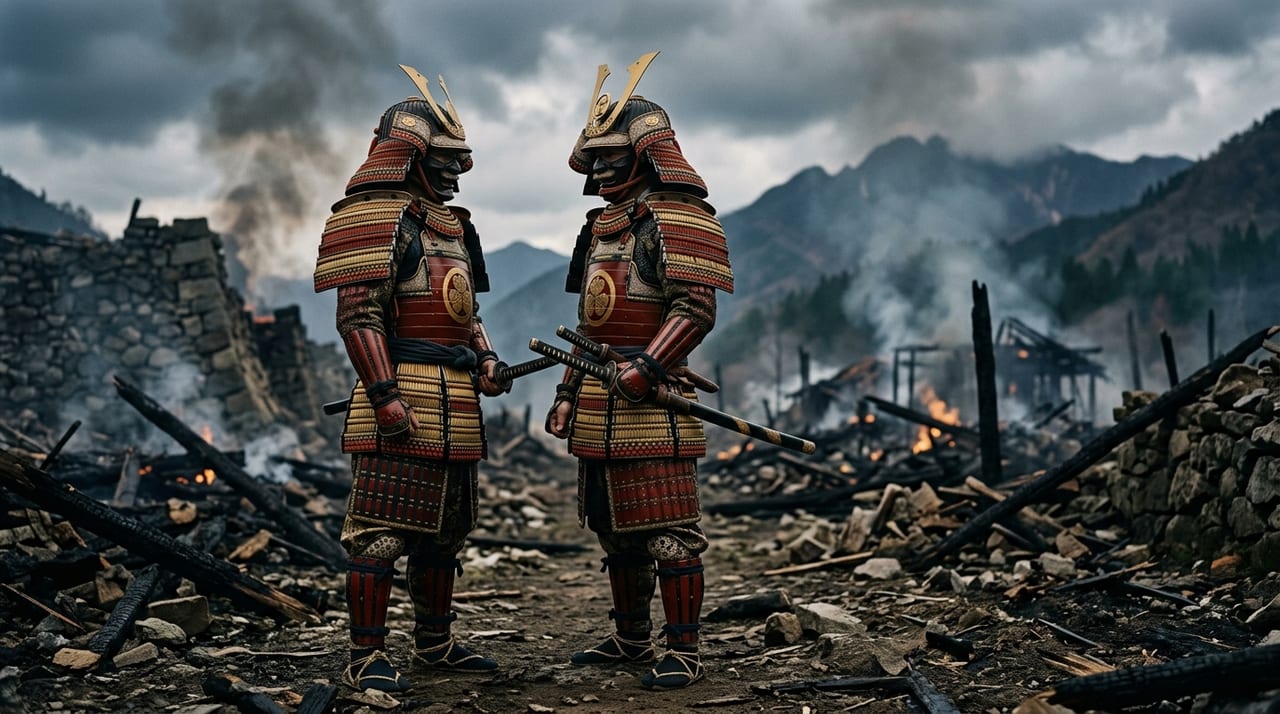
 * Image is for illustrative purposes only.
Date Masamune
伊達政宗
One-Eyed Dragon
Description
The Birth of the One-Eyed Dragon
Date Masamune, born in Yonezawa, Dewa Province, in Eiroku 10 (1567), was the 17th head of the Date family. He established dominance over Ōshū and, under the nickname "One-Eyed Dragon," carved his name into Sengoku history as a rare, unparalleled commander. He lost the sight of his right eye to smallpox in childhood, but rather than being diminished by this handicap, his single eye came to symbolize the fierce individuality and indomitable fighting spirit that defined Masamune.
Military Prowess in Youth
Masamune's military talent blossomed early. In Tenshō 17 (1589), at the age of just twenty-three, he defeated Ashina Yoshihiro at the Battle of Suriagehara and subjugated almost all of southern Ōshū. Even before that, at the Battle of Hitotoribashi in Tenshō 13 (1585), he himself fell into a crisis of being exposed to arrows and shot, and in the Ōsaki campaign of Tenshō 16 (1588) he struggled against, among others, his uncle Mogami Yoshiaki. He experienced many fierce battles in this way.
Profound Connoisseurship of Swords
Masamune's sword collecting was a political and cultural pursuit that went beyond mere hobby. The most famous of his blades, "Shokudaikiri Mitsutada," is a single sword said to be the work of Mitsutada, said to be the founder of the Osafune school. According to tradition, the name arose because Masamune cut down an attendant who had committed a transgression, and when the attendant hid behind a bronze candlestand, Masamune cut through the candlestand along with him. Mitsutada's blades are known for their splendid chōji-midare hamon and the beauty of their jigane (ground steel), but the sharpness that Shokudaikiri displays suggests a ferocity that surpasses even that renown. The sword later passed to the Mito Tokugawa family and was reduced to a fire-damaged blade in the Great Kantō Earthquake of 1923. In 2015, however, it was confirmed that it survives at the Tokugawa Museum in its fire-damaged state.
Legendary Favorite Swords
The katana "Ōkurikara" is said to be the work of Sōshū Hiromitsu. According to tradition, in the Genna era it was presented to Masamune by Shogun Tokugawa Hidetada as a reward for the stone walls built for Edo Castle. Kurikara means the Kurikara dragon king, the manifestation of Fudō Myōō, and the name derives from the Kurikara dragon carved into the blade. It was originally a tachi of over three shaku that was shortened by ō-suriage (heavy shortening), and its present cutting length is a little over two shaku two sun. Further, "Taikogane Sadamune" is a tanto said to be the work of Sadamune, who is said to have been either a disciple or a son of Masamune of Sōshū. The name derives from the fact that a wealthy merchant of Sakai who used "Taikogane" as his trade name owned it. In the 12th month of Genna 3 (January 1618), Masamune's son Tadamune received it from Shogun Hidetada, and it has been transmitted as the foremost treasure of the Sendai Date family. By holding these famous swords of the realm, the Date family displayed the dignity of a warrior house both at home and abroad.
Patronage of Swordsmiths
Masamune did not merely collect famous swords; he also devoted himself to promoting sword production within his own domain. In Keichō 19 (1614), he retained Kunikane, also called the first domain smith of the Sendai domain, thereby laying the foundations of Sendai swordsmithing. The first-generation Kunikane is said to be a descendant of the Yamato Hoshō school. Under Masamune's orders he studied with Etchū-no-kami Masatoshi of Kyoto and left his name for his work in the masame (straight-grain) forging style of the Yamato tradition. The Kunikane family continued as swordsmiths to the Date family until the 13th generation in the late Edo period.
Aesthetic Sense and Brilliance of Dress
Masamune's aesthetic sense is also clearly expressed in his attire. In Bunroku 2 (1593), the splendid military dress of the Date troops who joined the Bunroku campaign drew acclaim from the people of Kyoto. It is also said that from then on, people fond of flashy dress came to be called "date-mono." The black-lacquered five-plate armor (kuro-urushi gomaidō gusoku) said to have been used by Masamune, held by the Sendai City Museum, and the large crescent-moon maedate that adorns its helmet continue to captivate people today as masterpieces that condense the Date aesthetic.
International Outlook and Foresight
As symbolized by the dispatch of the Keichō Embassy, Masamune was also a man of grand vision who kept the whole world in view. His foresight in sending Hasekura Tsunenaga to Rome and attempting diplomacy with the King of Spain and the Pope displays an international sensibility not seen in other Sengoku daimyō.
Relationship with TOUKENZA
Toukenza (TOUKENZA) has its operating base in Sendai, which flourished as the castle town of Date Masamune.
Notable Swords
- Shokudaikiri Mitsutada (a tachi said to be the work of Mitsutada. Its name is said to derive from the anecdote of cutting down an attendant together with his candlestand. Burned in the Great Kantō Earthquake, it survives at the Tokugawa Museum.)
- Ōkurikara (a katana said to be the work of Sōshū Hiromitsu; Important Art Object. It bears a carving of a Kurikara dragon and is said to have been presented to Masamune by Shogun Tokugawa Hidetada as a reward for the stonework of Edo Castle.)
- Taikogane Sadamune (a tanto said to be the work of Sadamune; Important Cultural Property. In the 12th month of Genna 3 (January 1618), Masamune's son Tadamune received it from Shogun Hidetada, and it was regarded as the foremost treasure of the Sendai Date family.)