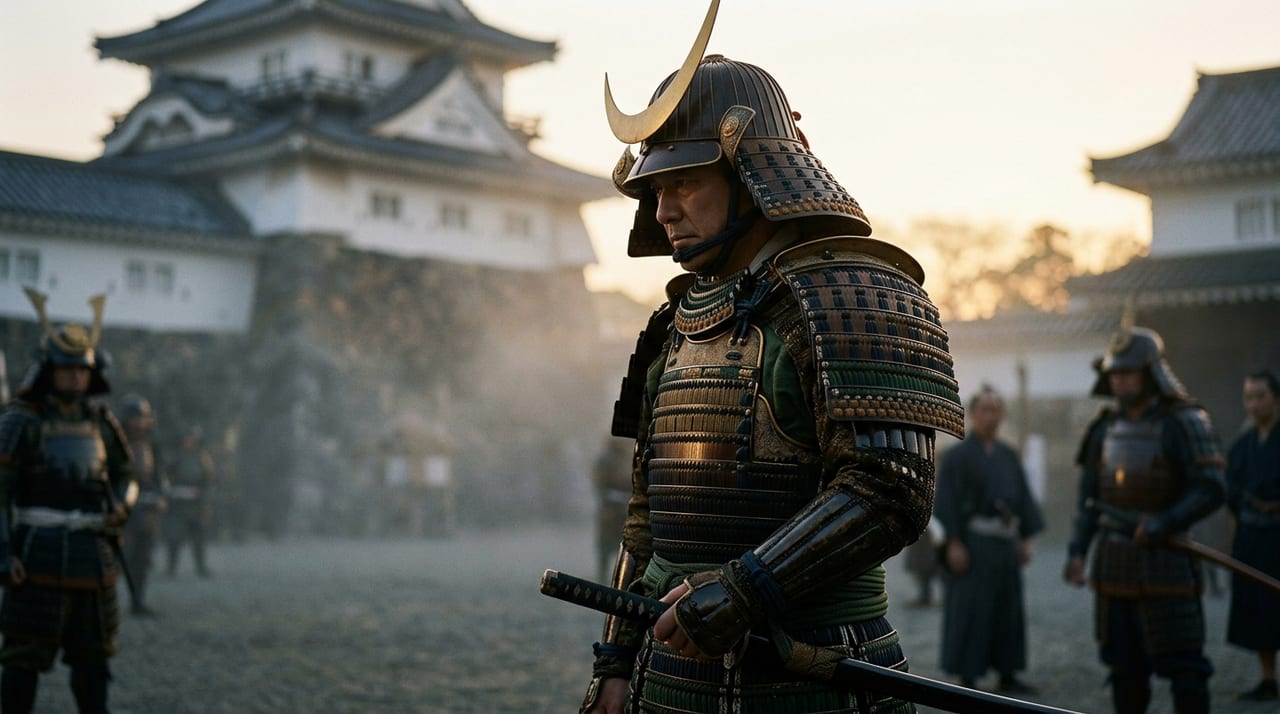
 * Image is for illustrative purposes only.
Tokugawa Hidetada
徳川秀忠
The Second Tokugawa Shogun
Description
The Misconception of Mediocrity
Born in the seventh year of Tenshō (1579) as the third son of Tokugawa Ieyasu at Hamamatsu Castle, Tokugawa Hidetada was long judged to be a “mediocre second-generation ruler” and an “incompetent shōgun who arrived late at Sekigahara.” In recent years, however, some have also come to value his skill as a ruler. If we calmly consider what Hidetada actually accomplished, we can see that it was none other than his abilities that completed the shogunate, the “castle” his father had built; that reinforced it with a sound legal framework; and that laid the foundations for more than 250 years of Tokugawa rule.
The Truth About Arriving Late at Sekigahara
At the Battle of Sekigahara in the fifth year of Keichō (1600), Hidetada led an army of 38,000 but was slowed by the siege of Ueda Castle, where Sanada Masayuki was holed up, and failed to arrive in time for the main battle. When Hidetada rejoined Ieyasu at Ōtsu, he was reprimanded by Ieyasu for throwing his column into disorder with a hasty march and exhausting his troops. This experience of arriving late had a serious effect on Hidetada, and afterward he grew into a ruler who valued caution and certainty above all else.
The Buke Shohatto and the Development of Law
The law most representative of Hidetada's reign is the Buke Shohatto (Laws for the Military Houses), promulgated in the first year of Genna (1615) in Hidetada's name (in substance, under Ieyasu's leadership). This law set out the codes of conduct that all daimyo across the country were to observe. In principle it prohibited the new construction or expansion of daimyo castles, and it forbade daimyo from marrying or forming alliances with one another without permission. Through this law the Tokugawa shogunate obtained a powerful legal basis for controlling the daimyo nationwide, and it became the foundation of the bakuhan system that lasted for the next 250 years. Hidetada also established the Kinchū narabini Kuge Shohatto to control the imperial court, and he strengthened the ban on Christianity to establish religious order within the country. This series of legal reforms shows that Hidetada was not merely a military commander but an excellent legislator and administrator.
Shogunal Authority and Swords
In Hidetada's era, swords were deeply tied to the order of warrior society. The swords possessed by the Tokugawa shogun family were not mere weapons but symbols of shogunal authority with strict ceremonial meaning, and their bestowal functioned as the highest reward.
Hidetada and the Wakizashi “Ōmihara”
As an anecdote about Hidetada and swords, there is the story of the wakizashi “Ōmihara” recorded in the Hosokawa Tadaoki-kō Nenpu. Hosokawa Tadaoki, who had inherited the beloved sword “Ōmihara” from his father Yūsai, did not part with it even when his heir Tadatoshi asked for it. Hearing of this, Hidetada took the Hosokawa father and son with him to bathe in the Asakusa River. When he picked up the Ōmihara that had been placed on the riverbank, he said, “I will borrow this, relay it, and bestow it upon you,” and gave it to Tadatoshi, so the story goes.
The Summer Siege of Osaka and Final Victory
In the Summer Siege of Osaka in the first year of Genna (1615), Hidetada directed the forces from the front and drove the Toyotomi house to ruin. With the deaths of Toyotomi Hideyori and Yodogimi and the burning of Osaka Castle, the Tokugawa unification of the realm was completed, and an age of peace known as the Genna Enbu (the Genna peace) began.
Hidetada's Legacy
Hidetada handed the position of shogun to his heir, Iemitsu, in the ninth year of Genna (1623) and died in the ninth year of Kan'ei (1632). His legacy lies in invisible things: legal institutions and peace. The Edo period was an age of peace in which the legal framework of the Buke Shohatto regulated warrior society, and within that peace the culture of swords blossomed into a refined art. That era rested on the institutional foundations Hidetada had put in place. The paradox that “the artistic perfection of the sword is realized precisely in an age of peace” speaks most eloquently, from the perspective of sword culture, to the significance of what Hidetada accomplished as a ruler.