New Arrivals — Browse our catalog for the latest authentic Japanese sword arrivals. Browse →
6th day of the 5th month, Keichō 20 (1615)
Around Dōmyōji village (Shiki District) and Konda village (Furuichi District), Kawachi Province, in the area of present-day Fujiidera and Habikino, Ōsaka Prefecture
Forces
Toyotomi army
Tokugawa side (Yamato column)
About 15 min read
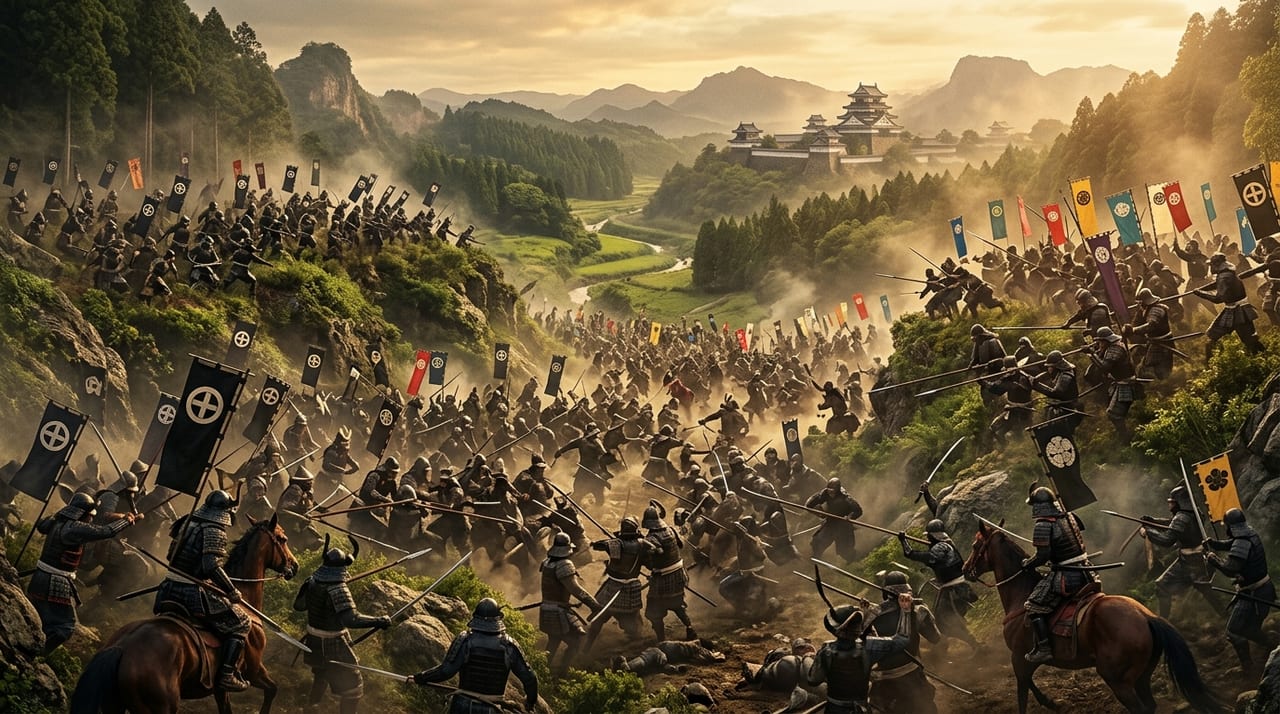
The Battle of Dōmyōji was fought on the 6th day of the 5th month of Keichō 20 (1615), as one phase of the Summer Campaign of Ōsaka, near Dōmyōji village in Shiki District and Konda village in Furuichi District, Kawachi Province. The Toyotomi army, having left Ōsaka Castle, meant to meet in Kawachi the Tokugawa forces advancing along the Yamato road. But the unit of Gotō Mototsugu, which went ahead, ended up fighting alone, and Gotō fell on Komatsuyama and Susukida Kanesuke at Dōmyōji. Mōri Katsunaga and Sanada Nobushige arrived later and held the line, but on news of defeat the same day at Yao and Wakae the Toyotomi army withdrew. The shogunate side is given as about 34,300 men and the Toyotomi side as about 18,400.
After the peace that ended the Winter Campaign, on the 1st day of the 4th month of Keichō 20 Tokugawa Ieyasu ordered the daimyo of the Kinai to seize rōnin leaving Ōsaka. Ieyasu left Sunpu for Nagoya on the 4th, and on the 9th Ōno Harunaga, who had been handling the peace talks, was attacked inside the castle. The Toyotomi side distributed gold and silver to rōnin and began preparing weapons, choosing a decisive battle in the open field over a siege. At a council on the 22nd, the Tokugawa side decided to send its force of some 155,000 toward Ōsaka in two columns, by the Kawachi road and the Yamato road. On the Toyotomi side, a unit under Ōno Harufusa took Kōriyama Castle in Yamato, burned Sakai on the 28th, and at the battle of Kashii on the 29th Hanawa Naoyuki and others were killed.
The Toyotomi army left Ōsaka Castle on the 1st day of the 5th month. A vanguard of 6,400 under Gotō Mototsugu went first, followed by a rear body of 12,000 under Mōri Katsunaga and Sanada Nobushige. On the 5th, Mōri and Sanada took position at Tennōji and decided to meet the shogunate army near Dōmyōji early the next morning. The plan was for the vanguard and rear body to join near Dōmyōji and then face the enemy coming from the direction of Kokubu.
The shogunate side was the Yamato column under Mizuno Katsunari as vanguard general, followed by Honda Tadamasa, Matsudaira Tadaakira, Date Masamune and others.
Gotō Mototsugu had been a retainer of the Kuroda house, but in Keichō 11 (1606) he left it with his whole family. After seeking refuge with the Hosokawa and others he served the Ikeda, but under a ban on his employment elsewhere (the hōkō-kamae) he lived as a rōnin in Kyoto from about Keichō 16, and when the Ōsaka campaign began he entered Ōsaka Castle in Keichō 19 at the invitation of Ōno Harunaga. In Ōsaka he is said to have been called a "return of Marishiten" for his skill in directing a review of the troops.
Around midnight on the 6th, Gotō left Hirano with 2,800 men and reached Dōmyōji before dawn. The other units had not yet arrived, and Mizuno Katsunari's unit, the Tokugawa vanguard, had already advanced to Kokubu. Gotō crossed the Ishikawa and, as the next best course, took position on Komatsuyama, between the two.
Around four in the morning Gotō attacked the forces of Matsukura Shigemasa and Okuda Tadatsugu. Okuda, who had run ahead, was killed, and the Matsukura held on with the arrival of Mizuno Katsunari and Hori Naoyori. Gotō's men, under fire from Date Masamune's and Matsudaira Tadaakira's troops, drove the shogunate army back several times. In the final charge, however, they were struck on the flank by the troops of Niwa Ujinobu, and Gotō himself was hit by gunfire from the Date. Around noon Gotō was killed and his unit destroyed. He is said to have been fifty-six. In Ōsaka he was reckoned a man of such repute that even Ieyasu is said to have been wary of him.
Of his character, Nagasawa Kurōbei, who served close to him, writes in the Nagasawa kikigaki that he never scolded his men harshly for their failures and was broad-minded and merciful. The same work says that when he counted his wounds in the bath there were fifty-three. A few days before Dōmyōji, a monk who came as Ieyasu's envoy offered him 500,000 koku in Harima if he would submit, and he refused; the episode also gave rise to rumors that he was in secret contact with the Tokugawa side. At the battle of Imafuku he is said to have been shot in the side and, after checking the wound, declared that Lord Hideyori's fortune was strong.
Accounts of Gotō's death differ. Date family records say the musketeers of Katakura Shigenaga killed him, the Bukō zakki says Yamada Jūrōbei, a retainer of Matsudaira Tadaakira, did, and the Naniwa senki says he was shot in the hip, could not walk, and was beheaded at his own request by Yoshimura Buemon.
In the afternoon the remainder of the vanguard, Susukida Kanesuke, Akashi Takenori, Yamakawa Katanobu and others, reached Dōmyōji. These troops, some 3,600 in all, fought the Tokugawa forces that had crossed Komatsuyama. Susukida fought sword in hand and was killed, and the rest fell back toward Konda. Then about 15,000 men under Ōno Harunaga and the force of Mōri Katsunaga reached Dōmyōji.
Sanada Nobushige's 7,000 to 8,000 men appeared at Konda. Katakura Shigenaga of the Date force attacked them, and fierce fighting followed. Using an ambush, the Sanada troops pushed the Date back toward Dōmyōji and then withdrew to Fujiidera to join the Mōri. The two sides faced each other in a stalemate.
Around half past two in the afternoon, news of defeat at Yao and Wakae and an order to retreat arrived. At Yao and Wakae, Kimura Shigenari and Chōsokabe Morichika had met the main Tokugawa army advancing along the Kawachi road, and Shigenari had been killed. With Sanada's unit as rear guard, the Toyotomi army began to withdraw toward Tennōji after about four o'clock. Mizuno Katsunari urged pursuit, but the other commanders declined, citing the exhaustion of their men.
On the same 6th day, at the battles of Yao and Wakae, Kimura Shigenari (6,000) and Chōsokabe Morichika with Masuda Moritsugu (5,300) met the main Tokugawa army of about 120,000 advancing along the Kawachi road. Morichika's unit, facing Tōdō Takatora's 5,000 in the fog, lay low to draw the enemy in and then charged, killing Tōdō Takanori and others. But Kimura's unit broke, and Morichika pulled back for fear of being caught between himself and the relief force of Ii Naotaka; Shigenari was killed fighting Ii Naotaka's 3,200. The Tōdō and Ii units both suffered heavy losses. Dōmyōji and Yao-Wakae were fought the same day in different places, and the records show that the Toyotomi units, being hastily assembled, could not keep close contact and were beaten one by one.
The shogunate side won. Losses are given as 180 killed and over 230 wounded for the shogunate army, and over 210 killed and 5 prisoners for the Toyotomi army. By these figures the shogunate losses were not small, which suggests how hard Gotō's unit fought. Several explanations exist for the late arrival of the Toyotomi units: that they set out at the wrong time because of dense fog; that the hastily assembled units scattered in fog and darkness; and that Gotō's unit had the task of delaying the enemy until the later units took position. None is settled.
On the next day, the 7th, the last decisive battle was fought at Tennōji and Okayama. The charges of the Sanada, Mōri and Ōno Harufusa units came close to the shogunate headquarters, but around three in the afternoon the Toyotomi army was destroyed and fell back wholly to the main enclosure of Ōsaka Castle. The castle burned and fell, and on the 8th Hideyori and thirty-one others are said to have taken their own lives. Sources differ on the dates of the fall and the suicides. Dōmyōji can be seen as the battle, on the day before that final stage, in which the Toyotomi side was beaten without coordination among its units.
- Gotō Mototsugu: commander of the Toyotomi vanguard. He fought hard on Komatsuyama and was killed around noon. - Susukida Kanesuke: Toyotomi vanguard commander. He fought sword in hand at Dōmyōji and was killed. - Sanada Nobushige: rear-body commander. He fought the Date at Konda and served as rear guard in the retreat. - Mōri Katsunaga: rear-body commander. He bought time at Dōmyōji until Sanada arrived. - Mizuno Katsunari: vanguard general of the shogunate's Yamato column. He relieved the Matsukura and urged pursuit after the retreat began. - Date Masamune and Katakura Shigenaga: Masamune, as the fourth echelon of the shogunate side, fired on Gotō's men; Shigenaga fought Sanada's troops at Konda. - Matsudaira Tadaakira and Honda Tadamasa: the third and second echelons of the shogunate side. Tadaakira joined the fire on Gotō's men.
Gotō Matabē
Commander of the Toyotomi vanguard; fought on Komatsuyama and fell around noon
Susukida Kanesuke
Vanguard commander; killed at Dōmyōji
Sanada Yukimura
Rear-guard commander; fought Date forces at Konda and covered the retreat
Mōri Katsunaga
Rear-guard commander; held at Dōmyōji until Sanada arrived
Date Masamune
Fourth echelon on the Tokugawa side; fired on Gotō's troops
Katakura Shigenaga
Date commander who engaged Sanada's troops at Konda
Mizuno Katsunari
Vanguard general of the Yamato column; relieved Matsukura's force and urged pursuit