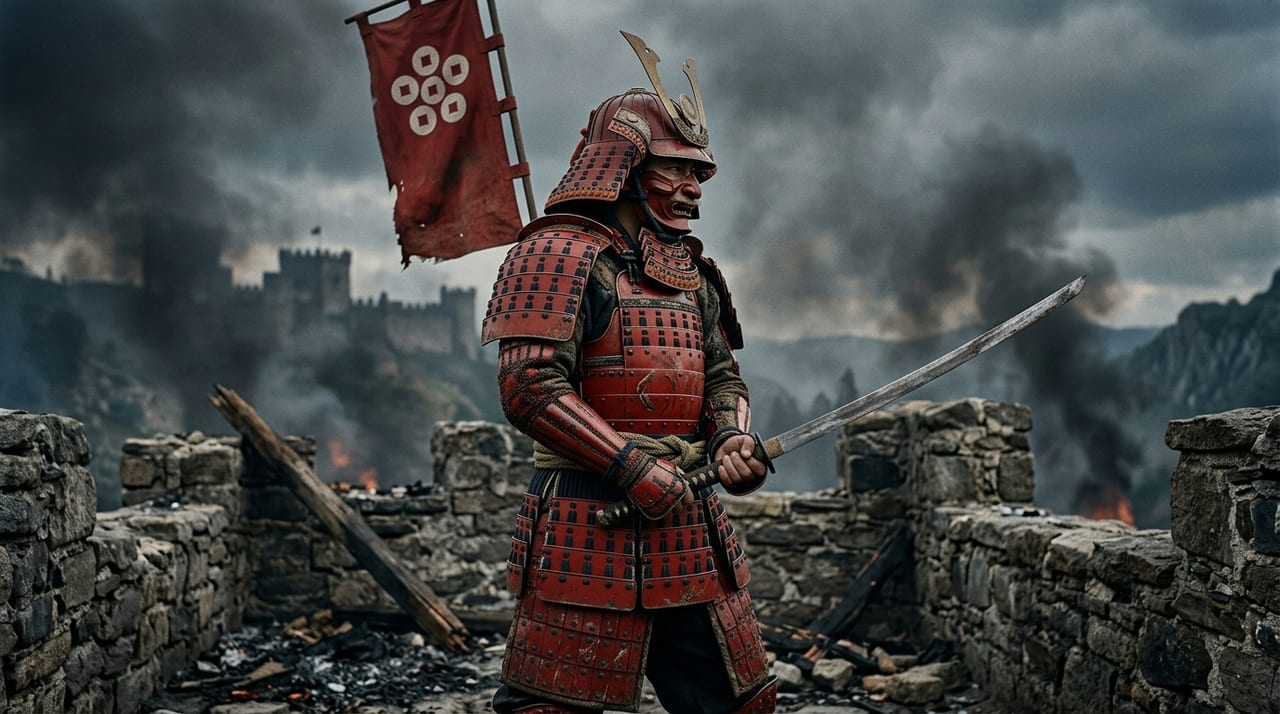
 * Image is for illustrative purposes only.
Sanada Yukimura
真田幸村
Japan's Greatest Warrior
Description
Sanada Yukimura's Birth
Born in Eiroku 10 (1567; also given as Genki 1 (1570)) as the second son of Sanada Masayuki, Sanada Nobushige (Yukimura) was a rare Sengoku warlord of a kind that appears only once in an age. For his fierce fighting in the Osaka campaigns, he was called “the finest warrior in Japan” (Hinomoto ichi no tsuwamono). His father, Sanada Masayuki, was a master of intrigue who was labeled a hyōri hikyō no mono (a cunning double-dealer). Nobushige inherited his father's strategic talent, but he charged across the battlefield with a boldness that far surpassed it.
Youth as a Hostage
The first part of Nobushige's life was a time of patient endurance as a hostage. He was sent to Echigo as a hostage of Uesugi Kagekatsu, and later to Osaka as a hostage of Toyotomi Hideyoshi. During this time, he learned up close both the spirit of righteousness of the Uesugi house and the ambition of the Toyotomi house as masters of the realm. At the Battle of Sekigahara, he sided with the Western Army alongside his father. Halting Tokugawa Hidetada's large army at the Battle of Ueda Castle and preventing it from reaching Sekigahara was the true mark of the military strategy of the Sanada father and son.
Exile at Kudoyama
After the defeat at Sekigahara, Nobushige was exiled with his father to Kudoyama, Kii Province. These fourteen years of confinement were days of anguish for Nobushige, but they were also a time of training that sharpened his resolve as a warrior. In Keichō 19 (1614), upon receiving word of the Osaka Winter Campaign, Nobushige escaped Kudoyama and entered Osaka Castle. From here, Nobushige's legend begins.
Sanada-maru
The Sanada-maru, which Nobushige built during the Osaka Winter Campaign, was an independent outpost constructed south of Osaka Castle. It bore the defense and succeeded in repelling the fierce assaults of the Tokugawa army. The fighting at the Sanada-maru was a masterpiece that displayed Nobushige's outstanding skill in fortification and his tactical eye. Seeing Nobushige outmaneuver a great army with a small force was reminiscent of Kusunoki Masashige's defense of Chihaya Castle in the past.
The Osaka Summer Campaign
The Osaka Summer Campaign of Keichō 20 (1615) was the culmination of Nobushige's life. Clad in akazonae armour and raising the rokumonsen banner, Nobushige resolved to die and charged toward the main camp of Tokugawa Ieyasu. He carried out this charge three times. It threw the Tokugawa army into confusion and drove Ieyasu's main camp to the brink of ruin, to the point that his uma-jirushi (horse standard) fell. It is also said that Ieyasu himself was prepared to take his own life. This fierce charge is passed down forever as one of the most valiant scenes in Japan's military history.
Nobushige's Swords and the Six Coins
What swords and spears Nobushige favored is not known for certain. The account that his long sword was a Masamune and his short sword a Sadamune appears in the Meishō Genkōroku of the early Meiji period. The story that he regarded Tokugawa Ieyasu as his arch-enemy and never parted with a Sengo Muramasa daishō (pair of long and short swords) goes back as far as the Tōgen Iji of Genroku 14 (1701). The rokumonsen, a banner signifying the fare for crossing the Sanzu River, symbolizes the unwavering resolve of Sanada warriors, who always went into battle prepared to die. The swords wielded beneath that banner carried Nobushige's very spirit.
The Legend of Japan's Finest Warrior
Nobushige, who had exhausted his strength in the Osaka Summer Campaign, rested his wounded body in the grounds of Yasui Shrine. There he was discovered by Nishio Munetsugu, a musket captain of the Echizen Matsudaira house. It is said that after leaving the words “Take this head and make it your glory,” he was cut down. He died at the age of forty-nine. Voices praising Nobushige's martial prowess rose from friend and foe alike, and his fame grew even higher after his death.
Most of the swords passed down in the Sanada family have been scattered, but Nobushige's unbending spirit, as an embodiment of bushidō, still captivates people today. The red armour, the six-coin banner, and the single sword held in hand offer an eternal answer to the hearts of Japanese people who continue to ask what it means to be a warrior.
Notable Swords
- Sengo Muramasa's daishō (pair of long and short swords) (legend, as recorded in the Genroku-period Tōgen Iji: he regarded Tokugawa Ieyasu as his arch-enemy and never parted with them; Nobushige's verified favorite blades are unknown)