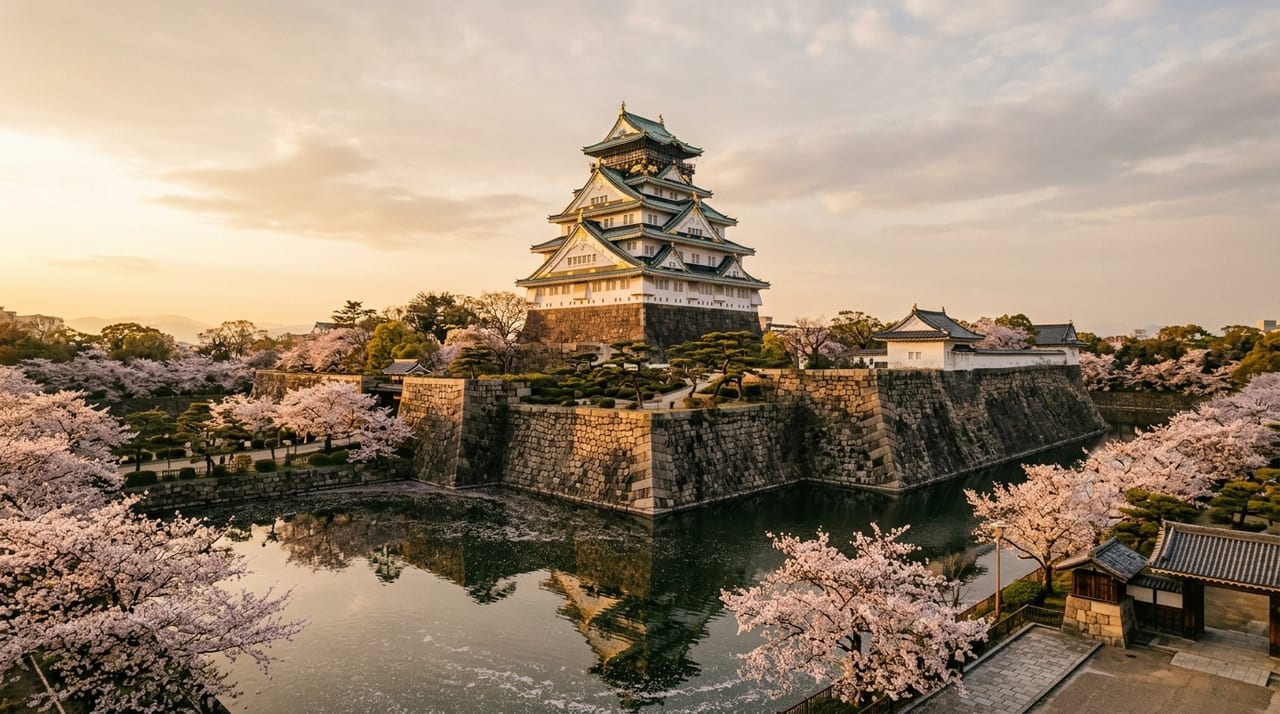
 * Image is for illustrative purposes only.
Osaka Castle
大阪城
Osaka Castle is a historic castle in the Kansai region (Built in 1583 (Tenshō 11)). Its lord was Toyotomi Hideyoshi.
Overview
About the Castle
Osaka Castle is a colossal, unprecedented fortress built by the ruler of the realm, Toyotomi Hideyoshi, to make his overwhelming power known throughout the land. It was the stage for many events that determined the direction of Japanese history. In Tenshō 11 (1583), after defeating Shibata Katsuie at the Battle of Shizugatake, Hideyoshi began building a magnificent castle on the site of Ishiyama Honganji, a strategically vital location in the realm. The Toyotomi Osaka Castle that he built was protected by triple moats and huge stone walls, and gold leaf was lavishly used on the keep. According to the records of missionaries, its splendor even surpassed that of Azuchi Castle.
History of Construction
Hideyoshi directed the Shikoku campaign, the Kyushu campaign, and the Odawara campaign from this castle as his base, and he achieved the unification of the realm in Tenshō 18 (1590). When Hideyoshi died in Keichō 3 (1598), Tokugawa Ieyasu came to control the realm after the Battle of Sekigahara in Keichō 5 (1600), but Hideyoshi's heir, Hideyori, still resided in Osaka Castle. In the Winter Siege of Osaka in Keichō 19 (1614), the Sanada-maru built by Sanada Yukimura dealt a heavy blow to the Tokugawa side. In the Summer Campaign of the following year, Keichō 20 (1615), Yukimura's fierce charge threatened Tokugawa Ieyasu's main camp, and the Toyotomi family met a heroic end.
Architecture and Structure
The Tokugawa shogunate completely filled in the Toyotomi Osaka Castle and built an entirely new Tokugawa Osaka Castle on top of it. The massive stone walls and broad moats seen today date from this Tokugawa period, and the huge stones, including the Tako-ishi (Octopus Stone), are among the largest in Japan. The current keep was restored in Shōwa 6 (1931) through donations from citizens. Although it is built of reinforced concrete, it holds historical significance as Japan's first restored keep. Inside, the museum displays the life of Hideyoshi and the history of Osaka across eight floors, and from the top floor, visitors can take in a panoramic view of Osaka's urban landscape.
Connection to Swords
In Japanese history, Osaka Castle was a castle that determined the fate of the realm, and it is the one and only castle that was involved in all three historic turning points: Hideyoshi's unification of the realm, the downfall of the Toyotomi family in the Osaka campaigns, and the establishment of the Tokugawa shogunate-domain system. Osaka is still a city where sword trading is active today, and several antique dealers specializing in Japanese swords are in business. The breath of sword culture remains alive in modern Osaka as well.
Connection to Swords
In discussing the relationship between Osaka Castle and the Japanese sword, one cannot avoid the Sword Hunt edict issued by Toyotomi Hideyoshi in Tenshō 16 (1588). This policy, which confiscated swords, short swords, bows, spears, and firearms from farmers under the pretext that they would be used as nails for the Great Buddha of Hōkō-ji, advanced the separation of warriors and farmers. It fundamentally transformed Japan's social structure and established the sword as the symbol of samurai status, making it a historic turning point. From then on, wearing a sword became a privilege of the samurai, and the Japanese sword rose above being a mere weapon to become a symbol of status and pride. Hideyoshi himself was also a collector of rare, renowned swords, gathering famous pieces from across the country in the course of unifying the realm. The most famous of Hideyoshi's favorite swords is the Ichigo Hitofuri (made by Awataguchi Yoshimitsu), and its name derives from 'the single tachi that Yoshimitsu forged in his lifetime.' It was damaged by fire in the Summer Campaign of Osaka, but it was later re-edged by the Tokugawa family, and it is now transmitted as an Imperial Household property. In the Osaka campaigns, Sanada Yukimura carried out a fierce charge that pressed on Tokugawa Ieyasu's main camp, showing the ultimate of combat with the sword in hand. In these battles, many famous swords were used in actual combat, and many blades were lost to the flames of war. With the arrival of the Edo period, Osaka became the economic center as the kitchen of the realm, and a new-era sword culture called Osaka shintō flourished. Inoue Shinkai, with some works designated Important Cultural Properties, was called the 'Osaka Masamune' for the beauty of his nie (crystalline grain). Tsuda Sukehiro pioneered tōran-ba, a revolutionary wave-like temper pattern. These two are called the two great masters of Osaka shintō, and Osaka, together with Edo, became the two major production centers of the shintō period. By touring both the exhibits inside the Osaka Castle Keep and the Osaka Historical Museum, one can deeply understand Hideyoshi's sword policy and the world of Osaka shintō. Because Osaka was a merchant town, it was also a major hub for the distribution and sale of swords, and it has a history of sword dealers lining its streets. Osaka's sword dealers were connoisseurs who brokered famous blades to daimyo and samurai across the provinces, and the culture of sword appraisal developed alongside these places of trade. Osaka Castle is both the castle of the ruler of the realm and, as the source of the Sword Hunt edict that determined the social value of the Japanese sword, the most important castle in the history of swords.
Highlights
- Reconstructed tower (history museum inside)
- Massive stone walls (among Japan's largest)
- Osaka Castle Miraiza (former military headquarters)
- Gokuraku Bridge and inner moat
- Hōkoku Shrine (enshrining Hideyoshi)
- Site of Sanada Maru (southern outer fortress)
* Opening hours and admission fees are subject to change. Please check the official website before visiting.