New Arrivals — Browse our catalog for the latest authentic Japanese sword arrivals. Browse →
August 7, 1576 (Tenshō 4/7/13) / December 4, 1578 (Tenshō 6/11/6)
Kizugawa Mouth, Settsu Province (present-day area around Suminoe Ward, Osaka City, Osaka Prefecture)
Forces
Oda Forces (Second Battle)
Mōri / Honganji Allied Forces
About 14 min read
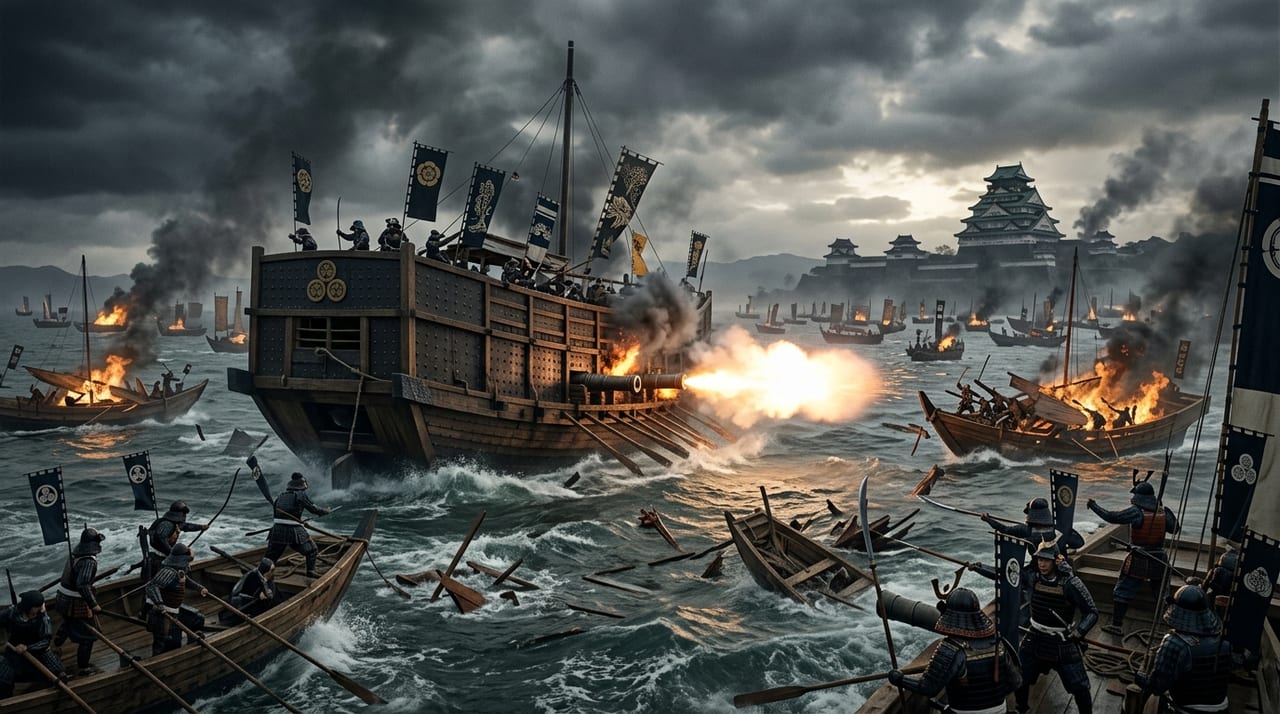
The Battle of Kizugawaguchi, fought on two occasions, in Tenshō 4 (1576) and Tenshō 6 (1578), at Kizugawaguchi (the mouth of the Kizu River) in Settsu (present-day mouth of Osaka Bay), is a sea battle that occupies a unique place in Japan's Sengoku history. In the first battle, the Mōri navy used hōroku hiya (incendiary bombs) to destroy the Oda-side navy. In the second, however, the tekkōsen (iron-clad ship) built by Kuki Yoshitaka under Nobunaga's orders made its debut and drove back the Mōri navy. This "tekkōsen" is noted as one of the earliest armored warships in world naval history, and in its innovation of science, technology, and strategic vision, it clearly demonstrates Nobunaga's genius.
The Battle of Kizugawaguchi took place as part of the ten-year war between Nobunaga and Ishiyama Hongan-ji (the Ishiyama War, 1570–1580). Ishiyama Hongan-ji (on the site of present-day Osaka Castle), taking advantage of its location facing Osaka Bay, continued to resist while receiving provisions from the Mōri navy. For Nobunaga, the key to conquering Hongan-ji lay in cutting off the supply route at Kizugawaguchi.
The toughness of Ishiyama Hongan-ji was not merely military. The followers gathered under Kennyo, the chief abbot who led the Ikkō-ikki, held a firm resolve to fight on the basis of religious conviction. The faith symbolized by the saying handed down as "Advance and be reborn in paradise; retreat and fall into the hell of incessant suffering" produced a motivation for battle entirely different from that of Sengoku warlords. Behind the ten years it took Nobunaga to conquer this Hongan-ji lay two factors: this religious motivation and the continued supply by the Mōri navy.
In the first Battle of Kizugawaguchi in Tenshō 4 (1576), the Mōri navy, centered on the Murakami navy and numbering about 700 to 800 vessels, overwhelmed Nobunaga's navy of roughly 200 to 300 vessels. The main force of the Mōri navy's attack combined hōroku hiya (unglazed clay balls filled with gunpowder) with firearms, and the Oda navy, whose ships were mostly wooden, burst into flames one after another. The Oda-side navy (the Numama, Manabe Sadatomo, and others) suffered a devastating blow and allowed provisions to be shipped to Hongan-ji.
The Murakami navy was a maritime military group that held sway over the Seto Inland Sea. The navy formed by the three Murakami families, Innoshima, Noshima and Kurushima, working together was a group of maritime professionals who knew the advantages of the Seto Inland Sea intimately. Their main tactic was fire attack with incendiary bombs called hōroku hiya, which were the natural enemy of wooden ships. Furthermore, their techniques of "naval battle," combining long-range attacks using firearms with boarding in close combat, were at the highest level in Japan at the time.
After the defeat in the first battle, Nobunaga ordered a fundamental innovation in naval warfare capability. The man entrusted with it was Kuki Yoshitaka, a naval daimyo based in Shima Province, who was later also called a "pirate daimyo." Yoshitaka met Nobunaga's demands and proceeded with the construction of the tekkōsen, an unprecedentedly large vessel.
Regarding the six great ships Yoshitaka built in Ise, the Tamon-in Diary records them as "iron ships" and gives their size as "seven ken across and twelve or thirteen ken lengthwise" (one manuscript of the Shinchō Kōki gives a length of eighteen ken and a width of six ken). A letter from the missionary Organtino reports that they were equipped with three cannon and many large firearms. The idea is said to have been to use iron armor to defend against hōroku hiya, but there are various theories about whether they had armor and how large they were.
On December 4, 1578 (Tenshō 6/11/6), the second Battle of Kizugawaguchi broke out. The Mōri navy once again attempted to deliver provisions to Hongan-ji. This time, however, the Oda navy's formation was completely different. Leading the way were six tekkōsen led by Kuki Yoshitaka.
The Mōri and Murakami navy, numbering about 600 vessels, initially appeared to have the advantage, surrounding the Kuki forces. But Yoshitaka drew the enemy ships in close and hit the enemy commander's ship with a volley from the large firearms and cannon mounted on the great ships. Thereafter, the Shinchō Kōki reports, the Mōri navy could no longer approach the Kuki forces and withdrew. However, Mōri-side records state that the Mōri navy landed at Kizu-ura, and since provisions continued to reach Hongan-ji afterward, some hold the view that a complete blockade was not achieved.
Afterward, the land routes running from Mōri territory to Osaka Bay were also gradually taken by the Oda side. In Tenshō 8 (1580), Kennyo made peace with Nobunaga and left Hongan-ji. The victory at Kizugawaguchi is regarded as one of the battles that influenced the outcome of the ten-year Ishiyama War.
The Battle of Kizugawaguchi was one of the most innovative events in the history of naval warfare in the Sengoku period. Within a short two years after the defeat in the first battle, Nobunaga built and deployed the tekkōsen, which fundamentally changed the conventional view of naval warfare. This attitude of "learning from failure and overturning with technology" shows the essential quality of Nobunaga as an innovator.
The appearance of the tekkōsen, alongside the spread of firearms (the introduction of firearms, 1543), marks a major turning point in the military technology history of Japan. The revolution combining two materials, gunpowder and iron, was also a symbol of an age in which the role of swords, weapons from ancient times, was changing.
Oda Nobunaga's innovativeness is summed up in one point: "breaking existing frameworks." The small elite charge at the Battle of Inō, the surprise attack at Okehazama, the three-rank volley firing at Nagashino (there are alternative theories), and the tekkōsen at Kizugawaguchi were all practical applications of Nobunaga's methodology of "questioning common sense and overturning it with technology."
This idea of "changing the conventions of war through technological innovation" also resonates with a similar period of transformation in the world of Japanese swords. In the Sengoku period, the uchigatana became widespread, and a practical style of wearing swords replacing the earlier tachi took hold. The tachi was hung from the waist with its edge facing downward, whereas the uchigatana was worn thrust into the waist with its edge facing upward, allowing quicker movement from drawing to striking. This "shift to the uchigatana" was also one of the technological innovations grounded in the realities of the battlefield.
The "Heshikiri Hasebe" possessed by Nobunaga (a National Treasure, held by the Fukuoka City Museum) is an uchigatana said to be the work of Hasebe Kunishige of the Nanboku-chō period. It is said to have been named after an anecdote in which Kannai, a tea attendant who had committed a breach of etiquette, hid under a tray shelf and was cut down with a single pressing stroke. The "overwhelming by force" that this sword symbolizes parallels how the tekkōsen at Kizugawaguchi overwhelmed the Mōri navy by force. In Nobunaga's era, swords and warships were products that embodied the same spirit of "iron innovation."
Bizen Province (present-day Okayama Prefecture) is known as the largest production center of Japanese swords. Sword-smith groups centered on Osafune were active from the Kamakura period. Swords forged by renowned masters of the Bizen tradition, such as Kagemitsu, Nagamitsu and Kanemitsu, were prized among the western daimyo.
Oda Nobunaga
Oda Nobunaga — the visionary strategist who ordered the construction of iron-armored warships
Takigawa Kazumasu
Takigawa Kazumasu — Oda naval commander at Kizugawaguchi
Kobayakawa Takakage
Kobayakawa Takakage — Mōri naval commander in the second battle
Mōri Terumoto
Mōri Terumoto — head of the Mōri clan who sent naval support to Honganji