New Arrivals — Browse our catalog for the latest authentic Japanese sword arrivals. Browse →
7th day of the 5th month, Tenshō 4 (June 3, 1576)
Tennōji, Settsu Province (present-day Tennōji Ward, Osaka City)
Forces
Oda Forces
Hongan-ji forces (Ikkō-ikki)
About 11 min read
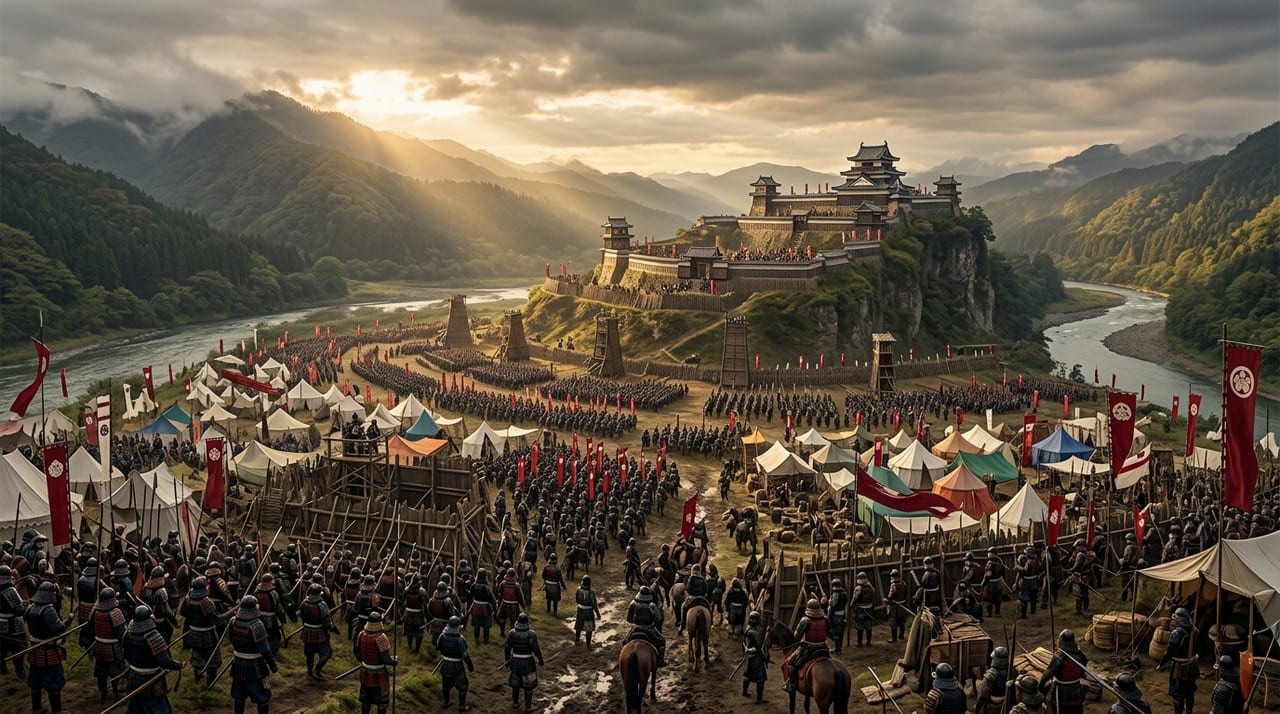
On June 3, 1576 (Tenshō 4/5/7), at Tennōji in Settsu Province (in the vicinity of present-day Tennōji Ward, Osaka City), Oda Nobunaga attacked a large Hongan-ji army with only about 3,000 men. The army had sortied from Ishiyama Hongan-ji, where Kennyo was holed up, and surrounded the Tennōji fort; it included the Saika musketeers. Although Nobunaga was struck by a musket ball and wounded in a critical situation, he refused to withdraw, remained on the battlefield, and turned the battle into a victory. The "Battle of Tennōji" is known as one of the fiercest local engagements of the Ishiyama War (1570–1580). It is remembered as an event that symbolizes Nobunaga's fortitude as a warlord and the sword and musket culture of Sengoku-period samurai.
The Ishiyama War was a large-scale religious war fought intermittently from Genki 1 (1570) to Tenshō 8 (1580) between Oda Nobunaga and Ishiyama Hongan-ji (on the site of present-day Osaka Castle), the head temple of the Ikkō sect (Jōdo Shinshū). Hongan-ji abbot Kennyo cooperated with the Ikkō-ikki forces of Kaga, Echizen, Settsu, and Kawachi to form a powerful opposition to Nobunaga's control of the Kinai region. Ishiyama (near present-day Osaka Castle) was easy to defend because of its terrain. It had a maritime supply route from the Seto Inland Sea, and it was one of the most formidable strongholds Nobunaga faced.
In Tenshō 3 (1575), at the Battle of Nagashino, Nobunaga used three-rank volley fire (sandan-uchi) to defeat the cavalry of Takeda Katsuyori decisively. Although the traditional account is open to question, the fact that he organized and deployed large numbers of muskets systematically is certain, and the battle opened a new chapter in Sengoku military history. In the following year, Tenshō 4 (1576), Nobunaga strengthened the encirclement of Ishiyama Hongan-ji. At the same time, he was forced to respond on several fronts to anti-Nobunaga forces, a coalition of the Mōri, the Uesugi, and Hongan-ji, that sought to restore Shogun Ashikaga Yoshiaki.
At this time, Hongan-ji allied with Mōri Terumoto, and the Mōri began sending provisions and other supplies by sea. (In the 7th month of the same year, at the First Battle of Kizugawaguchi, the Mōri naval forces led by Murakami Takeyoshi of the Noshima Murakami succeeded in delivering them.)
In the 4th month of Tenshō 4, Nobunaga had forts built to encircle Hongan-ji. He placed Sakuma Nobuhide (son of Sakuma Nobumori) and Akechi Mitsuhide in the Tennōji fort, south of Ishiyama Hongan-ji. On the 3rd day of the 5th month, the army of Ban Naomasa, which was attacking Kizu (its vanguard included Miyoshi Yasunaga and others who had surrendered to Nobunaga the previous year), was surrounded by Hongan-ji musketry and collapsed. Naomasa was killed in action. Riding the momentum, the Hongan-ji forces surrounded the Tennōji fort with a large army, said by one account to number 15,000.
Mitsuhide, Nobuhide, and the others in the beleaguered fort asked Nobunaga, who was in Kyoto, for reinforcements. Nobunaga entered Wakae Castle in Kawachi on the 5th day of the 5th month, but because the sortie was sudden, troops did not gather. On the 7th, he charged the Hongan-ji forces with only about 3,000 men. This decision demonstrated Nobunaga's strategic fortitude. At the same time, it embodied the Sengoku image of a warlord who inspired his troops' morale by taking the front line himself.
During the battle, Nobunaga was struck in the leg by a Hongan-ji musket ball (bullet) and wounded. This fact is recorded in Ōta Gyūichi's Shinchō Kōki. Despite his wound, Nobunaga did not leave the battlefield and continued to direct his forces from the front. His presence raised his men's morale and made possible a counterattack that overturned their numerical inferiority.
Before the fierce counterattack Nobunaga led from the front, the Hongan-ji forces broke, and the Battle of Tennōji ended in victory for the Oda army. The Oda forces pursued the Hongan-ji troops as far as the gate of Ishiyama Hongan-ji and killed more than 2,700 of them. Nobunaga then had siege forts (tsukejiro) built around Hongan-ji. Through this victory, he succeeded in temporarily re-establishing the encirclement of Ishiyama Hongan-ji.
However, the Ishiyama War continued after this. Owing to the activity of the Mōri naval forces (at the First Battle of Kizugawaguchi in the 7th month of 1576, the Hongan-ji side had the upper hand) and the resistance of Ikkō-ikki across various regions, Hongan-ji held out until Tenshō 8 (1580). It would take Nobunaga another four years to finally bring Ishiyama Hongan-ji to submission.
The Battle of Tennōji is also significant as a battle that symbolizes a turning point in Japan's weapons culture in the late Sengoku period. By this time, both Nobunaga's army and the Hongan-ji musketeers were already actively using matchlock muskets (hinawajū) as one of their main weapons. The very fact that Nobunaga was struck by a musket ball proves that muskets held decisive power on late-Sengoku battlefields.
On the other hand, samurai of this era still constantly wore a long sword and a short sword (daitō and wakizashi; Japanese swords), and in close combat swords and spears were the main weapons. In field battles such as the Battle of Tennōji, it was common for long-range musket fire to be followed by close combat with spears and swords. That Nobunaga is said to have fought at the front himself embodies the image of the Sengoku warlord who did not shrink from taking the battlefield with a sword at his side.
Furthermore, the existence of the Hongan-ji musketeers shows that not only samurai but also adherents of the Ikkō sect (including farmers and townspeople) organized musket units and fought on equal or better terms with samurai forces. This reveals that the status- and culture-based order of "samurai and swords" was being greatly shaken in the late Sengoku period.
This battle, in which Nobunaga achieved victory at Tennōji even though he was wounded, occupies a special place in the history of Japanese swords and blades. It sits at the crossroads of the Sengoku spirit (the image of a warlord who "does not fear death and fights for his convictions") and the military transformation that shaped early-modern Japan.