New Arrivals — Browse our catalog for the latest authentic Japanese sword arrivals. Browse →
11th month, Tenshō 4 (1576) – 9th month, Tenshō 5 (1577)
Nanao, Noto District, Noto Province (present-day Kojōyama, Nanao City, Ishikawa Prefecture)
Forces
Uesugi Forces
Nanao Castle Garrison (Hatakeyama)
About 15 min read
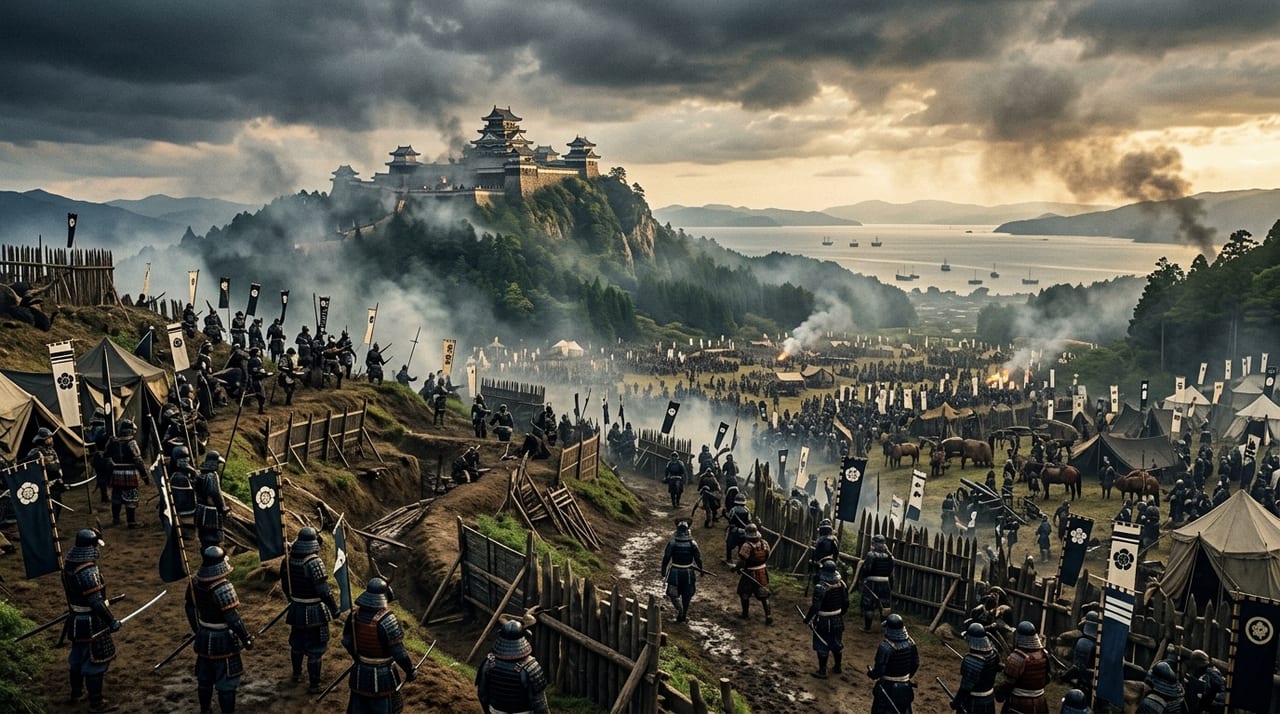
The Siege of Nanao Castle, fought from Tenshō 4 (1576) to Tenshō 5 (1577), was a prolonged siege lasting nearly a year, in which Uesugi Kenshin, the "God of War" of Echigo, sought to establish control over Noto Province (present-day Noto Peninsula in Ishikawa Prefecture). Nanao Castle was the main castle of the Noto Hatakeyama clan, the shugo daimyō of Noto Province. It was a mountain castle built on the summit of Kojōyama (300 m above sea level), overlooking Nanao Bay, and in both scale and strength it was the finest castle in Noto.
With the fall of this castle, the contest for supremacy in Hokuriku entered a new stage, and Kenshin gained control over the vast Hokuriku region, encompassing Noto, Etchū, and Kaga. Immediately after Nanao Castle fell, Kenshin achieved a historic victory by repulsing the large army of Oda Nobunaga at the Battle of Tedorigawa, which highlighted the peak of his military power.
The Noto Hatakeyama clan, which had ruled Noto Province for generations, was a distinguished house and a branch line of the Hatakeyama family, one of the three kanrei families of the Muromachi shogunate. However, as the Sengoku period began, the Noto Hatakeyama clan was torn by constant internal strife, and the domineering conduct of powerful retainers within the household (including senior vassals such as Yusa Tsugumitsu) continued, so that the authority of the clan head was markedly weakened.
Uesugi Kenshin began to intervene actively in Noto around Tenshō 2 (1574). After establishing control over Etchū Province (present-day Toyama Prefecture), Kenshin attempted to extend his power further west into Noto, Kaga, and Echizen. Voices calling for Kenshin's help were raised from within the Noto Hatakeyama household, and Kenshin used this as a pretext to deepen his involvement in Noto.
In the 11th month of Tenshō 4 (1576), Kenshin entered Noto from Etchū and began the siege of Nanao Castle. However, the castle's terrain gave it outstanding natural advantages, and it was difficult to take quickly. Kenshin captured the branch castles one after another, isolating Nanao Castle, but in the 3rd month of Tenshō 5 (1577) he temporarily returned to Echigo because Hōjō Ujimasa had mobilized troops in the Kantō region. In the intercalary 7th month of the same year, he returned with a large army and resumed the siege of Nanao Castle.
The siege that began in the 11th month of Tenshō 4 (1576) continued, with interruptions, until the 9th month of the following year. Nanao Castle was protected by natural fortifications, and the castle had stockpiles of food, water, and weapons, so a direct assault was extremely difficult. Kenshin's army cut off the castle's supply routes and made starvation tactics (exhausting the castle's provisions through encirclement) its main strategy.
While the siege dragged on, a tragedy unfolded inside the castle. In summer of Tenshō 5 (1577), a plague raged within Nanao Castle, and the warriors who formed the core of the garrison fell one after another. Many senior retainers and soldiers, including the castle lord Hatakeyama Haruōmaru, lost their lives to the disease. The garrison's strength declined rapidly, and the castle fell into a desperate situation.
Amid these circumstances, people within the castle began to betray it to Kenshin. Yusa Tsugumitsu, a senior retainer of the Noto Hatakeyama clan, together with Nukui Kagetaka and others, secretly colluded with Kenshin. On the 15th day of the 9th month of Tenshō 5 (1577), they rose in revolt inside the castle, killed Chō Tsugutsura and the Chō clan, and opened the castle gates to let the Uesugi army in. The castle fell as though it had crumbled from within.
Kenshin's poem, said to have been composed on the night of the 13th day of the 9th month, shortly before the fall of Nanao Castle, while he was in the field, is famous. This poem, beginning with "Frost fills the camp, the autumn air is clear; / lines of geese pass beneath the midnight moon," is said to have been written by Kenshin at his encampment overlooking Nanao Castle at the close of the nearly year-long siege. It has been passed down to later generations as a demonstration of Kenshin's learning and sensitivity as a warrior.
Shortly after the fall of Nanao Castle, on the 23rd day of the 9th month of Tenshō 5 (1577) (by the lunar calendar), Kenshin clashed with the Oda army at the Tedorigawa River (present-day Tedorigawa in Ishikawa Prefecture). In this "Battle of Tedorigawa," the Uesugi army led by Kenshin is said to have won a decisive victory over the great Oda army led by Shibata Katsuie and Takigawa Kazumasu (said to number about 40,000; Hashiba Hideyoshi had left the field without permission partway through).
The Oda army had rushed to relieve Nanao Castle, but the castle had already fallen. It is said that as the Oda army was retreating, it was pursued by the Uesugi army while crossing the Tedorigawa, and suffered heavy losses. Later military historians regard this battle as one of the few examples in which Kenshin clearly demonstrated superiority over the military power of the Oda army. However, the scale and course of the battle differ depending on the historical sources, and debate among researchers continues.
After this, Kenshin withdrew to Echigo but continued to manage Hokuriku. However, in the 3rd month of Tenshō 6 (1578), Kenshin suddenly collapsed at Kasugayama Castle (present-day Jōetsu City, Niigata Prefecture) and died of a stroke (also said to be a cerebral hemorrhage). He was 49 years old. The Siege of Nanao Castle and the Battle of Tedorigawa became the last glorious military victories of Kenshin's life.
Uesugi Kenshin himself is especially well known among Sengoku warlords as a connoisseur and collector of swords. Famous swords in Kenshin's possession include the "Kenshin Kagemitsu" (a famous late-Kamakura blade made by Bizen Osafune Kagemitsu), which are known to have been especially prized by him. After Kenshin's death, these famous swords were passed on to Uesugi Kagekatsu and were handed down for generations as treasures of the Uesugi house.
In addition, the poem that Kenshin is said to have composed in the field during the siege of Nanao Castle shows the image of Kenshin as a warrior who also possessed a high level of cultural refinement. Swords were not merely weapons but also the object of the warrior's spiritual symbolism and artistic taste, and held an important meaning for Kenshin. Kenshin's view of swords was linked to the spirit of "Bi" (Bishamonten), and it appears as a deep reverence for the sword as a weapon that embodies battles fought for righteousness.
The Siege of Nanao Castle was one of the greatest achievements of Uesugi Kenshin's management of Hokuriku. Through this victory, Kenshin largely pacified Noto Province and, together with Etchū and Kaga, brought the vast domain of the three Hokuriku provinces effectively under his control. Kenshin's sphere of influence extended from the territory of the Kantō kanrei in the east to the three Hokuriku provinces, and it became a threat that Oda Nobunaga could not ignore.
Had Kenshin not died suddenly in Tenshō 6 (1578) and had continued to live, his ultimate goal of advancing from Hokuriku into the Kinai region might have been realized. The Siege of Nanao Castle was the last great step forward toward that goal. After Kenshin's death, Hokuriku again fell into turmoil, and it was ultimately brought under the rule of the Oda and Toyotomi regimes through the struggles of Shibata Katsuie and Toyotomi Hideyoshi and others.
Today, the Nanao Castle ruins (Kojōyama) in Nanao City, Ishikawa Prefecture, have been developed as a historic site, and from the summit, which overlooks Nanao Bay, visitors can sense the strategic importance the site held in its time. A stone monument inscribed with the poem that Kenshin is said to have composed has also been erected on site, and the site welcomes many visitors as a historic site of the Siege of Nanao Castle. The Nanao Castle ruins are widely known as a valuable remnant that conveys to the present the history and culture of the Noto Peninsula and the turmoil of Hokuriku during the Sengoku period.