New Arrivals — Browse our catalog for the latest authentic Japanese sword arrivals. Browse →
June 29, 1575 (21st day, 5th month, Tenshō 3)
Nagashino, Mikawa Province — Shitaragahara plain (present-day Shinshiro City, Aichi Prefecture)
Forces
Oda–Tokugawa Allied Forces
Takeda Forces
About 11 min read
On the 21st day of the 5th month of Tenshō 3 (1575), the allied forces of Oda Nobunaga and Tokugawa Ieyasu utterly crushed the elite troops of Takeda Katsuyori at Shitaragahara in Mikawa Province. The Battle of Nagashino is regarded as a symbol of the most dramatic tactical revolution in Sengoku-period Japanese history, and it is remembered as the turning point at which a new weapon, the matchlock arquebus, changed a battlefield that had been dominated by swords, bows and spears.
The affair began when Takeda Katsuyori laid siege to Nagashino Castle in Mikawa Province, which was defended by Okudaira Nobumasa. The castle's commander, Okudaira Nobumasa, held out against the fierce assaults of the massive Takeda army with fewer than 500 men, and he dispatched Torii Sune'emon as an envoy to request reinforcements from Ieyasu. Sune'emon was captured by the Takeda forces. He shouted to the castle garrison that reinforcements were coming, and was then crucified. His loyalty has been praised in later generations.
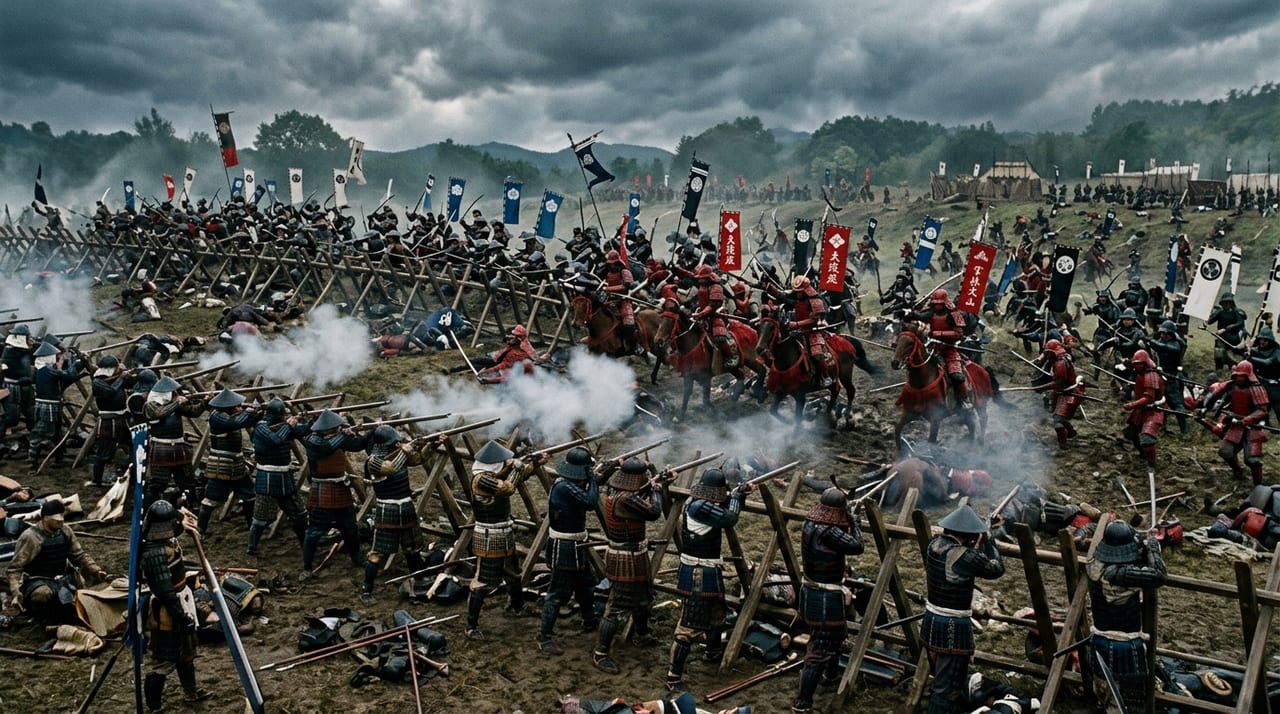
Nobunaga responded to this crisis with about 30,000 troops, and at Shitaragahara he built a long anti-cavalry palisade and established a formation to meet the Takeda army.
The most famous element in discussing the Battle of Nagashino is the tactic of three-rank volley fire (sandan-uchi). Nobunaga is said to have organized a rotating firing system in which about 3,000 matchlock arquebuses (according to various accounts) were arranged in three rows, so that when one row fired, the next was ready to fire. Through this tactic, the weakness of the matchlock arquebus, which took time to reload, was compensated for, and continuous fire became possible.
However, recent research has pointed out that Edo-period military chronicles, such as Oze Hoan's Shinchōki (Hoan Shinchōki), greatly exaggerated events, and a number of scholars hold that the actual nature of three-rank volley fire as a historical fact remains unclear. Rather, it is considered that the essence of the victory lay in the combination of the large number of matchlock arquebuses Nobunaga had prepared and the physical barrier of the anti-cavalry palisade (bōsakusaku).
In any case, the Takeda cavalry fell one after another before the anti-cavalry palisade and the bullets, and many of the Takeda family's elite senior retainers, including Yamagata Masakage, Naitō Masatoyo, Baba Nobuharu and Hara Masatane, died in succession. In this single battle the Takeda family lost the core of its elite, and its decline in effect began.
From the perspective of sword culture, the Battle of Nagashino is also a battle that symbolizes the transformation of the age of the sword.
In Sengoku-period battles, the sword was the ‘last weapon.’ After attacks with bows, arrows and spears, the sword came into its own in close combat. However, as matchlock arquebuses spread across the battlefield, the very opportunities for close combat began to change. At Nagashino, the anti-cavalry palisade blocked cavalry charges, and the Takeda warriors, famed for their hand-to-hand combat, fell to bullets before they could bring the fight to the close-quarters melee in which they excelled.
This means that the ideal of personal martial valor, embodied by ‘a hero bearing a famous sword,’ ceased to be effective in the face of organized firepower. The cavalry tactics of the Takeda army, symbolized by Yamagata Masakage's akazonae (‘red regiment’), were a beautiful yet ephemeral embodiment of a ‘dying culture of the sword.’
On the other hand, sword culture did not decline after Nagashino. Rather, because its practical value on the battlefield relatively diminished, the sword came to carry more strongly the spiritual and ceremonial aspects of being the ‘soul of the warrior’ and a ‘symbol of rank.’ Nobunaga himself was known as a collector of famous swords, and he owned famous blades including Heshikiri Hasebe.
The siege of Nagashino Castle, which was the premise of the Battle of Nagashino, also deserves attention in relation to sword culture. Okudaira Nobumasa, who took Kamehime (Ieyasu's daughter) as his principal wife, led fewer than 500 soldiers, who held out against the Takeda army's 15,000 men until reinforcements arrived. This castle defense is told as an embodiment of the bushidō spirit, the idea that a small, resolute, elite force can sometimes be stronger than a massive army that relies on numbers.
The crucifixion of Torii Sune'emon, as an anecdote, is praised in later generations as the ultimate in loyalty, giving one's life for one's lord, and it became a subject of Edo-period military chronicles and plays.
The Battle of Nagashino not only decisively brought about the decline of the Takeda family, but also transformed the tactical system of the Sengoku period as a whole. Nobunaga's method of organizing the large-scale use of matchlock arquebuses spread among the Sengoku warlords in later years, and it made them reaffirm the importance of numbers and organizational capacity on the battlefield.
The Takeda family survived until the fall of Takeda Katsuyori in Tenshō 10 (1582), but the blow of losing its senior retainers at Nagashino proved fatal. On the other hand, the victorious Oda-Tokugawa alliance was strengthened, and Nobunaga's advance toward the unification of the realm moved forward greatly.
The Battle of Nagashino symbolizes, in Japan's military history, the turning point from the medieval to the early modern period, and the shift from an era of individual martial prowess centered on swords and bows to an era of firearms and organized tactics. Yet even after overcoming that transformation, the sword remained at the spiritual core of the samurai. Nagashino prompted the shift from ‘the sword as a weapon’ to ‘the sword as a soul.’
1575年の長篠の戦いは、織田・徳川連合軍の鉄砲戦術が武田の騎馬隊を破った合戦として知られる。鉄砲が脚光を浴びるこの戦いにおいて、日本刀が果たした接近戦・追撃の役割を史実に即して考える。
2026-07-07
戦国から江戸初期にかけて、主君が武功のあった家臣に刀剣を与えた「論功行賞」の慣習を、国宝「圧切長谷部」「大般若長光」の由緒から読み解く。
2026-10-05
長巻は刀身と同程度の長さを持つ長柄を特徴とする日本刀の一形態で、南北朝から戦国時代に騎馬武者や歩兵が戦場で用いた。薙刀・野太刀との違い、現存する名品、拵えの構造を詳しく解説する。
2026-07-09
1543年の種子島への鉄砲伝来は、日本の戦場と武器体系を大きく変えた。新兵器の普及のなかで、日本刀が戦場で担い続けた接近戦・組討ちの役割と、刀剣需要の変質を歴史的に考察する。
2026-07-06