New Arrivals — Browse our catalog for the latest authentic Japanese sword arrivals. Browse →
Winter, Tenshō 2 (1574) – 6th month, Tenshō 3 (1575)
Bitchū Province (present-day western Okayama Prefecture), centered on Bicchū-Matsuyama Castle and subsidiary forts
Forces
Mōri–Ukita allied forces
Mimura clan
About 11 min read
The Mimura clan, which ruled Bitchū Province (present-day western Okayama Prefecture), was an influential regional power that served under the Mōri clan during the Sengoku period and bore great weight as a check on the Aki and Bingo regions. The clan head, Mimura Motochika, had inherited the alliance with the Mōri clan that had been maintained since the time of his father, Iechika, but from the end of the Genki era into the early Tenshō era, this relationship deteriorated rapidly. The direct trigger for the Mimura clan's defection was that the Mōri clan made peace with the Urakami and Ukita clans in Genki 3 (1572), and in Tenshō 2 (1574) concluded a separate peace with Ukita Naoie. For the Mimura clan, the Ukita clan was the mortal enemy who had assassinated their father Iechika, and an alliance between the Ukita and Mōri clans was something they could not possibly accept. In addition, it is believed that Oda Nobunaga, whose power was rapidly expanding at the time and who was strengthening his hostile stance toward the Mōri clan, also influenced the Mimura clan's decision. Motochika chose to leave the Mōri clan and pursue a path of alignment with the Oda side, raising the standard of revolt against the Mōri across all of Bitchū Province. This was the origin of the Bitchū Rebellion.
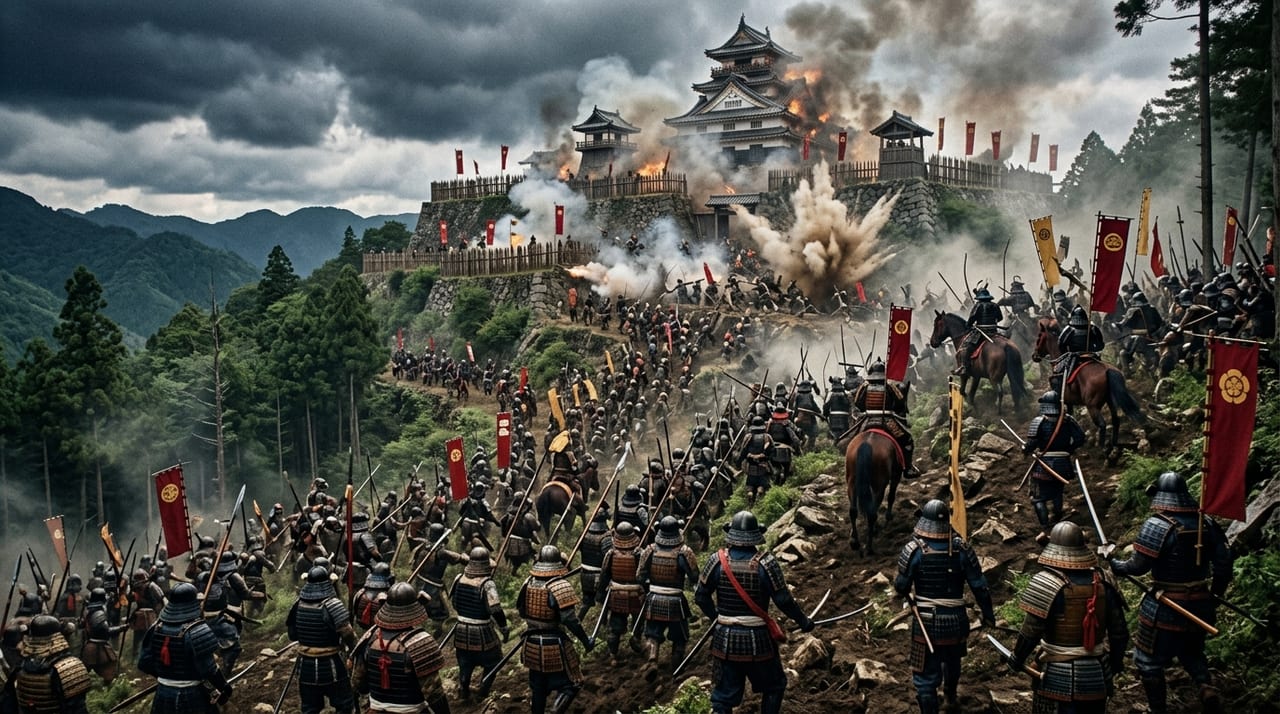
Upon learning of the Mimura clan's defection, the Mōri clan dispatched a full-scale punitive force to Bitchū beginning in the winter of Tenshō 2 (1574). The large army that Mōri Terumoto sent with Kobayakawa Takakage as supreme commander, joined in part by the forces of Ukita Naoie, adopted a policy of conquering the Mimura side's various castles one by one. The Mimura side, centered on their main castle, Bitchū Matsuyama Castle, resisted by dispersing their forces among branch castles across Bitchū, including Nariwa Castle, Tsuruokubi Castle, Yuzuriha Castle, and Sachiyama Castle. However, being unable to stand against the large army alone, their castles were defeated one by one. Yuzurugi Castle (present-day Niimi City), held by Mimura Motonori, a kinsman of Mimura Motochika, was also taken, and the situation gradually shifted in favor of the Mōri side. Ultimately, the allied Mōri and Ukita forces surrounded Bitchū Matsuyama Castle, drawing the siege into a protracted campaign while awaiting defections from within the castle. Mimura Motochika continued to hold the castle, but with no prospect of reinforcements remaining, the castle fell on the 22nd day of the 5th month. Motochika committed suicide at the nearby Shōrenji Temple on the 2nd day of the 6th month. This brought the Bitchū Rebellion, which had lasted roughly half a year, to an end.
Bitchū Province was also a land that held a distinctive place in the history of Japanese swords. The Ao-e school, based in Aoe in Bitchū Province (present-day Kurashiki City), was a group of swordsmiths that began in the late Heian period and flourished during the Kamakura and Nanbokuchō periods. It is an ancient tradition that continued for a long time, changing its style over the ages through the Ko-Ao-e, Chū-Ao-e, and Sue-Ao-e periods. Ao-e school works are based on a straight hamon interspersed with small midare, and show in the jigane a distinctive surface texture called 'sumi-hada.' They are highly regarded as a school that established its own style, distinct from the major Gokaden such as Bizen, Yamashiro, and Sōshū. The Bitchū Rebellion itself was a struggle for territory among Sengoku daimyo, namely the Mimura clan and the Mōri and Ukita clans, and was not a battle in which the provenance of any particular famous sword is directly recorded. However, Bitchū Province, the stage of the rebellion, was also the province where these Ao-e swordsmiths once worked. In an era when Sengoku daimyo and regional powers went into battle wearing tachi passed down through generations, it is believed that the Mimura clan, a regional power of Bitchū, was likewise not unconnected to the sword culture rooted in the local area.
With the fall of Bitchū Matsuyama Castle and the suicide of Mimura Motochika, the Mimura clan, which had long governed Bitchū, was effectively destroyed. After the rebellion, the Mōri clan incorporated Bitchū Province into its own domain, and a senior Mōri retainer was installed as castellan of Bitchū Matsuyama Castle. This allowed the Mōri clan to further consolidate its territorial rule in the Chūgoku region, and established Bitchū's position as a forward base facing the Oda forces to the east. Meanwhile, Ukita Naoie, who had cooperated in this rebellion, strengthened his independence in the Bizen and Mimasaka areas, and later went on to forge his path as an independent daimyo. The Bitchū Rebellion was not merely the suppression of a single regional power's revolt. It held significance as a turning point at which the balance of power among the three—the Mōri, Ukita, and Oda—was greatly reorganized.
The Bitchū Rebellion, as an important event that determined the map of power in the Chūgoku region in the early Tenshō years, has long been recorded in topographical records and gunkimono. Behind Mimura Motochika's defection lay the Mōri side's diplomatic decision to make peace with the Ukita clan, the enemy who had killed his father. The rebellion is also evaluated as an event that symbolizes the fragility of the position in which the regional powers of the Sengoku period were placed—the structural problem whereby their own survival was determined by diplomacy among daimyo. Furthermore, the Mōri clan's complete control of Bitchū through this rebellion also laid the groundwork for the Mōri side's later defensive arrangements during Hashiba Hideyoshi's Chūgoku campaign, in which they established defenses with front-line positions at castles such as Takamatsu Castle on the Bitchū-Bizen provincial border. In Okayama Prefecture, the ruins of Bitchū Matsuyama Castle and historic sites associated with the Mimura clan still remain, and are positioned as important subjects of local historical research.