New Arrivals — Browse our catalog for the latest authentic Japanese sword arrivals. Browse →
8th–9th month, Tenshō 19 (1591)
Kunohe Castle, Mutsu Province (present-day Ninohe City, Iwate Prefecture)
Forces
Toyotomi/Nanbu Nobunao Forces (Punitive Army)
Kunohe Masazane's Forces (Defending)
About 18 min read
In Tenshō 19 (1591), Toyotomi Hideyoshi's unification of the realm had entered its final stage. The previous year, Tenshō 18 (1590), saw the Hōjō clan destroyed (the Odawara campaign), and in Ōshū as well, Hideyoshi's Ōshū shioki was advancing the allocation of domains to the various daimyō. Yet there was one man who openly raised the banner of revolt against this "settlement": Kunohe Masazane, a senior retainer of the Nanbu house based in Ninohe in Mutsu Province (present-day Iwate Prefecture).
The Kunohe Masazane rebellion is positioned as one of the final examples of organized resistance in Sengoku Japan. Against an order in which national unification had been completed, a powerful local figure rose to defend traditional customs and autonomy. This configuration was also an event that called into question the meaning of the warrior class's wearing of swords.
Kunohe Masazane (birth year unknown – 1591) was a kokujin lord who, as a senior retainer of the Sannohe Nanbu house, held considerable power in northern Mutsu. Although he and the Nanbu house head, Nanbu Nobunao, were originally of the same Nanbu clan, there had been a long-standing dispute over the family headship between them.
In the second decade of the Tenshō era (1582–1591), the Nanbu house was in a state of tension in which, in effect, two axes of power stood side by side: the main line of the Sannohe Nanbu house (Nobunao) and the powerful figure of the Kunohe house (Masazane). Masazane was an outstanding warrior, a distinguished military commander who, in his generation, greatly expanded the power of the Kunohe house.
At the Odawara campaign in Tenshō 18 (1590), Nanbu Nobunao submitted to Toyotomi Hideyoshi. Through this submission, the Ōshū shioki was carried out, confirming Nobunao's domain, while Masazane's sphere of power was also forced to be reorganized. The Toyotomi regime's strengthening of control over the provinces was, for Masazane, something that fundamentally threatened his independent standing.
Furthermore, the rivalry between Masazane and Nobunao deepened over how to respond to the Kasai-Ōsaki uprising (an uprising by former retainers of the Kasai and Ōsaki houses) and other unrest that broke out across Ōshū from the 10th month of Tenshō 18 (1590). It is also said that Masazane sought to use this uprising to expand his own power. In the 3rd month of Tenshō 19 (1591), Masazane rose in revolt with 5,000 troops. Nobunao gave up on suppressing the revolt on his own and asked Hideyoshi for help, and the movement toward a Toyotomi punitive campaign accelerated.
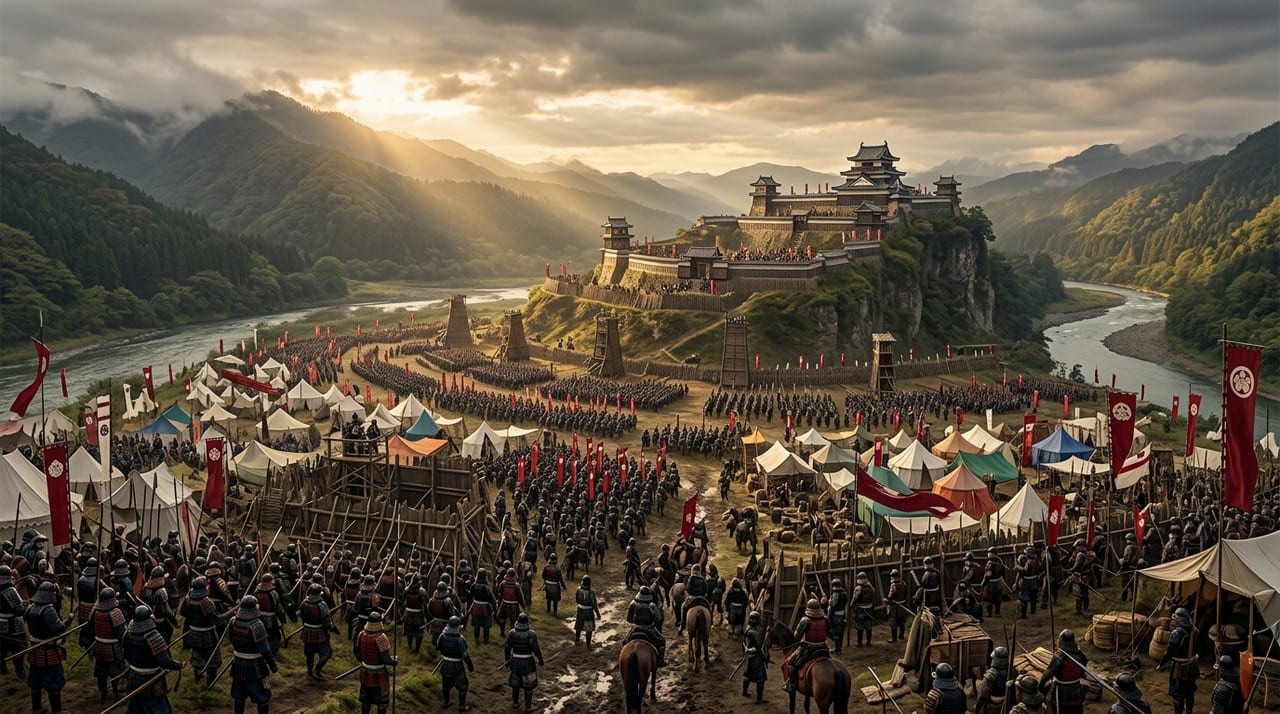
Kunohe Castle, which Masazane chose as his base for the siege, was a natural stronghold built at the confluence of the Mabechi River and the Shiratori River. Surrounded on three sides by cliffs and rivers, it was known as a site of high defensive strength even among the mountain castles of the time.
The castle was not large, but Masazane resolved to hold out here. The garrison, said to number around five thousand, was hopelessly small against the overwhelming Toyotomi army. However, it is also thought that behind Masazane's choice to hold out lay a calculation: the possibility of extracting a "conditional surrender through peace negotiations." In fact, in the peace negotiations described below, surrender of the castle on certain terms was initially offered.
On the 20th day of the 6th month of Tenshō 19 (1591), Toyotomi Hideyoshi organized the Ōshū re-pacification army, with Toyotomi Hidetsugu as commander-in-chief, to suppress the Kunohe Masazane rebellion and the uprisings across Ōshū. At the center of the attack on Kunohe was Gamō Ujisato, one of the generals Hideyoshi trusted most, who had just been transferred from Matsuzaka in Ise to Aizu-Wakamatsu.
Asano Nagamasa, Horio Yoshiharu, and Ii Naomasa, a senior retainer of Tokugawa Ieyasu, also joined the attack on Kunohe Castle. The total force besieging Kunohe Castle is said to have numbered 60,000, establishing an overwhelming encirclement against a garrison of only a few thousand.
The scale of this force's dispatch clearly reflects Hideyoshi's intent. The Kunohe Masazane rebellion was not a mere domestic dispute in the provinces but was positioned as a challenge to the authority of the Toyotomi regime, and it was necessary to demonstrate the "completion of unification" at home and abroad by suppressing it thoroughly.
On the 2nd day of the 9th month of Tenshō 19 (1591), the Toyotomi army surrounded Kunohe Castle. They ran field fortifications (palisades and moats) around the castle, achieving a complete encirclement. Masazane continued to resist despite his small force, but both provisions and ammunition were nearing their limits.
In the negotiations, Asano Nagamasa sent the priest Satten of Chōkō-ji, the Kunohe family temple, as envoy, and conveyed to Masazane the terms that "if the castle is surrendered, all will be spared." Masazane accepted these terms, and on the 4th day of the 9th month of Tenshō 19 (1591), he surrendered in the guise of a monk, and Kunohe Castle was opened.
But this peace agreement was broken. After the castle was surrendered, his younger brother Kunohe Sanechika and others inside the castle were confined to the Ninomaru and killed, and Masazane and the other ringleaders were beheaded at Sanhasama in Kurihara District (present-day Kurihara City, Miyagi Prefecture). The executions, which could be called treacherous, demonstrated the ruthlessness of the Toyotomi regime in maintaining order, and became a closing scene that symbolized the emptiness of "a warrior's promise and the sword (sincerity sworn with the blade)."
The Kunohe Masazane rebellion holds several important meanings from the perspective of Japanese swords and sword culture.
First, Tenshō 19 (1591), the year this rebellion ended, overlaps with the period when Toyotomi Hideyoshi's sword hunt edict (katanagari) of Tenshō 16 (1588) had largely taken hold. The sword hunt edict confiscated weapons from peasants and temples and shrines, but its intent was to "restrict the right to bear arms to the warrior class." The Kunohe Masazane rebellion was one of the last rebellions to challenge the apex of that warrior class (the Toyotomi regime) in the "society in which only warriors may wear swords" that the sword hunt was establishing.
Second, Ōshū and Mutsu had long been known as centers of swordsmithing. Ōshū, known as a source of high-quality iron called Nanbu iron, was also an important region in terms of sword materials. The completion of Ōshū's unification under the Toyotomi regime through the Kunohe Masazane rebellion also became an occasion for the activities of this region's swordsmiths to be incorporated into the central order.
Third, Gamō Ujisato is known as a general with deep cultural refinement. Ujisato was also a Christian daimyō (baptismal name Leon), and he loved the tea ceremony. Under Ujisato, who made Aizu his base, the warrior culture of Ōshū was reorganized under a certain order, which was also a turning point for the regional development of sword culture.
Also, Maeda Toshiie, who was assigned to the Tsugaru area within the Ōshū re-pacification army, was a daimyō who laid the foundations of the Kaga domain, based in Kanazawa, Ishikawa Prefecture. The Kaga domain held many famous swords throughout the Edo period (many are known as Kashū-tō, famous swords handed down in the Kaga domain).
The period around the Tenshō era (1573–1592) was also when the famous spear Nihongō was given by Toyotomi Hideyoshi to Fukushima Masanori, and it later became known through the story of "Nomi-tori" (the anecdote of Mori Tahei winning it from Masanori in a drinking bout). The arms and swords carried by the Toyotomi generals who took part in the Kunohe rebellion embody one aspect of the sword politics of the Tenshō era. This was a rebellion that fell at the close of the "sword politics" era, when Hideyoshi confirmed lord–vassal ties by bestowing famous treasures on his generals.
What sword Kunohe Masazane wore to the end is not recorded in the sources. Yet Masazane, who lived out his life as a Sengoku warrior, refusing with the sword to submit to his lord and striving to keep his "warrior's pride" to the end, embodies the warrior spirit of the Tenshō period.
The suppression of the Kunohe Masazane rebellion marked the final completion of Toyotomi Hideyoshi's unification of Japan. After this rebellion, Hideyoshi began the Bunroku campaign (the invasion of Korea) in the following year, Tenshō 20 (1592). With domestic rebellions quelled, Hideyoshi's gaze turned outward.
Among historians, there is a view that places the Kunohe Masazane rebellion as "the last Sengoku-style resistance." The unrest in Ōshū, continuing from the Kasai-Ōsaki uprising (Tenshō 18 (1590)) to the Kunohe rebellion (Tenshō 19 (1591)), was a chain of final resistances by local powerholders against the "centralized unification" of the Toyotomi regime.
From the perspective of swords, the end of the Kunohe rebellion marks the completion of the social reorganization of "the right and meaning of wearing a sword." Through the confiscation of weapons by the sword hunt, the establishment of provincial rule through the Ōshū shioki, and the suppression of Kunohe Masazane, a "strong man of the provinces," swords in Japanese society shifted more distinctly from "weapons of the battlefield" to "markers of warrior status and spiritual symbols."
The Toyotomi banners that fluttered before Kunohe Castle and the sword of Masazane, who held out within it: this contrast quietly tells, in the mountains of Ōshū, of the transformation in the "meaning of the sword" as Japan moved from the Sengoku period to the early modern era.
Gamō Ujisato
Gamō Ujisato — principal commander of the Toyotomi punitive army; newly installed lord of Aizu and one of Hideyoshi's most trusted generals; reportedly served as negotiator during the surrender.
Maeda Toshiie
Maeda Toshiie — one of the Toyotomi commanders in the punitive expedition; one of the Five Elders (Gotairō) and founder of the prosperous Kaga domain.
Toyotomi Hidenaga
Toyotomi Hidenaga — died just months before the revolt (1st month, Tenshō 19); his death reduced the Toyotomi regime's capacity for internal mediation, which may have contributed to the unrest in Ōshū.
Tsugaru Tamenobu
Tsugaru Tamenobu — another powerful northern Ōshū lord who submitted to Hideyoshi earlier than Masazane and took the opposite path; the Kunohe Revolt defined the contrast between their choices.