New Arrivals — Browse our catalog for the latest authentic Japanese sword arrivals. Browse →
7th–8th month, Tenshō 18 (August–September 1590)
Mutsu and Dewa Provinces (the Ōshū region), centered on Aizu Kurokawa Castle
About 14 min read
On July 11 of Tenshō 18 (1590), Odawara Castle surrendered and Hōjō Ujimasa and Ujiteru committed seppuku, bringing Toyotomi Hideyoshi's unification of Japan into its final phase. Hideyoshi moved from Odawara toward Shimotsuke, entering Utsunomiya Castle on July 26 to begin the administrative reorganization (shioki) of the Kantō and Ōshū regions. Date Masamune arrived late to the Odawara campaign—famously appearing before Hideyoshi dressed in white burial robes with a crucifix borne behind him—but his prior destruction of the Ashina clan of Aizu at the Battle of Suriagehara the previous year, which had made him the dominant power in Ōshū, was regarded as a clear violation of Hideyoshi's Sōbuji-rei edict against private warfare. When Masamune reached Utsunomiya on July 28, Hideyoshi informed him that his Aizu-area holdings would be confiscated. From a domain of roughly 1,140,000 koku across Ōu, Masamune was reduced to thirteen districts of Mutsu and Dewa totaling about 720,000 koku.
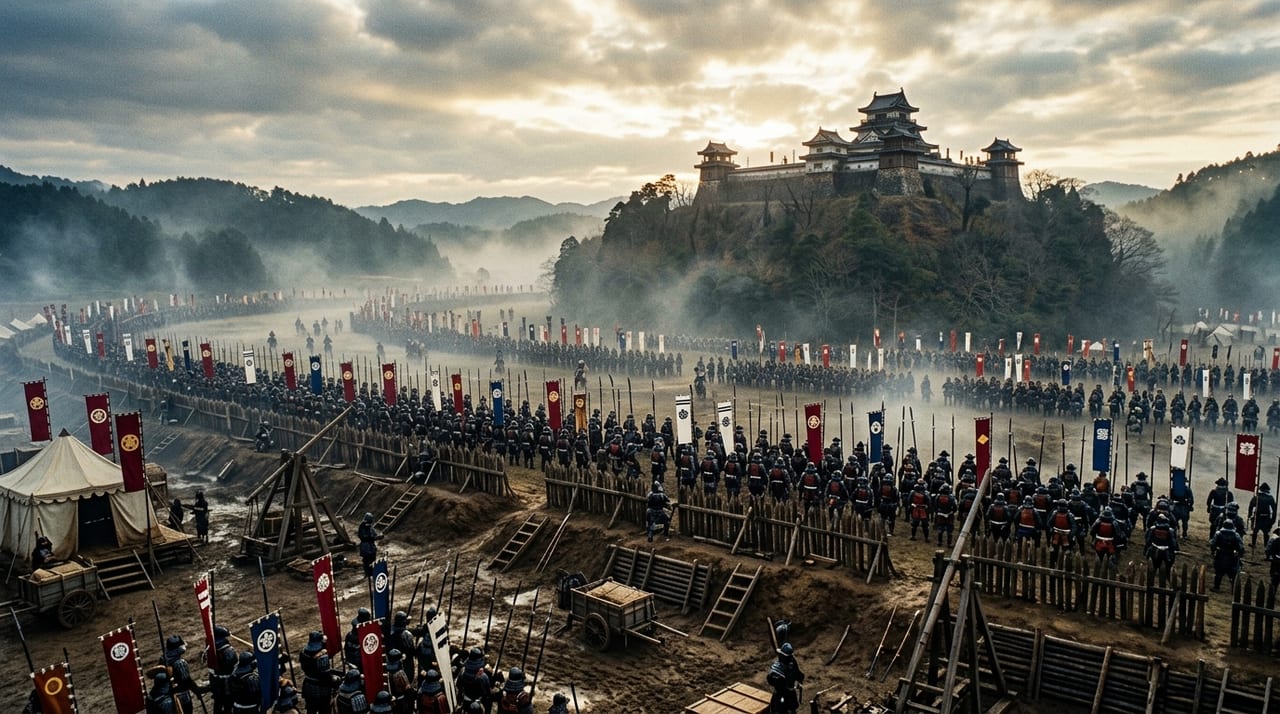
In August, Hideyoshi led his administrative army to Shirakawa and, on August 9, occupied Aizu Kurokawa Castle (present-day Wakamatsu Castle), making it the base for the Ōshū Shioki. Daimyō who had attended the Odawara campaign—Mogami Yoshiaki, Nanbu Nobunao, Tsugaru Tamenobu, Sōma Yoshitane, Iwaki Sadataka, and Togawa Mitsumori among them—had their domains confirmed, while around ten houses that had failed to attend, including Ōsaki Yoshitaka, Kasai Harunobu, Waga Yoshitada, Hienuki Hirotada, and Kurokawa Haruuji, were dispossessed. Kimura Yoshikiyo and his son Kiyohisa were newly installed in the confiscated Ōsaki and Kasai territories, while Gamō Ujisato was granted 420,000 koku in Aizu, becoming the linchpin of Toyotomi surveillance over Ōshū. With Date Masamune serving as guide, Hideyoshi's administrative army under Asano Nagamasa toured the region from Shirakawa in the south to Tsugaru in the north, forcibly conducting land surveys and dismantling castles (shiro-wari).
After the administrative army withdrew, former Ōsaki and Kasai retainers, angered by the Kimuras' abrupt land surveys, rose in revolt across the region, besieging Sanuma Castle where the Kimuras had taken refuge—the Kasai-Ōsaki Uprising. In its wake, the Waga-Hienuki Uprising, the Senboku Uprising, and the Fujishima Uprising broke out in succession, plunging Ōshū back into turmoil. On November 24, the Kimuras were rescued by Date Masamune, but suspicion arose that Masamune had secretly incited his former retainers to rebel, sparking serious friction with Gamō Ujisato of Aizu. Masamune traveled to Kyoto in February of Tenshō 19 (1591) to explain himself to Hideyoshi, but was ultimately stripped of several districts around Aizu and ordered instead to relocate to the recently confiscated Ōsaki and Kasai territories—a harsh punishment. In June of that year, Hideyoshi dispatched another large suppression force, fully quelling the uprising by July. This campaign, known as the Ōshū Re-Shioki, marked the final consolidation of Hideyoshi's unification of Japan.
The Ōshū Shioki and its aftermath profoundly affected the samurai society and sword culture of the Tōhoku region. Date Masamune is said to have treasured for the rest of his life the blade "Shokudaikiri Mitsutada," attributed to Mitsutada of the Bizen Osafune school, which he received from Hideyoshi. The sword later passed to the Mito Tokugawa family and was believed destroyed in the Great Kantō Earthquake, but in 2015 its fire-damaged remains were confirmed preserved at the Tokugawa Museum. That Masamune retained his status as a major daimyō even after the Ōshū Shioki is attributed in part to the personal trust he cultivated with Hideyoshi, of which the bestowal of a famous blade served as a symbolic gesture. Meanwhile, the local swords once held by the dispossessed Ōsaki and Kasai retainers were, in many cases, lost amid the chaos of the uprising or confiscated by the new overlords. The Ōshū Shioki brought a profound disruption to the sword and armor traditions that Tōhoku's distinctive samurai culture had cultivated throughout the Sengoku period.
What Hideyoshi imposed on the Ōshū daimyō through the Ōshū Shioki went beyond a mere reshuffling of domains. His administrative army forcibly conducted Taikō land surveys across the region and moved to disarm local samurai and farmers under the Sword Hunt Edict. This extended the kokudaka assessment system and the separation of warriors from farmers—already implemented in the Kinai and Kyushu regions—to Ōshū, which had until then retained its own distinctive structures of local rule. It was precisely the haste of these surveys that directly triggered the wave of uprisings across Ōshū, including the Kasai-Ōsaki revolt. Surviving Ōshū daimyō such as Date Masamune, Gamō Ujisato, and Nanbu Nobunao subsequently reorganized themselves into early-modern-style daimyō in the Toyotomi mold, through land surveys, castle dismantling, and the development of castle towns.
Gamō Ujisato, granted 420,000 koku in Aizu (later increased to 920,000) under the Ōshū Shioki, made Wakamatsu Castle (a renovation of Kurokawa Castle) his base and served as the linchpin of Tōhoku governance. Known as a Christian daimyō and a leading disciple of the tea master Sen no Rikyū, Ujisato also devoted himself to developing Aizu's castle town and promoting commerce and industry, embodying the Toyotomi model of provincial rule in the Tōhoku region. The friction between Ujisato and Date Masamune was more than a personal rivalry; it symbolized the clash between two contrasting models of Ōshū governance—the Date clan, still deeply rooted in traditional local lordship, and the Gamō clan, newly installed by the Toyotomi regime as an early-modern-style daimyō.
In the course of the Ōshū Shioki, Hideyoshi is said to have bestowed famous swords and tea utensils on daimyō who demonstrated submission, while in some cases confiscating heirloom swords along with the domains of those suspected of resistance. The exchange of swords functioned not merely as reward but as a political ritual that made loyalty to the Toyotomi regime visible. The episode of Date Masamune receiving "Shokudaikiri Mitsutada" stood in tension with the harsh reduction of his domain, symbolizing how Hideyoshi skillfully alternated between punishment and conciliation to absorb the powerful daimyō of Ōshū into his regime. The Ōshū Shioki completely reordered the distribution of domains in Tōhoku; thereafter, the Gamō, Uesugi, Date, Nanbu, and Satake houses each developed early-modern castle towns and governing institutions in their respective territories, laying the groundwork for the Tōhoku domains of the Edo period.
The course of the Ōshū Shioki is documented through multiple sources, including the "Date Tenshō Nikki," the "Masamune-ki," and the administrative papers of the Toyotomi regime. These records reveal in detail how Hideyoshi sought to incorporate Ōshū into his unified national regime not merely through military conquest but through the administrative techniques of land surveying, castle dismantling, and territorial reassignment. Through the Ōshū Shioki, the Kasai-Ōsaki Uprising, and the Ōshū Re-Shioki that followed, the distribution of Tōhoku's domains settled into essentially the form known from the early modern period, with the Date, Nanbu, Satake, and Uesugi (later relocated from Aizu) houses governing the region throughout the Edo period. This sequence of administrative actions represented the final chapter of Hideyoshi's national unification; with the suppression of the Kunohe Masazane Rebellion the following year, Tenshō 19, the Toyotomi regime's unification of Japan was, in name and in fact, complete.