New Arrivals — Browse our catalog for the latest authentic Japanese sword arrivals. Browse →
July 24, 1590 (Tenshō 18, 6th month, 23rd day)
Hachiōji Castle, Musashi Province (present-day Motohachiōji-machi and Shimoongata-machi, Hachiōji, Tokyo)
Forces
Toyotomi detachment
Hōjō forces (Hachiōji Castle garrison)
About 8 min read
In 1590, Toyotomi Hideyoshi, pressing his campaign to unify the country, launched a massive expedition against the Later Hōjō clan of the Kantō region — the Siege of Odawara. Hōjō Ujiteru, a senior member of the Hōjō house supporting the domain's rulers Ujimasa and Ujinao, held Hachiōji Castle in Tama District, Musashi Province, as his base. When the campaign opened, however, Ujiteru himself left the castle to help defend the main Hōjō stronghold at Odawara. In his absence, Hachiōji Castle was left in the hands of his deputy, Yokochi Kenmotsu Yoshinobu, along with senior retainers including Kanō Shuzen'ichian, Nakayama Kageyu Ienori and Kondō Dewa-no-kami Tsunahide. Their forces were limited, and even counting the domain's civilians — including women and children who had taken refuge there — the garrison numbered only around 3,000. With Hideyoshi's main effort concentrated against Odawara itself, the defenses of this outlying castle were inevitably thin.
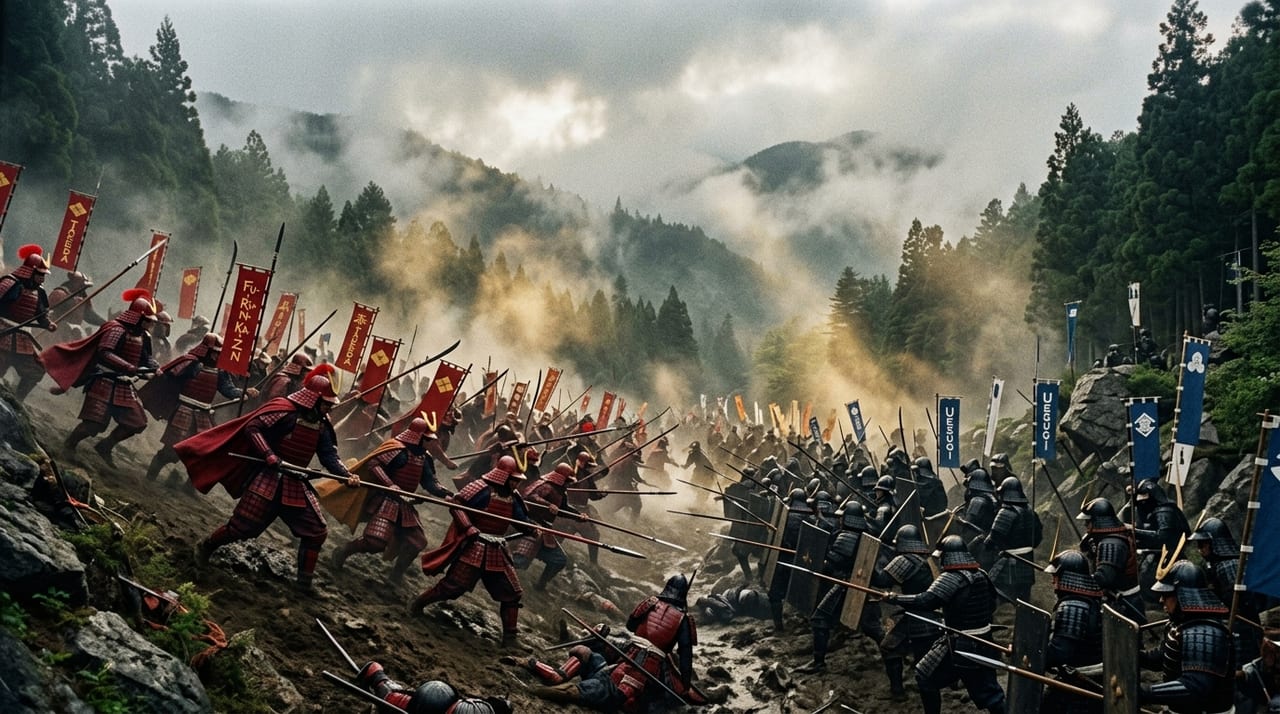
While besieging Odawara itself, Hideyoshi also organized detachments to reduce the network of Hōjō-affiliated castles across the northern Kantō one by one. The assault on Hachiōji fell to one such force, roughly 15,000 strong, under Uesugi Kagekatsu, Maeda Toshiie and Sanada Masayuki. In the predawn hours of the 23rd day of the 6th month of Tenshō 18 (July 24, 1590), the Toyotomi army advanced under cover of thick fog, striking the castle simultaneously from two directions: the main approach on the eastern face at Motohachiōji-machi, and the rear approach on the north side at Shimoongata-machi.
Though badly outnumbered, the Hōjō defenders put up fierce resistance, relying on the castle's steep mountain terrain, and the fighting inflicted substantial casualties on both sides. Yokochi Kenmotsu, the castellan, is said to have slipped out of the castle just before it fell, fled toward what is now Hinohara village, and taken his own life; Nakayama Ienori and other senior retainers of Ujiteru died fighting in various parts of the castle. The attacking force, too, is reported to have suffered considerable losses owing to the site's complex terrain and the defenders' determined stand — this was by no means a one-sided engagement.
Despite the fierce fighting, Hachiōji Castle fell in the space of a single day. As the castle collapsed, many of the women and children trapped inside are said to have taken their own lives, some by throwing themselves from the castle's Oshuden Falls — a grim ending that has been passed down through generations. The falls still exist within the castle ruins today, known as Oshuden-no-Taki, and remain a site where the victims are remembered. Among the many battles for the Hōjō's outlying castles during the Odawara campaign, the fight for Hachiōji is remembered as one of the fiercest.
News of Hachiōji's fall dealt a severe blow to morale among the Hōjō forces holding out at Odawara. That one of their satellite castles had been taken in a single day drove home the limits of their strategy of endurance and is thought to have strengthened calls within the Hōjō camp for negotiation and surrender. Not long after the news arrived, Odawara Castle surrendered without further bloodshed. Its lord, Ujinao, was exiled to Mount Kōya, while Ujiteru, held responsible for provoking the conflict, was ordered to commit seppuku alongside his brother Ujimasa on the 11th day of the 7th month of Tenshō 18. With this, the Later Hōjō as a warring daimyo house effectively came to an end, and Hideyoshi's pacification of the Kantō — and with it, the unification of Japan — was complete.
Hachiōji Castle's remains are now designated a National Historic Site, and visitors can view the stone walls of the Oshuden compound, the reconstructed suspension bridge, and the fortified summit works. Memorial rites for those who died in the castle's fall continue to be observed to this day. As one of the largest castle sieges fought in the Kantō region at the close of the Sengoku period, the battle remains deeply woven into local memory. Built as Hōjō Ujiteru's stronghold, this mountain castle is remembered as one of the settings that marked the final act of Hideyoshi's drive to unify Japan, and it continues to draw visitors interested in the history of the period.